Best Portable RV Waste Tanks (2026 Guide)
Portable RV waste tanks compared by capacity, wheel design, fittings, and handling – for boondocking, dry camping, and sites without sewer hookups.
A portable RV waste tank – sometimes called a tote tank or blue boy – solves a specific problem: how do you empty your black or gray tank when the dump station is too far to reach with a standard sewer hose, and you don’t want to move the entire rig?
They’re essential for boondockers and dry campers, useful at festivals and long-stay sites, and practical anywhere the sewer hookup is an inconvenient distance from your RV. You connect the tote to your tank outlet, fill it, then wheel or tow it to the nearest dump station.
The problem is that not all portable waste tanks are built the same. Small capacity tanks fill quickly and require multiple trips. Weak wheels crack under a loaded tank. Poorly designed handles make towing awkward. And low-quality caps are the most common source of odor and spill complaints.
This guide covers two of the most commonly recommended portable RV waste tanks – evaluated by capacity, wheel design, fittings, handling, and value. It also explains what to look for so you can confidently compare any option you come across. Jump to the quick picks or the detailed reviews below.
Recommended Portable RV Waste Tanks
Two well-reviewed options across different size and use-case needs:
Camco Rhino Portable Waste Tank
Well-reviewed tote tank available in multiple capacity and wheel configurations. Widely recommended in the RV community.
Check price →Thetford SmartTote2
Compact design with easy-grip handle and molded body. Sized for small tanks and tight storage – good for van lifers and small campers.
Check price →How We Evaluated These Tanks
Products were selected by evaluating manufacturer-listed specifications, user feedback patterns, and suitability for different RV use cases. We did not conduct hands-on testing. All spec claims are manufacturer-listed unless noted otherwise.
Matched to typical RV tank sizes and trip lengths. Smaller tanks (10-15 gal) suit compact rigs or short stays. Larger tanks (28-42 gal) reduce dump trips for extended boondocking.
2-wheel tanks are lighter and more maneuverable on flat ground. 4-wheel tanks distribute weight and stay upright on uneven terrain. No-flat wheels avoid punctures; pneumatic wheels offer better comfort over rough ground.
A well-designed handle determines how easy the tank is to pull when full – which can exceed 200 lbs for a large tank. We noted ergonomic handles, tow-behind vehicle compatibility, and handle rigidity under load.
The inlet and outlet fittings determine hose compatibility with your RV’s sewer outlet. A gate valve allows controlled emptying. Cap quality is the most common factor in odor and leak complaints.
A built-in rinse port makes it practical to flush the tank after emptying. Tanks without rinse ports require more effort to keep odor-free between uses.
Rotationally molded polyethylene construction is the most durable option. Thinner-walled tanks may flex or crack under heavy loads or after sustained UV exposure.
A 42-gallon tank can weigh well over 300 lbs when full, depending on the tank’s own weight and fill level – beyond what most people can handle alone. We noted whether the product’s capacity was practical to fill and empty without assistance.
Note: Product specs, included accessories, and fittings can change. Always confirm current capacity, wheel design, and hose compatibility on the product listing before buying.
Comparison Table
Side-by-side overview of the recommended portable RV waste tanks in this guide:
| Tank | Capacity | Wheels | Handle | Emptying | Best For | Link |
|---|---|---|---|---|---|---|
| Camco Rhino Best Overall | Varies by model | Varies by model | Tow handle | Gate valve | Many RV setups | Check price |
| Thetford SmartTote2 Compact | 13 gal (mfr. listed) | 2-wheel | Grip handle | Rotating spout | Small RVs, van life | Check price |
Detailed Reviews
A closer look at both tanks – what each does well, who it suits, and where it falls short. Specs are based on manufacturer listings; always verify current details on the product listing before purchasing.
1. Camco Rhino Portable RV Tote Tank
A widely recommended portable waste tank with multiple capacity options

The Camco Rhino is one of the more commonly reviewed portable RV waste tanks on the market, with strong user feedback across multiple capacity options. Available in various sizes, it connects to standard RV sewer outlets and dump station inlets via a gate valve system. Wheel configuration and capacity vary by model – confirm the specific version on the product listing before purchasing.
Pros
- Commonly recommended across diverse RV setups
- Compatible with standard sewer hose connections
- Molded polyethylene body designed for durability under load
- Available in multiple capacity versions – choose based on your usage
- Wide availability – easy to find parts and accessories
Cons
- Stability varies by model – check wheel configuration on listing
- No built-in rinse port on all models – confirm before buying
- Heavier than it looks when near capacity
2. Thetford SmartTote2
Compact and easy to handle – designed for smaller rigs and tight storage
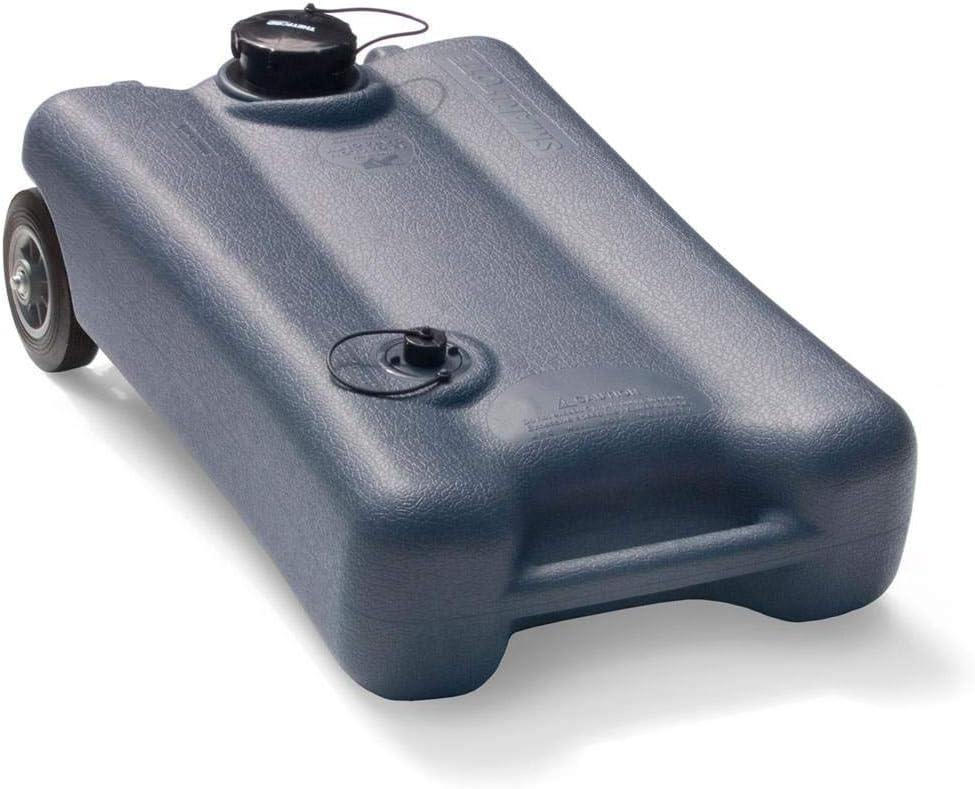
The Thetford SmartTote2 is sized for compact rigs where storage space and weight matter as much as capacity. At a manufacturer-listed 13 gallons, it’s designed to be practical for solo travelers and small campers who don’t generate the volume of waste that larger families or full-timers do. The molded body, easy-grip handle, and rotating spout emptying system make it more manageable than larger tanks, and its compact footprint stores more easily in small bays or under benches.
Pros
- Compact size stores easily in tight spaces
- Lighter when full – manageable solo
- Rotating spout for controlled emptying
- Good fit for van builds and small campers
Cons
- 13-gallon capacity fills quickly with multiple users
- More frequent dump trips on longer stays
- Not suitable for large rigs or families
How to Choose a Portable RV Waste Tank
The right tote tank depends on how often you use it, how far you need to move it, and how much waste your rig generates. Here’s what matters:
Match capacity to your typical stay length and tank size. A 10-15 gallon tank suits solo travelers or overnight stays. A 20-28 gallon tank covers a couple over several days. Larger tanks (30+ gallons) are for extended boondocking with multiple occupants – but remember that a full 42-gallon tank can weigh well over 300 lbs when full, depending on the tank’s own weight and fill level – typically requiring more than one person to move safely.
Start here: estimate your daily waste volume × days between dump tripsTwo-wheel tanks are lighter and easier to maneuver in tight spaces. Four-wheel tanks are more stable when full and on uneven ground – important if your campsite is rough or your tank is large. No-flat (solid) wheels avoid punctures; pneumatic wheels absorb vibration better over longer distances.
Uneven terrain: 4-wheel – Compact storage needed: 2-wheelConsider how far you’ll pull the tank and what surface you’ll be crossing. An ergonomic, rigid handle makes a real difference when a tank is fully loaded. Some tanks include a tow hitch fitting for attaching to an ATV or golf cart – useful when the dump station is a significant distance from the site.
Long distances to dump station: look for vehicle tow hitch compatibilityConfirm that the inlet fitting is compatible with your RV’s sewer outlet – most use standard 3-inch bayonet connections. A gate valve allows controlled, clean emptying at the dump station. Check cap quality carefully – the inlet and outlet caps are the most common source of odor complaints on any portable waste tank.
Verify fitting compatibility with your RV’s sewer outlet before orderingA built-in rinse port lets you flush fresh water through the tank after emptying – the most effective way to keep it clean and odor-free between uses. Tanks without rinse ports require more effort to maintain. If you plan to use the tank regularly, a rinse port is worth having.
Regular use: prioritize tanks with a built-in rinse portWhen empty, tote tanks still take up significant space. Measure where you plan to store it – whether in a pass-through bay, under a dinette, or strapped to the exterior – and compare against the tank’s stated dimensions. Some tanks have a lower profile than others at the same capacity.
Check tank dimensions against your available storage space before buyingCapacity reference: A typical RV couple generates approximately 5-8 gallons of black water per day. A 21-gallon tank gives roughly 3-4 days of capacity. A 32-gallon tank covers 4-6 days. These are general estimates – actual usage varies significantly by habits and fixture count.
Common Portable RV Waste Tank Mistakes
Most problems with portable waste tanks come from sizing or handling decisions made at purchase time:
Buying too small for your actual usage
A 10-gallon tank fills in one to two days for a couple – meaning multiple dump trips on any stay longer than a weekend. Think about your realistic daily usage and how many days you typically spend without hookups before choosing capacity.
Buying too large to handle safely
A 42-gallon tank can weigh well over 300 lbs when full, depending on the tank’s own weight and fill level – typically requiring two people and relatively flat ground to move safely. If you’ll be handling it solo, a 20-25 gallon tank is typically the practical upper limit for one person.
Ignoring the filled weight
Waste water weighs approximately 8.3 lbs per gallon. A 25-gallon tank at 75% capacity weighs over 155 lbs on top of the tank itself. Factor this into both your choice of capacity and your plan for getting it to the dump station.
Choosing weak or undersized wheels
Budget tanks often use small-diameter wheels that crack on gravel or rough campsite terrain. If your typical sites have uneven ground or gravel paths to the dump station, prioritize larger wheels or a 4-wheel design.
Not checking fitting compatibility
Most RV sewer outlets and tote tank inlets use standard 3-inch bayonet connections – but not all. Confirm that the tank’s inlet fitting matches your RV’s sewer outlet before ordering, and check whether a hose or adapter is included.
Not rinsing the tank after emptying
Residue left in the tank between uses causes persistent odors and degrades the interior over time. Flush with fresh water after every dump – a tank with a built-in rinse port makes this straightforward.
Towing at vehicle speed without securing the tank
If you’re towing a waste tank behind a vehicle on a hitch, keep speeds low and confirm the tow rating is appropriate for the loaded weight. An unsecured or overloaded tank can detach – a serious hazard on campground roads.
Storing with caps loose or missing
Even a slightly loose cap allows odors to escape during storage. After rinsing and drying the tank, confirm both the inlet and outlet caps are fully secured before storing. Replacement caps are inexpensive and worth keeping as spares.
Frequently Asked Questions
What size portable RV waste tank do I need?
Start by estimating your daily waste volume and how many days you typically go between dump trips. A couple generating 6-8 gallons per day needs at least a 20-gallon tank for a 3-day stay. For extended boondocking of 5+ days, a 28-32 gallon tank reduces the number of trips. Remember to account for filled weight – a full 30-gallon tank weighs approximately 250+ lbs and may require two people to handle safely.
Can portable RV waste tanks hold black water?
Yes – portable waste tanks are designed to hold both black water (toilet waste) and gray water (sink and shower water). Most tanks can handle either or both, though some RVers use separate tanks for each. Confirm that your tank’s fittings are compatible with your RV’s black tank outlet, and use tank treatment chemicals to manage odors during transport.
Is a 4-wheel RV tote tank better than a 2-wheel tank?
It depends on your terrain and capacity needs. Four-wheel tanks are more stable on uneven ground and less likely to tip when full – which matters at larger capacities. Two-wheel tanks are lighter, easier to maneuver in tight spaces, and typically less expensive. For most campers on reasonably flat sites with a 20-25 gallon tank, a 2-wheel design is practical. For extended stays, large capacities, or rough terrain, 4-wheel designs offer meaningful advantages.
How do you empty a portable RV waste tank?
Connect the tank’s inlet to your RV’s sewer outlet using the included hose or your standard sewer hose connection. Open your tank’s drain valve and allow waste to flow in. Close the valve, secure all caps, then wheel or tow the tank to the nearest dump station. At the station, connect the outlet hose to the dump inlet, open the gate valve, and allow the tank to drain fully. Rinse with fresh water before storing. For a full walkthrough of proper dump station procedure, see our RV sewer waste management guide.
Can you tow an RV waste tote behind a vehicle?
Some portable waste tanks include a tow hitch fitting that connects to an ATV, golf cart, or vehicle hitch – useful when the dump station is a long distance from your site. If towing on a vehicle, keep speeds very low, confirm the tow attachment is rated for the loaded weight, and use a spotter to prevent the tank from contacting the ground or tipping. Check the manufacturer’s towing guidance for the specific tank before attempting this.
Do portable RV waste tanks smell?
A well-maintained tank with secure caps should not create noticeable odors during transport or storage. The main causes of odor are: caps not fully secured, tanks stored without rinsing after use, or deteriorated cap seals. Add RV tank treatment to the tank during use, rinse thoroughly after emptying, and confirm all caps are fully tight before storing. Replacing worn cap seals is inexpensive and usually solves persistent odor issues.
Disclosure: This guide contains affiliate links. If you purchase through these links, we may earn a small commission at no extra cost to you. Recommendations are based on product specifications, suitability, and value – not commission rates.