Best RV Water Pumps
Everything you need to understand, choose, and upgrade your RV’s 12V water pump – for dry camping, full-time use, and everything in between.
When you turn on a faucet in your RV and nothing much comes out, the problem usually starts with the water pump. Your RV’s 12V water pump is what moves fresh water from the onboard tank to your sinks, shower, and toilet – and when it’s underpowered, noisy, or failing, every part of daily life in the RV is affected.
You need to think about your pump in three situations: when you’re camping without hookups and relying entirely on your fresh water tank, when a campground hookup delivers low pressure, and when your factory-installed pump simply isn’t keeping up with your actual use.
This guide walks through how RV water pumps work, how to pick the right one for your rig, and where to find deeper product comparisons when you’re ready to buy.
1. How RV Water Pumps Work
Most RVs use a 12-volt diaphragm pump connected directly to the onboard fresh water tank. The pump sits inline between the tank and your plumbing system, and activates automatically whenever water pressure in the lines drops below a set threshold.
Here’s the basic sequence: you open a tap, pressure drops in the plumbing lines, the pressure switch detects the drop and triggers the pump, the pump draws water from the tank and pushes it through your pipes, and the switch turns the pump off again once pressure is restored. The whole cycle happens in seconds.
When you’re connected to a campground’s city water supply, you bypass the pump entirely – water enters directly from the external hookup at whatever pressure the campground provides. The pump only comes into play when you’re running on tank water.
Quick tip: If your pump is short-cycling – turning on and off rapidly even when no tap is open – it often signals either a pressure leak in your plumbing or a failing pump pressure switch. An accumulator tank can also reduce cycling frequency and extend pump life.
2. When to Upgrade Your RV Water Pump
Factory-installed pumps are sized for average use, not for demanding conditions. Here are the clearest signs that yours needs replacing or upgrading:
Weak or inconsistent pressure
If your shower trickles or pressure drops sharply when two fixtures run at once, your pump is likely undersized for your usage.
Excessive noise
Older or cheaper diaphragm pumps can be disruptively loud – especially at night or in a small rig. Variable speed pumps run significantly quieter.
Constant short-cycling
A pump that clicks on and off repeatedly, even when no water is flowing, is working harder than it should and wearing out faster.
Full-time or heavy daily use
A budget factory pump isn’t built for the daily demands of full-time living. Higher-cycle use accelerates wear on lower-end pumps.
Multiple fixtures running simultaneously
Running a shower and a kitchen sink at the same time requires more flow than most standard 3 GPM pumps can comfortably deliver.
Long plumbing runs
In large motorhomes or fifth wheels with fixtures far from the tank, pressure loss over the distance can make a standard pump feel inadequate.
3. How to Choose the Right RV Water Pump
Matching the pump to your actual use case matters more than chasing the highest spec number. Here are the key factors:
Gallons per minute determines how many fixtures can run at once. A 3 GPM pump works for 1-2 simultaneous fixtures. 5+ GPM handles showers, sinks, and toilets running together comfortably.
Weekend camper: 3 GPM · Full-timer / family: 5+ GPMMost RV plumbing is designed for 40-60 PSI. A pump that shuts off at 50-65 PSI is typically suitable. Higher isn’t always better – excessive pressure can stress fittings and hoses.
Target range: 50-65 PSI shut-offStandard fixed-speed diaphragm pumps can be noticeable – especially if the pump is near sleeping areas. Variable speed pumps run much quieter and cycle less aggressively. Always mount on rubber isolators to reduce vibration transfer.
Light sleepers / small rigs: prioritize variable speedRelevant primarily for boondockers relying on battery power. Standard pumps draw around 7-10 amps while running. Lower amp draw extends battery life between charges. Variable speed pumps are also more power-efficient.
Boondocking: check amp draw, aim lower where possibleMost RV pumps are self-priming, meaning they can pull water upward from the tank without needing to be manually primed. Check the rated suction lift – typically 4-9 feet – to ensure it matches the vertical distance between your tank and the pump.
Standard RVs: 6+ feet suction lift is sufficient for most installationsIf you’re replacing a factory pump, check the port size and inlet/outlet configuration before buying. Most standard RV pumps use 1/2″ barbed ports, but this varies by manufacturer and model year.
Check your existing pump’s port size and mounting footprint before orderingQuick Reference: Flow Rate vs. Use Case
| Flow Rate | Fixtures Supported | Best For | Example Use |
|---|---|---|---|
| 2-3 GPM | 1-2 at a time | Weekend campers, solo/couple | Sink or shower, not both |
| 3-4 GPM | 2-3 at a time | Mid-size rigs, part-time RVers | Shower + kitchen sink running together |
| 4-5.5 GPM | 3-5 at a time | Full-timers, families, large rigs | Shower, sink, toilet simultaneously |
| 5.5-7 GPM | 5+ at a time | Large motorhomes, multiple bathrooms | High-demand setups with washer/dryer |
4. Types of RV Water Pumps
Not all RV water pumps are the same. Here’s a quick overview of the main categories:
12V Diaphragm Pumps
The standard choice for almost every RV. A rubber diaphragm flexes back and forth to move water, activated by a pressure switch. Reliable, widely available, and easy to replace.
Most common: nearly all RV setupsVariable Speed Pumps
Use electronic speed control to ramp up gradually rather than switching on at full power. The result is significantly quieter operation, smoother pressure delivery, and less short-cycling. A meaningful upgrade for full-timers.
Best for: noise-sensitive setups, full-time useHigh-Flow Pumps
Designed to deliver 5+ GPM for rigs with multiple bathrooms, larger freshwater demands, or long plumbing runs. Typically draw more power than standard pumps.
Best for: large rigs, families, heavy daily useDirect Replacement Pumps
Designed to match common factory pump footprints and port configurations for straightforward swaps. Useful when upgrading an existing pump without modifying plumbing.
Best for: replacing a failed factory pump like-for-likeWorth considering: Adding an accumulator tank alongside your pump – a small pressurized bladder tank that absorbs pressure spikes and reduces how often the pump cycles. It extends pump life and reduces noise even with a standard fixed-speed pump.
5. Common RV Water Pump Mistakes
Most pump problems are avoidable. These are the mistakes that show up most often:
Buying more GPM than you actually need
A 7 GPM pump in a small camper van used by one person is unnecessary and draws more battery power than a 3 GPM pump would. Match the flow rate to your actual fixture count and usage pattern – bigger is not always better.
Ignoring noise before buying
Standard diaphragm pumps can be surprisingly loud. If your pump is located near a bedroom or in a small rig where sound travels, the noise becomes a real daily irritant. Check whether the pump has a variable speed mode or look specifically for quiet-rated models before purchasing.
Skipping an accumulator tank
Without an accumulator, your pump activates every single time a tap is opened – even briefly. An accumulator stores a small volume of pressurized water so the pump doesn’t have to kick in for minor draws. It’s inexpensive and noticeably extends pump lifespan.
Mounting directly on the wall without isolators
Pumps vibrate. Mounted directly on a hard surface, that vibration transfers straight into the walls and floor of your rig, amplifying the sound significantly. Rubber mounting pads or isolators are cheap and make a noticeable difference.
Letting the pump run dry
Running a pump with an empty tank can damage the diaphragm. While many modern pumps are rated as run-dry safe, it’s still best practice to monitor your tank level and avoid running the system dry regularly.
Not winterizing the pump properly
Water left in the pump housing over winter can freeze and crack the casing or damage the diaphragm. Blow out the pump with compressed air or run RV-safe antifreeze through the system before cold-weather storage.
6. Who Needs a High-Performance Pump?
Not every RVer needs a top-of-the-line variable speed pump. Here’s a simple way to think about it:
Worth upgrading if you are:
- Full-time RVers – daily use puts consistent strain on factory pumps
- Families – multiple people using water simultaneously demands higher GPM
- Boondockers – battery efficiency matters; variable speed pumps draw less power at lower demand
- Large rig owners – long plumbing runs and multiple bathrooms need higher flow and pressure
- Light sleepers – pump noise is a real problem; variable speed is significantly quieter
Standard pump is fine if you are:
- Weekend campers – light use doesn’t stress a factory pump
- Solo or couple travelers – rarely running more than one fixture at a time
- Hookup-only campers – rarely using the tank pump at all
- Recent RV owners – if the existing pump works well, there’s no urgency to replace it
7. Top RV Water Pumps at a Glance
Here’s a quick overview of the pumps covered in this guide, with links to current pricing on Amazon:
SeaFlo 55-Series 12V
5.5 GPM, 60 PSI, 5-chamber diaphragm. Strong flow, 4-year warranty, run-dry capable.
Check price →Lippert Flow Max 689052
3.0 GPM, 50 PSI. OEM-grade quality, quiet, low power draw — reliable everyday pump.
Check price →Remco AquaJet ARV
5.3 GPM, 65 PSI, variable speed. Near-silent operation, Made in USA, 5-chamber design.
Check price →SHURFLO 4008-101-A65
3.0 GPM, 55 PSI. Commonly used in RV setups – proven, affordable, and widely available.
Check price →Kohree 7GPM 70PSI
7.0 GPM, 70 PSI. Maximum flow for large rigs, multiple bathrooms, and high-demand setups.
Check price →| Pump | Flow Rate | Pressure | Key Feature | Amazon |
|---|---|---|---|---|
| SeaFlo 55-Series Best Overall | 5.5 GPM | 60 PSI | 5-chamber, 4-yr warranty, run-dry safe | Check price |
| Lippert Flow Max Best Value | 3.0 GPM | 50 PSI | OEM standard, low power draw (9.5A) | Check price |
| Remco AquaJet Premium | 5.3 GPM | 65 PSI | Variable speed, ultra-quiet, Made in USA | Check price |
| SHURFLO 4008 | 3.0 GPM | 55 PSI | Budget-friendly, self-priming, reliable | Check price |
| Kohree 7GPM | 7.0 GPM | 70 PSI | Highest flow, large rigs, multi-bathroom | Check price |
Note: Specifications listed are based on manufacturer listings at time of writing. Always confirm current specs and compatibility on the Amazon product page before purchasing.
8. RV Water Pump Reviews
Here’s a closer look at each pump – what it does well, who it’s for, and where it falls short:
1. SeaFlo 55-Series 12V Water Pump
The best all-round choice for most RV setups

The SeaFlo 55-Series offers the best combination of flow rate, pressure, and build quality at its price point. Its 5-chamber diaphragm design is intended to reduce cycling and deliver more consistent pressure. With a manufacturer-listed 5.5 GPM at 60 PSI and a 4-year warranty, it covers the needs of most RV setups from couples to small families.
Pros
- 5.5 GPM supports running multiple fixtures at once (results vary by usage)
- 5-chamber diaphragm designed to reduce pump cycling
- Run-dry capable – protected if water supply runs out
- Built-in check valve prevents backflow
- 4-year warranty is above average for this category
Cons
- Fixed speed – not as quiet as variable speed options
- Higher GPM means more battery draw than a 3 GPM pump
2. Lippert Flow Max 689052
OEM-grade quality at an accessible price

Lippert pre-installs the Flow Max in a number of their own RV builds, which says something about its reliability baseline. For couples or solo travelers who don’t regularly run multiple fixtures at once, its 3 GPM flow is sufficient and its relatively low 9.5-amp draw is a genuine advantage for battery-conscious boondockers.
Pros
- OEM-level reliability at a value price
- Low 9.5A draw – good for battery-powered setups
- Comes with screen filter to protect against debris
- Quiet and consistent for everyday use
Cons
- 3 GPM will feel limited if running shower + sink simultaneously
- 50 PSI is on the lower end for full-timers who want strong shower pressure
3. Remco AquaJet 55-AQUAJET-ARV
Variable speed, ultra-quiet – the premium upgrade
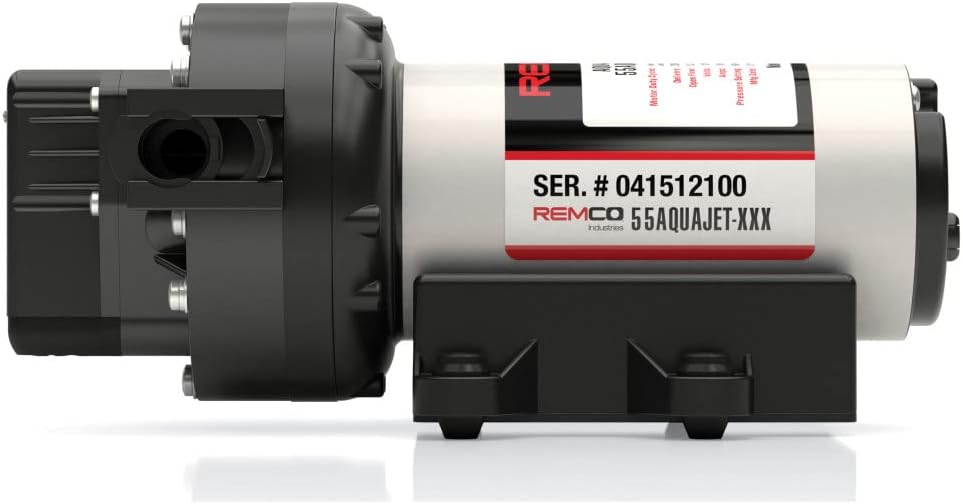
The Remco AquaJet is a strong choice for anyone who has dealt with a noisy pump. Its variable speed motor ramps up gradually rather than switching on at full power, which is designed to reduce noise, smooth out pressure delivery, and lower how often the pump cycles. Made in the USA with a 5-chamber diaphragm and a manufacturer-listed 65 PSI shut-off.
Pros
- Variable speed – designed to run quieter than standard fixed-speed pumps
- Gradual start-up reduces the pressure surge typical of fixed-speed pumps
- 5.3 GPM can support demanding multi-fixture use depending on your setup
- Made in USA – generally regarded for build quality and warranty support
- Reduced cycling may help extend pump lifespan over time
Cons
- Highest price point in this guide
- More electronics means more complexity if something fails
4. SHURFLO 4008-101-A65
The workhorse pump trusted by RV manufacturers for decades

SHURFLO’s 4008 series is commonly used in RV setups and has been included as a factory-installed option across a range of rigs. It’s affordable, and replacement parts are widely available. If you’re replacing a pump on a budget, or need a reliable backup, the SHURFLO 4008 is a low-risk choice with a long track record.
Pros
- Budget-friendly with a proven long-term track record
- Widely available – easy to find replacements and parts
- Adequate flow for solo travelers and couples
- Self-priming up to 7 feet
Cons
- Fixed speed – audible during use
- 3 GPM may not satisfy simultaneous multi-fixture use
- Older design compared to newer alternatives
5. Kohree 7GPM 70PSI 12V Water Pump
Maximum flow for large rigs and high-demand setups

When you’re running a large motorhome with multiple bathrooms, a washer/dryer hookup, and several people using water simultaneously, a 3-5 GPM pump will show its limits. The Kohree 7 GPM is worth considering for those genuinely high-demand setups. It offers more flow and pressure headroom than standard pumps, though at the cost of higher power draw.
Pros
- 7 GPM can support multiple fixtures running at once (manufacturer-listed)
- 70 PSI shut-off (manufacturer-listed) – more headroom than standard pumps
- Auto shut-off and self-priming for reliable operation
- Relatively affordable for the flow rate offered
Cons
- Higher power draw – not ideal for battery-limited setups
- Overkill for small rigs and light-use RVers
- Higher PSI – confirm your fittings and hoses are rated for sustained pressure
9. More RV Water Pump Resources
Looking to dig deeper into a specific use case or pump type? These guides cover individual categories in more detail:
Best RV Water Pumps
Full product comparison for 2026SeaFlo, Remco AquaJet, Lippert Flow Max, SHURFLO, and Kohree compared side-by-side across flow rate, pressure, noise, and value.
See best picks →Quietest RV Water Pumps
Variable speed and low-noise optionsFocused on pumps built for quiet operation – ideal for small rigs, night use, and anyone where noise is a daily priority.
Guide coming soonHigh-Pressure RV Water Pumps
5+ GPM options for large rigs and familiesFor RVers who need strong, consistent pressure across multiple fixtures – including setups with washer/dryers and multiple bathrooms.
Guide coming soonRV Water Pump Troubleshooting
Fix common pump problems yourselfCovers short-cycling, no-pressure issues, pump won’t turn on, and how to diagnose whether the pump or the plumbing is the root cause.
Guide coming soon10. Frequently Asked Questions
How strong should an RV water pump be?
It depends on how many fixtures you use simultaneously and how much daily use your rig sees. For most couples or solo travelers doing occasional camping, a 3 GPM pump at 55 PSI is sufficient. Families or full-timers running multiple fixtures at once benefit from 4.5-5.5 GPM. Going above that is generally only justified for large motorhomes with multiple bathrooms or onboard washing machines.
What PSI is good for an RV water pump?
Most RV plumbing is designed to operate comfortably between 40 and 60 PSI. A pump with a shut-off pressure of 50-65 PSI covers this range well. Avoid running your system consistently above 60 PSI without checking your fittings and hoses first – high sustained pressure can accelerate wear on older plumbing components.
How many GPM do I need for my RV?
A simple way to estimate: count how many fixtures might realistically run at the same time. Each fixture (faucet, shower head) uses roughly 1-2 GPM at normal flow. Two fixtures running simultaneously suggests a 3-4 GPM pump minimum. Three or more fixtures at once – common in family rigs – points toward 5 GPM or higher. When in doubt, sizing up slightly costs little and gives you headroom.
Are RV water pumps loud?
Standard fixed-speed diaphragm pumps are noticeably audible – you’ll hear the motor and the diaphragm clicking each time pressure drops. Variable speed pumps (like the Remco AquaJet) ramp up more gradually and run significantly quieter. Mounting any pump on rubber isolators and away from interior walls also reduces how much sound carries into the living space.
Can I upgrade my existing RV water pump?
Yes – replacing an RV water pump is one of the more approachable DIY upgrades. Most pumps connect with standard 1/2″ barbed fittings and a 12V power connection. The main things to check before buying a replacement are the port size, the mounting footprint, and whether the new pump’s flow rate and pressure match or improve on your existing setup. If in doubt, bring your current pump model number when shopping to confirm compatibility.
Do I need a pressure regulator with my RV water pump?
An RV water pump includes its own pressure switch and shuts off automatically – so no external regulator is needed when running on tank water. However, if you connect to a campground’s city water supply, a pressure regulator at the inlet is strongly recommended. Campground hookup pressure can be higher than your plumbing is designed to handle, and a regulator protects fittings, hoses, and the pump itself from pressure spikes.
Looking for the full picture on RV water systems – filters, sewer hoses, pressure regulators, and waste management? See our complete RV water systems and sewer solutions guide.
View the full guide →Disclosure: This guide contains affiliate links. If you purchase through these links, we may earn a small commission at no extra cost to you. Recommendations are based on product quality, specs, and suitability – not commission rates.