Best RV Water Filters (2026 Guide)
The top inline and canister RV water filters compared – for drinking water quality, campground hookups, and full-time RV living.
Campground water quality is inconsistent. One site might deliver clean, well-treated water. The next might come in smelling of chlorine, carrying sediment, or tasting like it came from a garden hose that sat in the sun all summer. If you drink it, cook with it, or just want better-tasting coffee, the water entering your RV matters.
An RV water filter is one of the cheapest upgrades you can make – and one of the most immediately noticeable. The right filter removes chlorine, sediment, and off-tastes before water reaches your faucets. The wrong one either slows your flow to a trickle or fails to address the actual contaminants in your water supply.
This guide evaluates the best RV water filters available in 2026 – based on filtration specs, certifications, user feedback, and RV use cases. We cover inline carbon options for hookup campers, canister systems for better filtration, and multi-stage setups for full-timers. For each one, we explain what it does, who it’s for, and whether it’s worth the price.
Already know the basics? Jump to the quick picks or the detailed reviews below.
Quick Picks – Best RV Water Filters 2026
Not sure which filter to choose? Here’s the short version:
GLACIER FRESH RV Inline Filter
Listed as NSF-certified with inline carbon filtration. Includes a flexible hose protector. A reliable option for campground hookups at a fair price.
Check price →Camco TastePURE XL
The most trusted budget inline filter in the RV market. Simple, effective, and widely available. Solid for weekend campers.
Check price →AQUA CREST NSF-Certified Filter
Listed as NSF/ANSI 372 certified for lead-free construction. Multi-stage filtration suited for RVers focused on drinking water quality.
Check price →Kohree 2-Pack Inline Filter
Manufacturer-listed capacity of up to 1,057 gallons per filter. Listed as NSF and BPA-free certified. The 2-pack keeps a backup on hand – useful for extended trips.
Check price →Camco EVO Premium Filter System
Canister-style design with replaceable cartridges. Better filtration depth than inline options. Built for daily use and long-term reliability.
Check price →How We Chose These RV Water Filters
The filters on this list were selected by evaluating available specifications, manufacturer certifications, user feedback patterns, and suitability for different RV travel styles. No single filter is right for everyone, so we prioritized variety across use cases – from occasional weekend campers to full-time RVers.
We looked at whether filters used single-stage or multi-stage filtration, and what contaminants each is designed to address – from basic chlorine and taste to sediment and chemical byproducts.
Filters listed as NSF 42, NSF 53, or NSF/ANSI 372 certified were given preference. We note where certifications are manufacturer-listed rather than independently verified by us.
Filters that noticeably reduce flow at typical RV hookup pressures were flagged. For full-time use, consistent flow matters as much as filtration performance.
All inline filters here use standard 3/4″ GHT connections compatible with most RV water inlet hoses. Canister systems require a bracket and more involved setup.
We considered both the upfront cost and the ongoing cost of replacements. Canister systems have a higher initial cost but lower per-use cost over time.
Weekend campers, full-timers, and boondockers have meaningfully different needs. We matched each product to the use case it fits best, rather than ranking everything on a single scale.
Note: Product specifications, certifications, and availability can change over time. Always confirm the details on the current product listing before purchasing.
Comparison Table
Side-by-side breakdown of the top-rated RV water filters:
| Filter | Type | Certification | Capacity | Flow Rate | Best Use Case |
|---|---|---|---|---|---|
| GLACIER FRESH Best Overall | Inline carbon, multi-stage | NSF certified (mfr. listed) | Check current listing | Designed for standard RV hookup flow | Campground hookup use |
| Camco TastePURE XL | Inline GAC + KDF | Made in USA | ~1,500 gal | High | Budget / weekend camping |
| AQUA CREST | Inline multi-stage | NSF/ANSI 372 (mfr. listed) | Up to ~2,000 gal (mfr. listed) | High | Drinking water focus |
| Kohree 2-Pack | Inline GAC + KDF | NSF + BPA-free (mfr. listed) | Up to 1,057 gal (mfr. listed) | High | Extended trips, backup supply |
| Camco EVO Premium | Canister, replaceable | NSF certified (mfr. listed) | Cartridge-based | High | Full-time RVers |
Detailed Reviews
Here’s what you need to know about each filter before buying:
Note: Specs listed below are based on manufacturer listings and product descriptions at time of writing. Always check the current Amazon listing to confirm certifications, capacity, and compatibility before buying.
1. GLACIER FRESH RV Inline Water Filter
Inline carbon RV water filter with flexible hose protector – designed for campground hookups
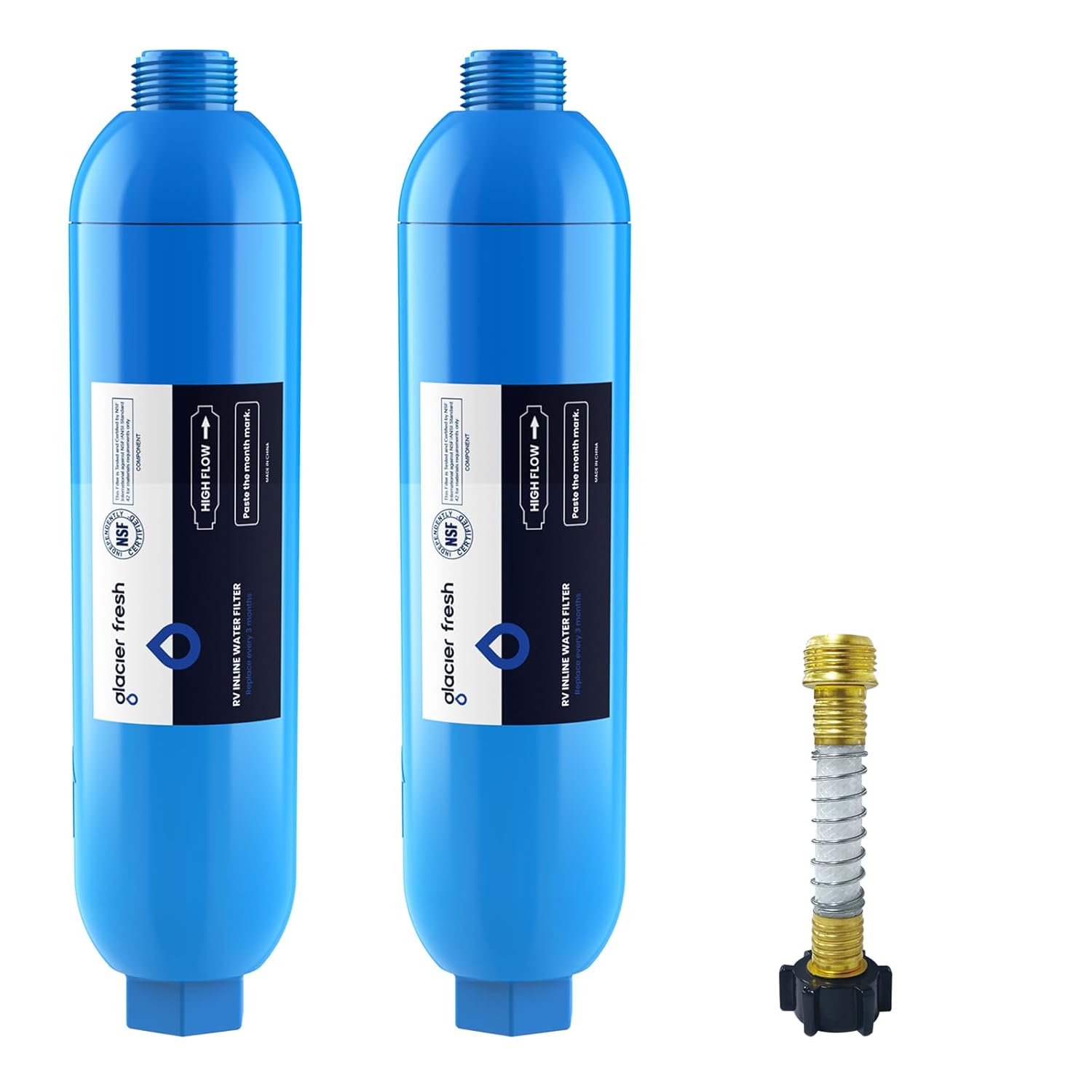
The GLACIER FRESH RV inline water filter is a straightforward, hose-compatible option designed for campground hookups. It includes a flexible hose protector to prevent kinking, is listed by the manufacturer as NSF certified, and is designed to reduce chlorine, sediment, and unpleasant taste from campground water. It strikes a strong balance between ease of use, filtration performance, and value for typical campground RV setups.
Pros
- Listed as NSF certified by the manufacturer
- Designed to reduce chlorine, sediment, and bad taste
- Includes flexible hose protector to prevent kinking
- Standard 3/4″ GHT connection – compatible with most RV hoses
- Easy to install – no tools required
Cons
- Single-use inline design – replace the full unit when spent
- Confirm capacity and micron rating on current product listing
2. Camco TastePURE XL (Model 40043)
The most trusted budget inline filter for RV use
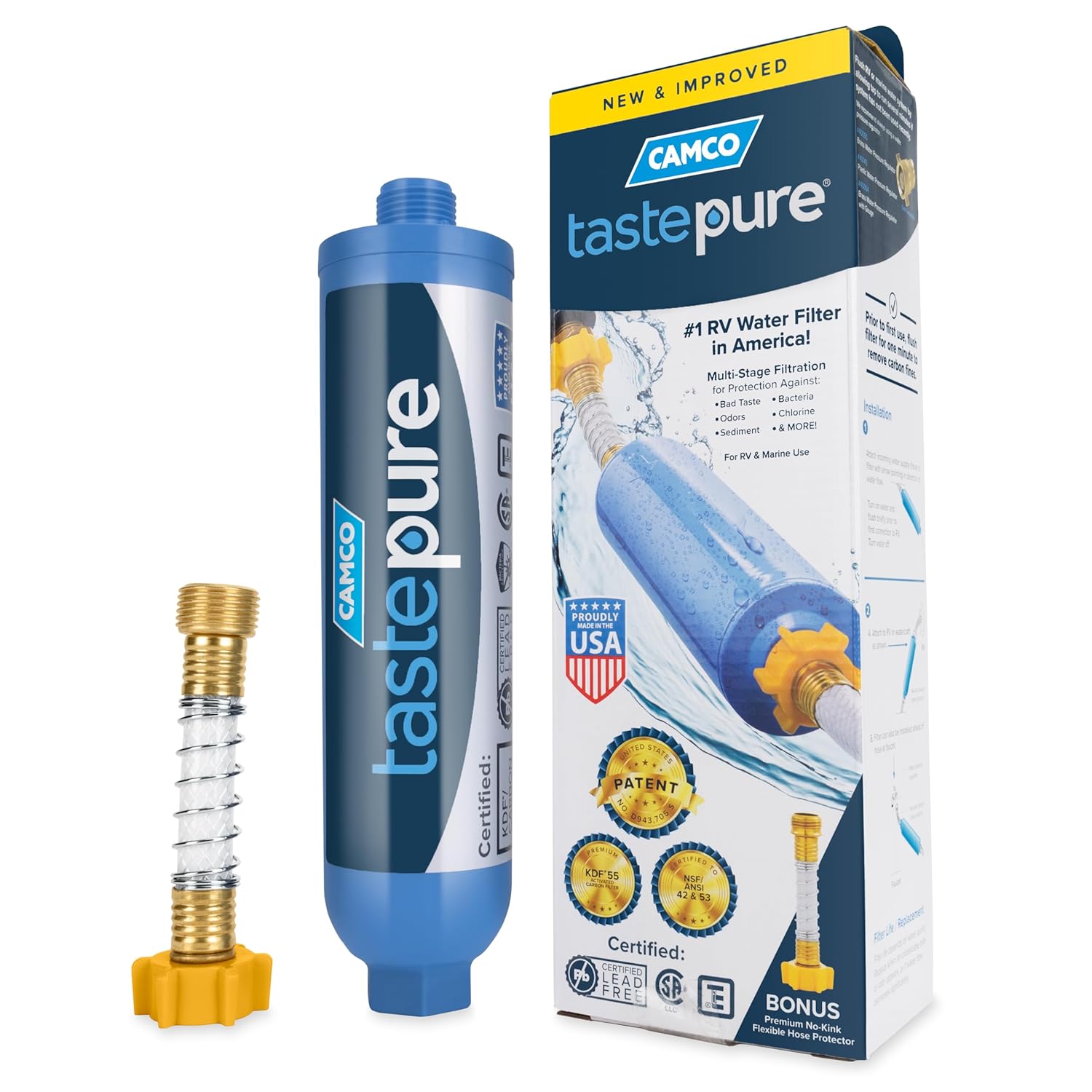
Camco is one of the most recognized names in the RV accessory market, and the TastePURE XL is among their most well-known products. It uses a GAC and KDF filtration combination that handles chlorine and bad taste effectively – no complex installation, no tools, just screw it on and go. For weekend campers or anyone not relying on their RV water as their primary drinking source, it’s hard to justify spending more.
Pros
- Most affordable option from a trusted brand
- Effective GAC + KDF reduces chlorine and taste
- No tools needed – installs in seconds
- Made in the USA
- Widely available at RV and outdoor stores
Cons
- Not NSF certified
- Single-stage – less thorough than multi-stage options
- Not ideal as a primary drinking water filter for full-timers
3. AQUA CREST RV Inline Water Filter
NSF/ANSI 372 listed – focused on drinking water improvement

If drinking water quality is your priority, the AQUA CREST stands out for its manufacturer-listed NSF/ANSI 372 certification, which relates to lead-free construction. Its multi-stage filtration goes further than basic inline carbon filters, making it a reasonable choice for anyone looking to improve the quality of campground water they drink regularly.
Pros
- Listed as NSF/ANSI 372 certified for lead-free construction
- Multi-stage removes more contaminants than basic filters
- Designed to maintain usable flow at typical campground pressures
- 2-pack available for extended use
- Good choice for varied or unknown water sources
Cons
- Higher price than basic inline options
- Still inline – not a full canister system
4. Kohree RV Inline Water Filter 2-Pack
High capacity with a backup filter included – great value per gallon

The Kohree 2-pack stands out for its per-gallon value. Each filter has a manufacturer-listed capacity of up to 1,057 gallons, and buying two at once means you always have a backup ready. The product is listed as NSF and BPA-free certified, uses a GAC and KDF filtration combination, and is designed to maintain consistent flow throughout its service life.
Pros
- Up to 1,057 gallon capacity per filter (manufacturer-listed)
- 2-pack means you always have a spare
- Listed as NSF certified and BPA-free
- Strong, consistent flow rate
- Good value per gallon filtered
Cons
- 20-micron rating – coarser than 5-micron options
- Less name recognition than Camco or AQUA CREST
5. Camco EVO Premium Water Filter System
Canister design with replaceable cartridges – the step up for full-timers
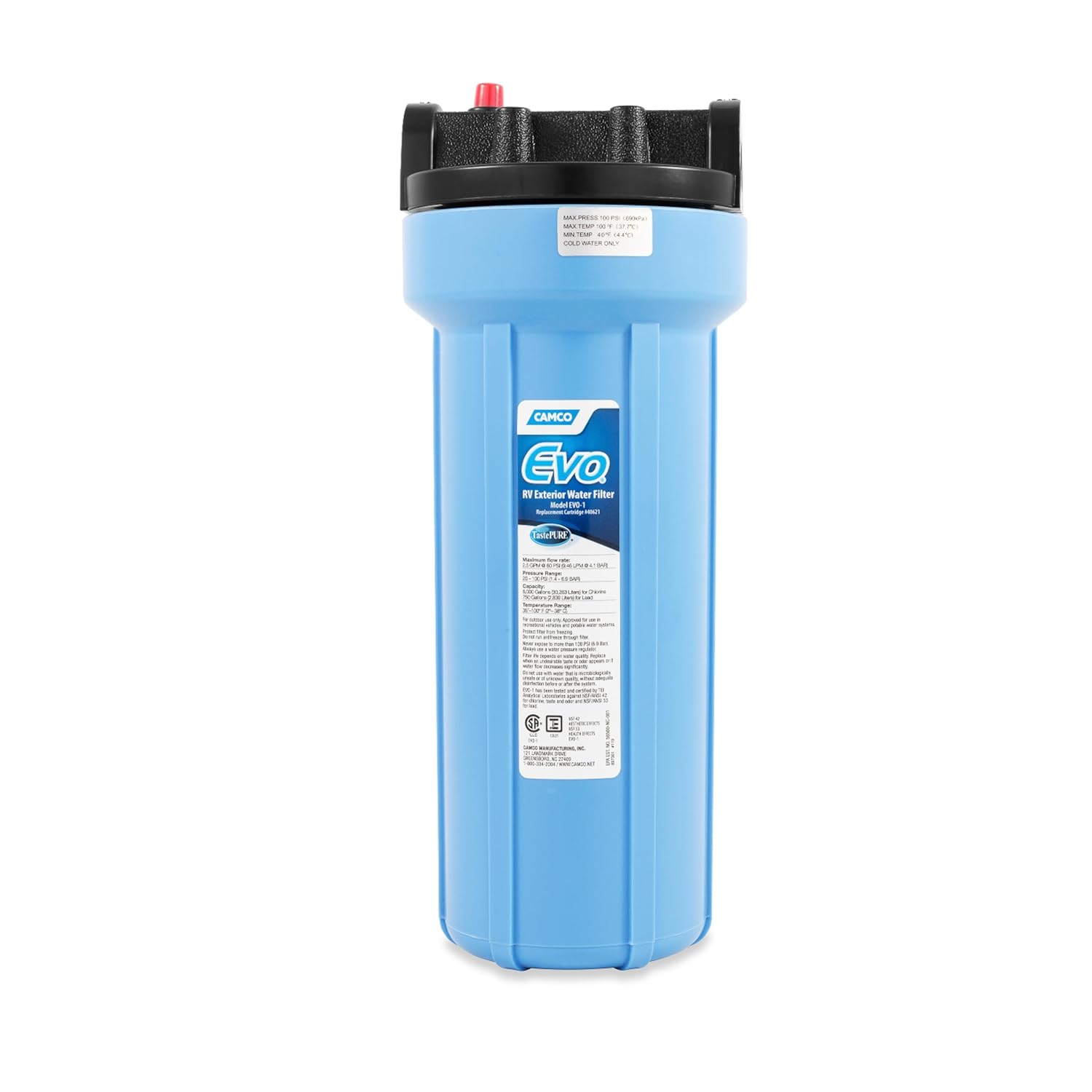
The Camco EVO is a canister-style filtration system rather than a simple inline filter. Instead of replacing the whole unit, you swap out the internal cartridge – which typically offers finer filtration and a larger filter surface area than inline models. For anyone putting significant daily use through their RV water system, the EVO delivers noticeably better filtration depth and long-term economics once you factor in cartridge cost versus full filter replacement.
Pros
- Replaceable cartridges – lower long-term cost
- Larger filter media than inline options
- Canister design typically allows for finer cartridge options than inline units
- Listed as NSF certified by the manufacturer
- Includes mounting bracket for semi-permanent installation
Cons
- Higher upfront cost than inline filters
- Requires more space and a semi-permanent setup
- Overkill for occasional campers
Types of RV Water Filters
Understanding filter types helps you pick the right one for your setup. Here’s a quick breakdown – for more detail on the full RV water system context, see our RV water systems guide.
Inline Filters
Screw onto your water inlet hose between the campground hookup and your RV. Simple, cheap, and easy to replace. The most common choice for campground RVers. Ideal for chlorine, sediment, and taste improvement.
Canister Filters
A housing unit that stays in place while you swap out internal filter cartridges. Better filtration surface area and lower long-term cost than replacing inline units. Requires a semi-permanent installation.
Multi-Stage Systems
Multiple filtration stages in sequence – sediment pre-filter, carbon filter, and sometimes a polishing stage. Removes a broader range of contaminants. Common in full-timer setups and higher-end rigs.
Whole-RV Systems
Installed on the main water line inside the RV, filtering all water entering the plumbing. Covers every faucet and fixture. More expensive and requires professional or confident DIY installation.
Quick guide: Weekend camper using hookups? Start with a good inline filter. Full-timer relying on varied water sources? Step up to a canister system or multi-stage setup.
How to Choose the Right RV Water Filter
The right filter depends on how you travel, where you fill up, and whether you’re drinking the water directly.
Filtration Level
Basic inline carbon filters handle chlorine, taste, and coarse sediment. If you want finer particle removal or protection against a broader range of contaminants, look for multi-stage or canister systems. Check the micron rating – 5 micron is finer filtration than 20 micron.
Flow Rate
Most inline filters maintain good flow at typical campground pressures. If you’re using a pressure regulator alongside a filter (which is recommended), ensure the two are compatible and don’t combine to restrict flow below a usable level.
Installation Type
Inline filters need no tools and take seconds to install. Canister systems need mounting and a slightly more involved setup. Whole-RV filtration typically requires cutting into the water line – more work, but a one-time install.
Replacement Frequency
Follow the manufacturer’s recommended replacement schedule – typically based on either elapsed time or gallons used, whichever comes first. Filters that appear to work fine can still be past their useful filtration life. With a canister system, only the cartridge gets replaced, not the housing.
NSF Certification
NSF-certified filters have been evaluated against established drinking water standards. If you use your RV water for drinking, look for filters listed as NSF 42 certified (taste and odor reduction) or NSF/ANSI 372 (lead-free construction) – and confirm the certification is current on the product listing.
Travel Style
Weekend campers at established campgrounds can do well with a basic inline filter. Full-timers, boondockers, and anyone using water from diverse sources benefit from a multi-stage or canister system with better contaminant coverage.
Common RV Water Filter Mistakes
Most water quality problems in RVs are avoidable. Here are the mistakes worth knowing before you buy:
Using no filter at all
Campground water quality varies significantly by location and season. Even water that tastes fine can carry sediment, chlorine byproducts, or other impurities that affect taste and appliance longevity. An inline filter costs very little relative to the protection it provides.
Not replacing filters on schedule
A filter past its capacity continues to look and function normally – water still flows through. But the filtration media is saturated, and contaminants pass through freely. Set a reminder based on gallons used or elapsed time, not appearance.
Choosing based on price only
The cheapest inline filter may be perfectly adequate for a weekend trip but fall short for full-time use or locations with known water quality issues. Match filter capability to your actual use case – a slightly more capable filter is almost always worth the marginal extra cost.
Using a low-flow filter for full-time use
Some inline filters restrict water flow noticeably under sustained use. For occasional camping this isn’t an issue. For full-timers running multiple fixtures regularly, a restricted flow quickly becomes a daily frustration. Confirm the filter’s flow rate before buying if daily use is your scenario.
Skipping a pressure regulator alongside the filter
A water filter does not regulate incoming pressure. At high-pressure campground hookups, excessive pressure can stress filter housings and fittings over time. Pair your filter with a pressure regulator – they’re cheap and protect both the filter and your RV’s plumbing.
Storing a wet filter between trips
An inline filter left connected and wet between camping trips can develop mold or bacterial growth inside the filtration media. Disconnect, drain, and store filters dry when not in use – or replace before your next trip if stored wet for an extended period.
Frequently Asked Questions
Do I really need a water filter for my RV?
Strongly recommended – especially if you drink from your RV’s water system. Campground water quality varies widely depending on location, source, and infrastructure age. At minimum, an inline carbon filter removes chlorine, improves taste, and adds a basic layer of protection. It’s one of the lowest-cost, highest-impact upgrades you can make to your RV setup.
Can I drink RV water with an inline filter?
Yes, with the right filter. For drinking water specifically, choose an NSF-certified option – ideally one certified to NSF 42 (taste and odor) or NSF/ANSI 372 (lead-free construction). A multi-stage inline filter like the AQUA CREST or GLACIER FRESH provides solid drinking water protection at most campgrounds. For areas with known water quality concerns, consider a canister system or multi-stage setup.
How often should I replace my RV water filter?
Follow the manufacturer’s guidelines, which are typically based on either elapsed time (often 3 months) or total gallons filtered – whichever comes first. The right interval varies by filter model and how heavily you use it. If you use campground water daily, you’ll likely hit the gallon limit before the time limit. When in doubt, replace it – a fresh filter is inexpensive compared to drinking degraded-quality water.
What’s the difference between inline and canister RV water filters?
Inline filters are single-use units that screw directly onto your water hose. When they’re spent, you replace the whole unit. They’re simple, cheap, and require no tools. Canister filters are permanent housing units where only the internal cartridge gets replaced. They offer a larger filter surface area, finer filtration options, and lower cost-per-gallon over time – but require more installation effort and upfront cost.
Should I use a filter when filling my freshwater tank, or only at hookups?
Both. When connecting to a campground hookup (city water), filter directly at the inlet. When filling your freshwater tank at a dump station or water fill point, filter inline during the fill. Tank water can develop its own taste and quality issues over time – running it through a filter before use is good practice, especially if the tank hasn’t been sanitized recently.
Do RV water filters work with well water or unknown sources?
Standard inline carbon filters improve taste, reduce chlorine, and remove sediment – but they don’t address everything that can be present in well water or unknown sources (bacteria, heavy metals, nitrates). If you’re regularly drawing from non-municipal water sources, consider a multi-stage system that includes sediment pre-filtration and a finer carbon stage, or have the water tested before relying on it for drinking.
Looking for the complete picture on RV water and waste systems – pumps, sewer hoses, tank treatments, and more? See our full RV water systems and sewer solutions guide.
View the full guide →Disclosure: This guide contains affiliate links. If you purchase through these links, we may earn a small commission at no extra cost to you. Our recommendations are based on product performance and value – not commission rates.