RV Safety Guide
RV Safety and Emergency Gear
What Actually Matters and What Most People Get Wrong
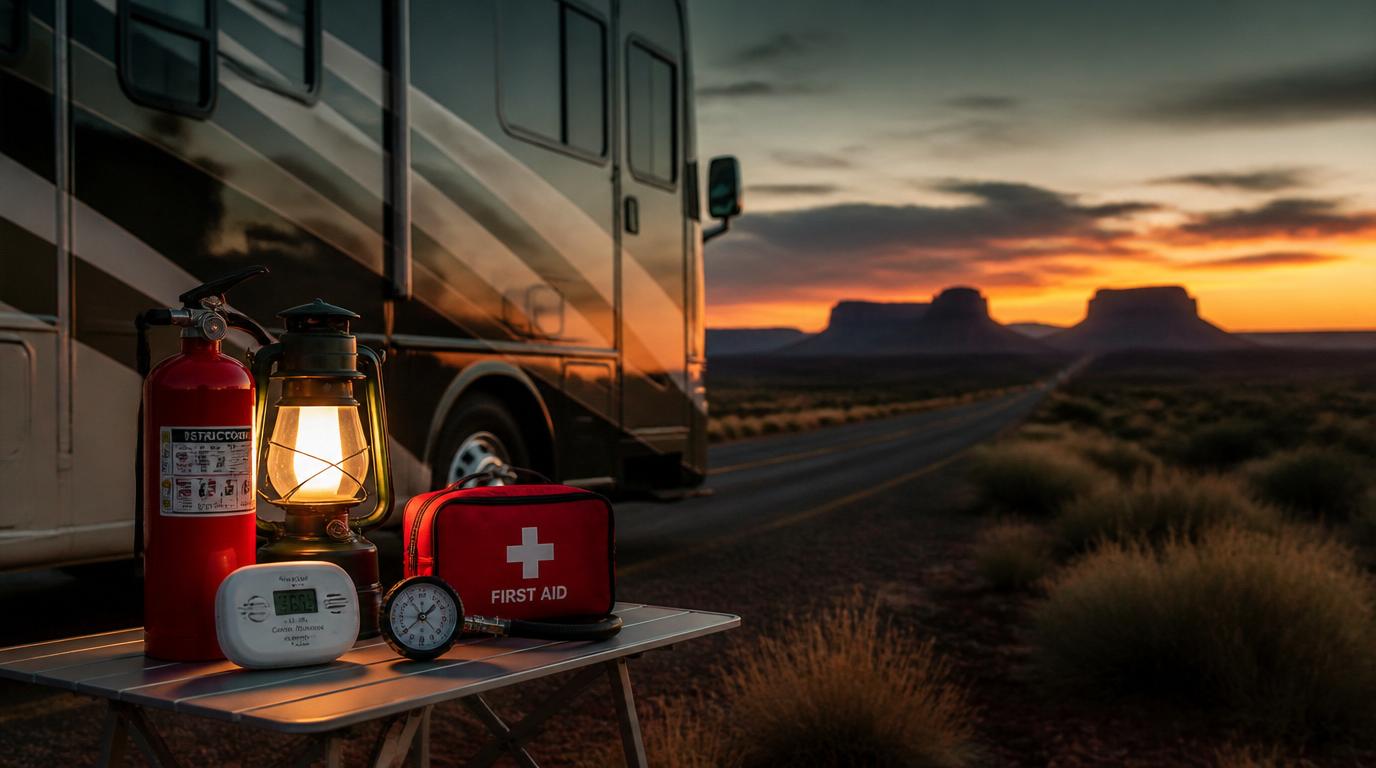
Why RV Safety Is Consistently Underestimated
Most people planning their first RV trip spend weeks researching leveling blocks, bedding options, and the best coffee makers for small spaces. Very few spend that same energy understanding what happens when a tire blows at highway speed, or what to do if a carbon monoxide alarm sounds at 2 a.m. in a campground.
This is not a criticism. It reflects how RV culture is marketed. The industry, the influencer ecosystem, and most online forums skew heavily toward comfort, convenience, and lifestyle. Safety gear is rarely photogenic. It does not make for compelling content. But the gap between how prepared most RVers feel and how prepared they actually are is real, and it has consequences.
The confusion is also structural. Many new RVers assume that because an RV came from a dealer – with smoke detectors, a propane alarm, and a fire extinguisher already installed – they are covered. They are not. Factory-installed equipment often represents the legal minimum, not a practical standard of safety. Equipment ages. Batteries die. Sensors drift out of calibration. And none of it addresses the full range of situations you may encounter on the road.
There is also a common pattern of misallocated preparation. Owners invest in satellite communicators for remote adventure scenarios while never replacing the ten-year-old fire extinguisher that came with the rig. They buy redundant backup cameras but have never checked whether their CO detector is still within its rated service life.
This guide is about correcting that imbalance. The goal is not to alarm you – RV travel is genuinely safe when managed thoughtfully – but to help you understand which risks are real, which gear actually addresses them, and how to build a safety approach that is practical rather than performative.
The Real Risks in RV Travel
Understanding risk well means understanding it accurately. The following categories represent the failure modes that actually injure or kill RV travelers, or cause serious property loss. They are worth knowing not to create anxiety, but to direct your attention where it belongs.
Fire Risk
Fire is the most consequential risk in RV ownership. An RV is a compact, enclosed space with multiple ignition sources, synthetic materials that burn quickly, and limited escape routes. When a fire starts in an RV, occupants typically have less than two minutes to exit safely.
The most common ignition sources are cooking-related (open flame and unattended stovetops), propane system failures (faulty regulators, damaged hoses, poor connections), and electrical faults (overloaded circuits, degraded wiring, issues at the shore power connection). Older rigs with original wiring are at meaningfully higher risk. Any RV that has been modified or had electrical work done by someone other than a qualified technician deserves close scrutiny.
The single most important thing to understand about RV fires: detection time and response time are compressed compared to a house. Gear that gives you even sixty additional seconds is not a luxury. It is the margin between a contained incident and a complete loss.
Carbon Monoxide and Propane Gas Risks
Carbon monoxide is produced by any combustion appliance – generators, furnaces, water heaters, and stovetops. It is colorless and odorless. In the enclosed environment of an RV, particularly with windows closed in cold weather or during generator use, CO can accumulate to dangerous levels faster than most people expect.
Propane leaks present a different but related hazard. Propane is heavier than air, which means it settles at floor level and can accumulate in bilge areas, under cabinetry, and in storage bays. A spark from any source – an appliance switching on, a light switch, static electricity – can ignite it. The risk is highest after a system has been disconnected and reconnected (like changing tanks), or when hoses and fittings are aging.
Both of these risks are invisible without detection equipment. Both are preventable with proper equipment and maintenance.
Electrical Hazards
Shore power connections at campgrounds introduce risks that most RVers have never considered. Campground pedestals vary significantly in condition and wiring quality. Problems include reversed polarity, open grounds, voltage fluctuations, and pedestals that deliver more or less voltage than rated. These conditions can damage appliances, create shock hazards, and in some cases cause fires.
Onboard electrical systems carry their own risks. Inverters, converters, and battery banks generate heat. Connections loosen over time. Fuses and breakers are protective only if properly rated for the circuits they serve. An RV that has had aftermarket solar or electrical work done may have wiring that was not installed to code and has never been inspected.
Tire Failure and Roadside Issues
Tire failure is the most statistically common serious incident in RV travel. This applies especially to larger rigs where tires carry significant sustained loads, and to any vehicle where tires are used past their recommended service life. RV tires often age out before they wear out – the rubber degrades from UV exposure and ozone even when tread depth looks acceptable.
A tire failure on a motorhome or fifth wheel at highway speed is not a minor event. It can affect steering, cause damage to the vehicle body and undercarriage, and in a worst case lead to rollover. Even a trailer tire failure can cause sway or loss of control.
Roadside issues more broadly – including mechanical breakdowns, fuel problems, and getting stuck – are common, often occur in locations with limited cell service, and are frequently underestimated by new RVers who are used to calling a standard roadside assistance service.
Remote and Isolated Locations
This risk category is not about danger from the environment or other people. It is about the practical reality that when something goes wrong – a medical emergency, a mechanical failure, a fall – help may be 45 minutes away or more. That changes what you need to have on hand. A first aid kit adequate for a neighborhood walk is not adequate for a campsite three hours from the nearest hospital. A communication plan that relies entirely on cell service does not work in many of the places RVers most want to go.
What Safety Gear Actually Matters
Gear can be grouped into three tiers based on what it protects.
Life Safety Equipment
This category is non-negotiable. The items here protect human life directly, and there is no meaningful substitute for having them in working condition.
Should be present in any RV with combustion appliances or a generator. Factory-installed units are not automatically adequate – check the installation date and the manufacturer’s stated service life, which is typically five to seven years. CO detectors have electrochemical sensors that degrade over time. An expired detector may still beep when tested with the test button (which tests the alarm circuit, not the sensor). Replace them on schedule.
Should be positioned in sleeping areas and near the kitchen. Combination CO/smoke units are practical for small spaces. Verify that what came with your rig is current and functional, not just present.
Should be accessible without obstruction and appropriate for RV use. An extinguisher that is blocked by gear in a cabinet, or that has not been inspected in years, provides false confidence. In an actual fire scenario, you will not have time to move things out of the way. Know where it is, know how to use it, and confirm it is in service.
Often bundled with CO detectors in RV-specific units. Verify that yours detects both. If your rig is older, confirm the unit is current – propane detectors also have service life limits and are often overlooked.
One that goes beyond bandages. In remote locations especially, the ability to manage a wound, treat a burn, or address an allergic reaction until professional help arrives is genuinely important.
RV System Protection
These items protect your systems and reduce the risk of incidents that can escalate to life safety situations.
Arguably the single most cost-effective item in this category. A quality EMS monitors incoming shore power for voltage problems, polarity issues, and wiring faults before they reach your RV. It protects appliances from damage and, more importantly, prevents the kinds of electrical conditions that can cause fires. There is a meaningful difference between a basic surge protector and a full EMS – the latter provides active monitoring and diagnostic capability.
Provide real-time data on tire pressure and temperature for all tires, including trailer tires. Tire pressure that is too low or too high is a leading factor in tire failures. A TPMS does not prevent failures from structural damage or age, but it addresses the most common and correctable cause.
Shows accurate state-of-charge for your house batteries. Running lithium or AGM batteries below their acceptable discharge floor regularly shortens their life. More importantly, it prevents the situation where you discover your batteries are depleted when you need power for medical equipment, lighting, or communication.
Emergency Preparedness
This category addresses situations where something has already gone wrong and you need to manage it safely until the situation resolves.
Reflective triangles or flares (triangles are preferable for extended use), work gloves, a quality flashlight with spare batteries, basic hand tools, and jumper cables or a jump starter rated for your vehicle. These are straightforward and inexpensive, and a breakdown without them is considerably worse.
A cell phone is not a communication plan. In areas with no cell coverage, a satellite communicator provides the ability to send your location and a distress signal to emergency services. This is especially relevant for boondocking, remote campgrounds, or travel in mountainous terrain.
Not survivalist quantities, but enough for 24 to 48 hours without resupply. This covers the scenario of a breakdown in a remote area, severe weather that keeps you in place, or arriving somewhere to find services unavailable.
What Most People Get Wrong
Buying Interesting Gear Instead of Essential Gear
The RV gear market is very good at selling things that feel like safety preparation but are not. Multi-tools, specialty gadgets, and redundant technology accessories fill storage space and drain budgets while the fire extinguisher remains out of date. The discipline of prioritizing unglamorous essentials before adding supplemental gear is more important than any individual product decision.
Trusting Factory-Installed Equipment
Dealers sell RVs with the equipment required by law. That equipment was installed when the unit was new. It has a service life. By the time many buyers purchase a used RV, the detectors may be expired, the fire extinguisher may need servicing, and the propane system may not have been inspected in years. Treat a used RV purchase as a starting point for a safety audit, not a guarantee of coverage.
Ignoring Maintenance as a Safety Issue
The majority of serious RV incidents are not caused by inadequate gear. They are caused by deferred maintenance. Tire blowouts from age and UV degradation, propane leaks from cracked hoses, electrical fires from degraded connections – these are maintenance failures, not equipment failures. A comprehensive safety approach includes regular, systematic inspection of tires, propane systems, electrical connections, and detector function. Gear cannot compensate for a system that has been neglected.
Preparing for Unlikely Events at the Expense of Likely Ones
A satellite communicator for a backcountry emergency is a reasonable investment for someone who regularly camps in remote areas. It is a low-priority purchase for someone who camps exclusively in full-hookup campgrounds and has not yet replaced their ten-year-old CO detector. Match your preparation to your actual travel patterns and the actual risk profile of where you go.
A Simple Priority Framework
If you are building your safety kit from scratch – or auditing what you already have – this is the order that matters.
Buy First
These items address the highest-probability, highest-consequence risks. If you do not have these, or cannot confirm they are in current working condition, they come before anything else.
- Working CO detector within its service life
- Working smoke detector within its service life
- Serviceable fire extinguisher, accessible and unobstructed
- Propane leak detector (if not combined with CO unit)
- Surge protector or EMS for shore power connections
- Tire pressure monitoring system
- Basic roadside emergency kit (triangles, flashlight, jump starter)
- First aid kit appropriate for the distances you travel
Add Next
Once the fundamentals are current and confirmed, these items meaningfully improve your position.
- Dedicated battery monitor
- Backup communication device (satellite communicator if you travel in areas with limited cell coverage)
- Expanded first aid supplies calibrated to your specific health needs or travel style
- A formal inspection of your propane system by a qualified technician if the rig is more than a few years old
Optional and Situational
These items may be appropriate depending on your specific use case, but they are additions to a solid foundation, not substitutes for one.
- Additional weather monitoring tools
- Specialized gear for specific environments (high altitude, extreme cold)
- Redundant communication options
For Further Reading
The priorities covered here set the foundation. Two areas warrant deeper treatment than a single guide can provide.
If fire risk is a concern – and it should be on every RVer’s radar given how quickly RV fires develop – a detailed look at detection, suppression, and escape planning is worth your time. The RV Fire Safety Guide covers the full picture of early detection, extinguisher types, and what to actually do in the first minutes of a fire.
If you want to build out a complete emergency kit rather than just the basics, there are meaningful decisions to make about first aid depth, tools, communication, and supplies for specific scenarios. The RV Emergency Kit Guide works through those decisions systematically and will save you both money and the experience of discovering gaps at the wrong moment.
If You Only Remember This
RV travel is not inherently dangerous. But it is different from living in a fixed structure, and those differences create specific risks that deserve specific attention.
The pattern that causes the most harm is not ignorance of exotic threats. It is the combination of outdated or unmaintained life safety equipment, confidence in gear that has not been verified, and preparation that addresses the wrong scenarios.
Focus on the real risks: fire, gas, electrical, and tire failure. These are the events that actually injure RVers and damage rigs. Prioritize life safety first: working detectors and a serviceable extinguisher are non-negotiable, and they need to be verified, not assumed. Keep your systems simple and reliable: a maintained, inspected rig with current equipment outperforms an impressive gear collection every time.
The goal is not perfection. It is a clear-eyed understanding of what matters, a commitment to keeping it current, and the judgment not to let interesting gear crowd out essential preparation.