RV Emergency Kit Guide
RV Emergency Kit Guide
What to Pack, What Actually Matters, and What Most People Get Wrong
Why Most Emergency Kits Miss the Point
Search for “RV emergency kit” and you will find two things: pre-assembled bundles with 72 items in a nylon bag, and forum threads where experienced RVers disagree about whether you need a hand-crank radio or a water filtration straw. Neither is particularly useful as a starting point.
The pre-made kits tend to include items that feel comprehensive but address scenarios most RVers will never encounter. The forum debates spiral toward edge cases – what to do if you break down in a blizzard 50 miles from cell service – while glossing over the situations that actually happen: a dead battery in a campground parking lot, a minor cut that needs proper cleaning, or a tire issue on a highway exit ramp with no shade and no water.
A good RV emergency kit is not a survival kit. It is not a hedge against catastrophe. It is a practical set of tools and supplies that helps you manage the situations you are actually likely to encounter, without leaving you stranded, uncomfortable, or dependent on a tow truck for something you could have handled yourself.
The goal of this guide is to help you build a kit that reflects how you actually travel – your rig, your routes, your travel companions, and your realistic risk profile. That means some items are non-negotiable for everyone, some depend entirely on your travel style, and some can be left off the list entirely without meaningful consequence.
What “Emergency” Actually Means in RV Travel
Before deciding what to pack, it helps to define what you are actually preparing for. The word “emergency” covers a wide range from mildly inconvenient to genuinely serious, and your kit should be calibrated to the realistic distribution of those scenarios – not the worst-case end of the spectrum.
Roadside breakdown – dead batteries, tire failures, blown fuses, mechanical issues. Most are not dangerous. They are inconvenient, and the right tools turn a six-hour ordeal into a two-hour one.
Stuck without services – a campground further than expected, a closed store, a weather delay. A 24-48 hour buffer of water and food resolves most of these without drama.
Minor injury or medical issue – cuts, burns, allergic reactions, blisters. A basic medical kit handles the large majority. Distance from care determines how deep that kit needs to go.
Weather delay or isolation – unable to leave due to rain, mud, snow, or road conditions. Primarily a comfort scenario. Supplies to stay put for a day or two resolves it.
What is notably absent: wilderness survival, natural disasters, extended off-grid emergencies. Those scenarios exist, but they describe a specific category of travel requiring specific preparation – not the baseline every RV owner needs.
The Core Emergency Kit: What Everyone Needs
Regardless of how you travel, these items belong in every RV. They address the highest-probability scenarios and require no special knowledge to justify.
Roadside Safety
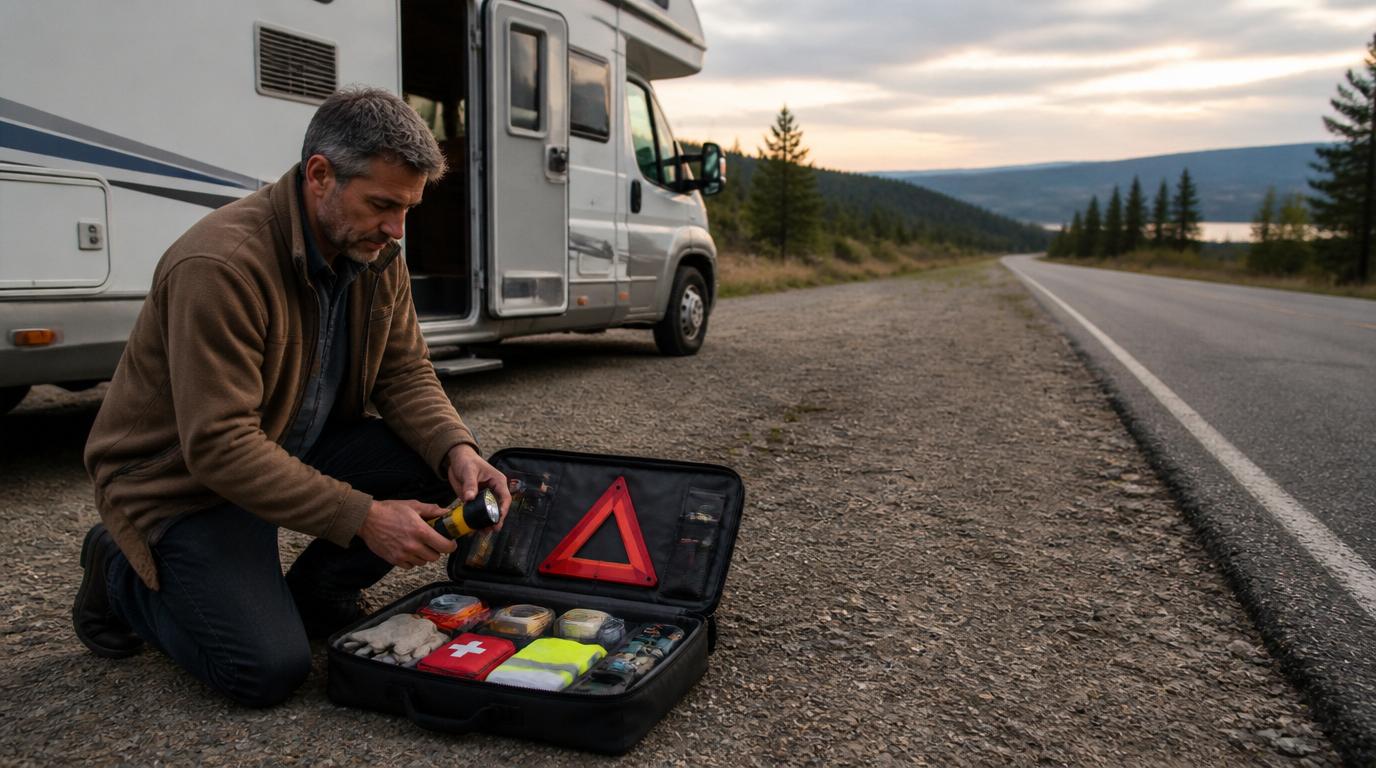
When stopped on a road shoulder or in a low-visibility area, making yourself visible to other drivers is an immediate priority. Reflective triangles are preferable for extended use because they do not burn out – place them at 10 feet, 100 feet, and 300 feet behind the vehicle in the direction of traffic. A battery-powered flare adds visibility in genuine low-light conditions.
A quality flashlight with spare batteries covers the most basic need: seeing what you are doing after dark. A headlamp is more practical when you need both hands free. Work gloves protect your hands during tire changes or any roadside work involving dirty or sharp materials.
Basic Tools
A roadside tool kit needs to cover only the jobs you might actually do on the side of a road: a lug wrench and jack rated for your rig’s weight, a basic screwdriver set, pliers, and an adjustable wrench. Zip ties, electrical tape, and duct tape handle temporary fixes that get you to a service location.
Know how to use the jack that came with your rig before you need it. RV jacks vary significantly in placement and procedure, and the side of a highway is not the right place to learn.
Jump Starter or Jumper Cables
A dead battery is among the most common roadside scenarios for any vehicle. For an RV with both a chassis battery and house batteries, knowing which battery is dead and how to address it matters. A portable jump starter rated for your engine size handles most situations without requiring another vehicle. Jumper cables are a useful backup but require a willing second driver.
Check your jump starter’s charge every few months. A unit that has not been used in a year may not have enough reserve to start an engine when you need it.
Water and Basic Food Buffer
Carry a minimum of one gallon of water per person per day for at least two days. If you are stuck without hookups, waiting for a tow, or delayed by weather, having water on hand changes the situation from urgent to manageable.
A basic food buffer means non-perishable items that require no cooking: nuts, dried fruit, crackers, protein bars. Enough for 24 to 48 hours per person. Rotate regular pantry items through the kit and replace them before they expire – no special “emergency food” purchases needed.
First Aid Essentials
At minimum: adhesive bandages in multiple sizes, sterile gauze pads, medical tape, antiseptic wipes, antibiotic ointment, tweezers, scissors, nitrile gloves, and pain relievers. This handles the large majority of minor injuries during RV travel – cuts, scrapes, blisters, and minor burns.
Add any personal medications that you or your travel companions take regularly, along with a written list of those medications and relevant medical information for each person. If anyone in your group has a known severe allergy, an antihistamine and an epinephrine auto-injector (if prescribed) are non-optional.
Medical Kit Depth: Matching Your Kit to Your Distance from Care
The basic first aid kit above is appropriate when traveling within roughly 30 to 45 minutes of a hospital or urgent care. When you travel further from services, the kit needs to go deeper. The calibration question is simple and honest: how far are you typically from medical care?
The core first aid items listed above. Appropriate for campground travel, weekend trips, and routes where medical care is reliably accessible. Keep it stocked and current.
Add: a SAM splint or moldable splint for immobilizing sprains and fractures, elastic compression bandages, burn gel and non-stick burn dressings, a cold pack, wound closure strips for deeper cuts, and a basic CPR face shield.
More comprehensive wound care supplies, a tourniquet (with the training to use it correctly), a prescription antibiotic if your doctor will provide one for travel, and ideally a wilderness first aid certification for at least one person in your group. At this level, the training matters more than the gear.
Match the kit depth to your realistic travel pattern, not to a remote scenario you visit once a year.
Tools That Actually Help vs. Tools That Usually Don’t
The test for any tool is straightforward: can you name a specific situation you are likely to encounter where it makes a meaningful difference? If constructing that scenario requires significant imagination, the tool probably does not belong in your baseline kit.
A good multi-tool covers a surprising number of small repairs. A portable 12V air compressor lets you address a slow leak without a tow. A tire plug kit handles many minor punctures. A tow strap rated for your rig’s weight. A headlamp for hands-free work.
A portable generator makes sense if you regularly travel without hookups and need power for critical systems. A battery-powered lantern is practical for extended outages. A deeper hand tool set if you are mechanically inclined and comfortable doing your own repairs on the road.
A full socket set, power tools, extensive spare parts inventories, manual hand saws, and most contents of pre-made survival kits. These reflect real needs in specific contexts – but for most RVers on developed roads between established campgrounds, they add weight without addressing any likely scenario.
Communication and Navigation
Cell coverage is the most commonly overestimated resource in RV travel planning. Large areas of the American West, parts of the Southeast, and many popular destinations in national forests and BLM land have limited or no reliable cell service. A communication plan that depends entirely on a cell phone is not a complete plan.
When a satellite communicator makes sense: If you regularly travel to areas with unreliable coverage, camp in remote locations, or travel solo where a breakdown could leave you genuinely isolated, a satellite communicator is a worthwhile addition. These devices send a GPS location and distress signal to emergency services regardless of cell coverage, and many support basic two-way messaging for communicating with family or roadside assistance.
When it probably does not: If you travel exclusively to developed campgrounds with reliable service, stay on major highways, and are never more than 30 minutes from a populated area, a satellite communicator addresses a scenario you are unlikely to encounter. It is not a bad investment – but it is not a priority gap to fill before the core fundamentals are in place.
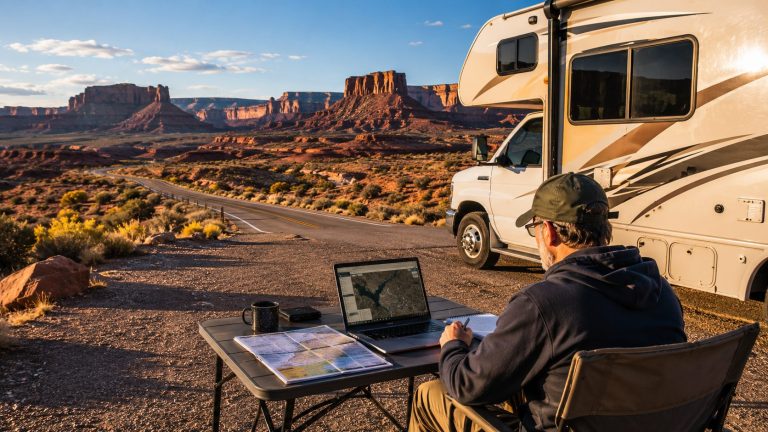
Regardless of that decision: carry downloaded offline maps for your travel areas. GPS apps that require cell service to load maps are not useful when you do not have service. Paper maps remain a reliable backup that requires no battery and no signal.
Building Your Kit Based on How You Actually Travel
Rather than one universal list, the right kit depends on your actual travel patterns. Here is how the core kit scales across three common profiles.
Campground and Hookup Travel
The core kit described above covers this profile well. Focus on roadside safety, basic tools, a jump starter, water buffer, and a basic first aid kit. Keep it compact and organized. The risk of overpacking here is real – a bloated kit is harder to maintain and harder to use when you need it.
Weekend and Short-Trip Travel
Core kit plus an intermediate first aid kit and a tire plug kit. If your routes pass through areas with limited cell service even occasionally, add offline maps and consider a satellite communicator. Most weekend travelers fall somewhere between Profile 1 and this level depending on their routes.
Boondocking and Remote Travel
All of the above, plus an advanced medical kit, a satellite communicator, extended water storage, a minimum 72-hour food buffer, and a more complete tool kit if you are comfortable with mechanical repairs. The further you go from services, the more your kit functions as genuine self-sufficiency rather than a bridge to outside help.
Common Mistakes
Pre-assembled kits are convenient but often poorly matched to RV-specific needs. Many include items useful for car emergencies but irrelevant to an RV, while missing basics like a heavy-duty jump starter or a lug wrench sized for your rig. Know what is in your kit and why each item is there.
A kit so large and disorganized that you cannot find what you need under stress is worse than a smaller, well-organized one. Every item should earn its place. If you cannot explain what specific scenario it addresses, it probably does not belong.
Emergency kits go stale. Jump starters lose charge. Batteries die. Food expires. First aid supplies run out and are not replaced. Set a calendar reminder every six months to check and refresh your kit. This is the single most common failure mode – a kit that was once adequate and has quietly degraded over time.
A kit built around a wilderness survival situation provides limited value for the highway shoulder breakdown that is far more likely to happen. Prioritize the common scenarios first. Add depth for uncommon ones only after the basics are solid.
For Further Reading
The emergency kit sits within a broader approach to RV safety that is worth understanding fully. The foundation is knowing which risks are real and how to prioritize across all of them – the RV Safety and Emergency Gear guide covers that hierarchy clearly and explains why most people invest in the wrong places first.
For fire-specific preparation – which deserves its own focused attention given how quickly RV fires develop and how compressed the response window is – the RV Fire Safety Guide walks through causes, prevention habits, and what to actually do in the first sixty seconds of a fire.
If You Only Remember This
The emergency kit that actually helps you is not the most comprehensive one. It is the one that addresses your realistic scenarios, stays organized and maintained, and can be accessed quickly when something goes wrong.
Focus on realistic scenarios. A breakdown, a minor injury, a 24-hour delay without services. These are the situations you will actually face. Build your kit around them before adding anything else.
Keep it simple. A smaller kit that you know completely and can navigate under stress outperforms a larger kit that takes ten minutes to search through. Every item should have a reason to be there.
Maintain and check your kit. A jump starter uncharged for eight months, expired medications, and a flat spare tire are not emergency preparedness. They are the appearance of it. Check every six months. Replace what has been used. Recharge what needs it.
Your kit is not a one-time purchase. It is a system you manage over time, calibrated to how you travel and updated as that changes.