RV Portable Power Stations Guide How They Work and When They Actually Make Sense
Portable power stations have become one of the most searched RV power topics in recent years. The marketing is compelling: no installation, no fuel, no noise, solar-compatible, and capacities that sound impressive on paper. The reality is more nuanced – and understanding the difference matters before spending several hundred to several thousand dollars on one.
The confusion around portable power stations is understandable. They look like a battery, function partly like a generator, and can connect to solar panels like a charge controller. They are marketed to RV owners, van lifers, emergency preppers, and homeowners all at once. That broad positioning obscures the specific situations where they genuinely perform well – and the situations where they fall significantly short.
A portable power station is a convenience product, not a full power system. Understanding what that means in practice is the starting point for any purchase decision.
This guide explains what portable power stations actually are, how they compare to the alternatives, and when they are the right tool for the job. For context on how they fit into a complete RV electrical system, see the Complete RV Electrical Guide.
What a Portable Power Station Actually Is
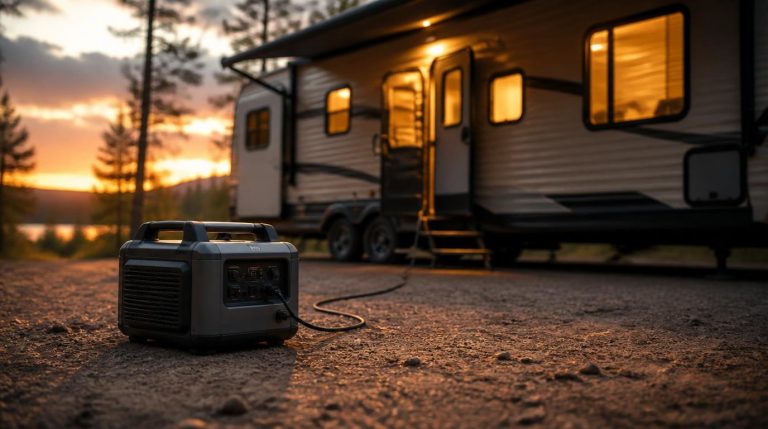
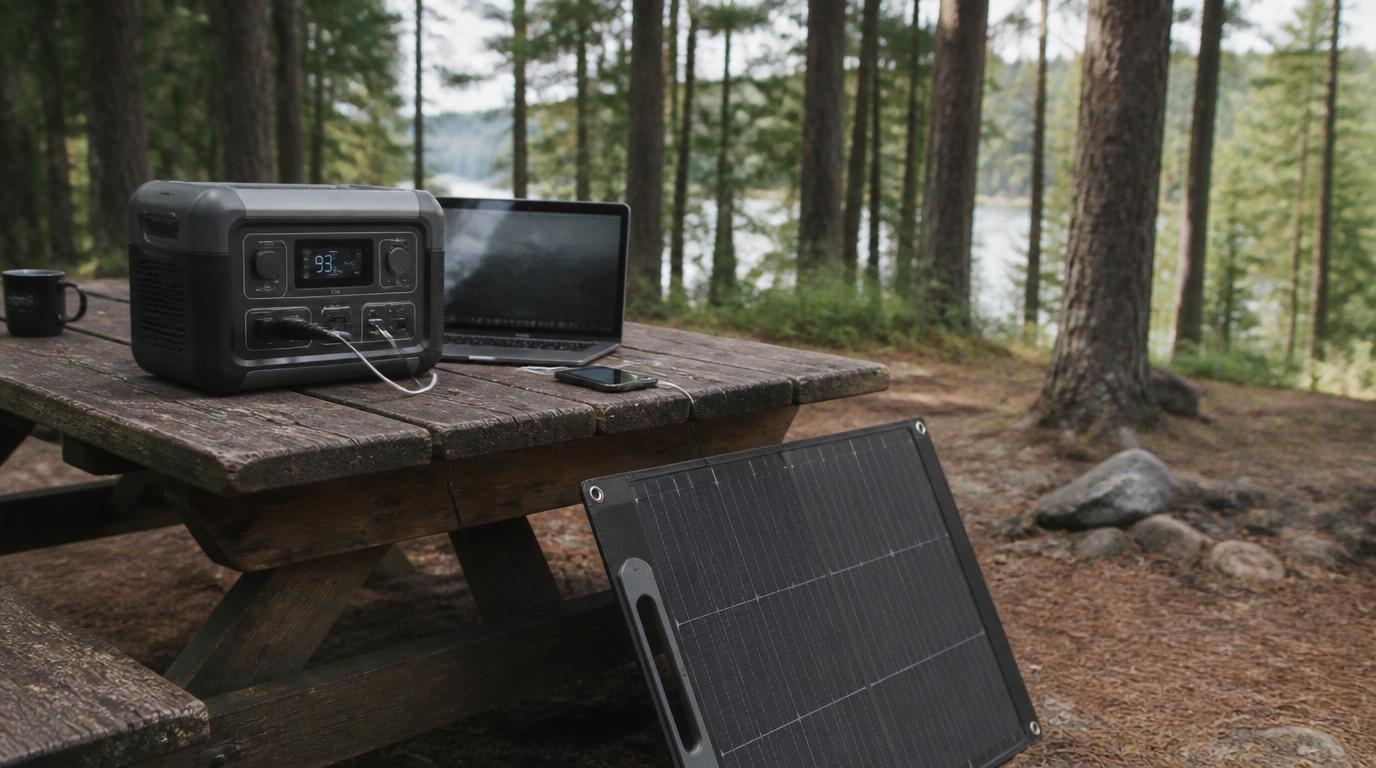
A portable power station is a self-contained unit that integrates three components into one enclosure: a battery (almost always lithium), an inverter that converts battery DC power to AC output, and a charge controller that manages incoming power from solar panels, wall outlets, or a car’s 12V port.
In a traditional RV electrical system, these three components are purchased and installed separately. The battery bank is wired into the RV’s 12V system. The inverter is connected to the battery bank and the RV’s AC panel. The charge controller sits between the solar panels and the battery. Each component is sized, matched, and installed for that specific rig.
A portable power station skips all of that. You pick it up, set it down, plug things into it, and charge it when it runs low. There is no installation, no wiring, no compatibility checking between components. The trade-off is that everything is fixed – you cannot expand the battery capacity, swap out the inverter, or upgrade the charge controller without buying a new unit.
What a portable power station is not: It is not a generator. It does not produce power from fuel – it stores power that was put into it from another source. Once the stored energy is depleted, it must be recharged before it can power anything else. This distinction matters enormously for understanding runtime and limitations.
How Portable Power Stations Work
Charging
A portable power station can be charged from three sources: a standard wall outlet (AC charging), solar panels connected via the unit’s solar input port, and a vehicle’s 12V outlet or cigarette lighter socket. Wall outlet charging is the fastest method and most practical when at home or at a campground with hookups. Solar charging is slower and depends on panel wattage, sunlight conditions, and the unit’s maximum solar input rating. Vehicle charging is the slowest method and primarily useful as a supplement during driving.
Most portable power stations have a maximum solar input rating of 150-600W depending on the model. This input ceiling determines how quickly the unit can recharge from panels – and limits how much a large-capacity unit can recover in a single day of solar production.
Storage
Capacity is measured in watt-hours (Wh). A 1,000Wh unit stores 1,000 watt-hours of energy. That is the ceiling on total power output before the unit needs recharging – accounting for inverter efficiency losses, which typically reduce usable output to around 85-90% of the rated capacity.
Lithium iron phosphate (LiFePO4) chemistry is now common in higher-quality portable power stations. LiFePO4 offers better cycle life (2,000-3,500 cycles), more stable discharge characteristics, and better safety than older lithium-ion chemistries. Budget units still use lithium-ion, which degrades faster and has a shorter usable lifespan.
Output
Portable power stations typically provide multiple output types: standard AC outlets (120V), USB-A and USB-C ports at various wattages, a 12V DC barrel output, and sometimes a car-style 12V cigarette lighter socket. The AC inverter is rated at a maximum continuous wattage – typically 1,000-3,000W depending on the unit – which determines the largest appliance the unit can power.
Portable Power Station vs. RV Battery System
The most important comparison for RV owners is between a portable power station and a properly installed RV battery system. These are not equivalent solutions at different price points – they serve different purposes with different trade-offs.
| Factor | Portable Power Station | Installed RV Battery System |
|---|---|---|
| Installation | None required | Wiring, fusing, mounting required |
| Expandability | Limited or none | Add batteries, panels, or inverter capacity |
| Integration | Standalone – not integrated with RV systems | Powers RV’s 12V and AC systems directly |
| Cost per usable Wh | Higher | Lower at larger capacity |
| Portability | Fully portable | Fixed in the RV |
| Powers RV appliances directly | Only via AC outlets – not 12V RV loads | Yes – both 12V and AC loads |
| Right for | Weekend use, small rigs, supplement power | Regular off-grid use, high consumption, integration |
The integration point is important and often misunderstood. An installed battery system powers the RV’s built-in 12V circuits – the lights, water pump, furnace fan, and refrigerator control board – directly through the RV’s wiring. A portable power station does not connect to these circuits. It powers devices plugged into its own outlets. If your RV’s water pump runs on 12V and you want to use it off-grid, a portable power station does not help unless you run an extension cord and use a 12V-to-plug adapter – an inelegant workaround that a proper battery system handles automatically.
For a detailed explanation of how RV battery systems work and how to size one, see the RV Batteries Guide. For specific portable power station recommendations organized by use case, see the Best RV Portable Power Stations guide.
Portable Power Station vs. Generator
Portable power stations are frequently described as “silent generators” in marketing materials. This framing is misleading enough to cause real purchase regret.
A generator produces power from fuel on demand. As long as there is fuel, it continues producing. Runtime is effectively unlimited with refueling. A portable power station stores a fixed amount of energy. When that energy is depleted, production stops until the unit is recharged – which takes time, whether from solar or a wall outlet.
A generator provides on-demand power recovery. A portable power station provides quiet, convenient power delivery until its stored capacity runs out. These are fundamentally different capabilities.
Where a portable power station genuinely outperforms a generator: silence, indoor usability, zero emissions, lower maintenance, and convenience for light to moderate loads. Where a generator is definitively superior: sustained high-draw loads (air conditioning), rapid battery recovery, and any situation where runtime matters more than noise or convenience.
The practical division for most RV owners: a portable power station handles day-to-day device charging, lighting, and small appliance use without noise or fuel cost. A generator handles air conditioning, emergency battery recovery, and situations where a cloudy week has depleted the main system. They complement each other – neither replaces the other for the use cases where the other excels.
For a full explanation of how generators fit into an RV power system, see the RV Generators Guide.
When Portable Power Stations Actually Make Sense
Weekend Campers
One to two nights off-grid with light consumption – device charging, a fan, LED lighting, maybe a small coffee maker. A 500-1,000Wh unit handles this comfortably and can be recharged at home between trips.
Van Life and Small Rigs
Builds where installation space is limited or the owner wants flexibility to remove or relocate the power source. A portable power station avoids the complexity of a full electrical installation while still providing meaningful off-grid capability.
Supplement to Existing System
Adding capacity to an existing installed system without rewiring. A portable unit can handle overflow loads – a workspace setup, camera gear charging, or a CPAP machine – without drawing from the main battery bank.
Occasional Off-Grid Use
Campers who primarily use hookups but occasionally camp without shore power for a night. A portable power station avoids the cost of a full battery system installation for use cases that do not justify it.
The common thread in all these scenarios is that consumption is light to moderate, the duration off-grid is short, and the simplicity of a no-install solution is genuinely valuable. When any of these conditions shift – higher consumption, longer off-grid stays, or heavier loads – the limitations of a portable power station become more consequential.
When Portable Power Stations Do NOT Make Sense
Running air conditioning. A standard RV rooftop air conditioner draws 1,200-1,800 watts continuously. A 1,000Wh portable power station running a 1,500W AC load would be depleted in under 40 minutes – and most units of that size cannot sustain 1,500W output continuously anyway. Portable power stations rated at 2,000-3,000W can physically run a small AC unit, but the runtime is so limited that it is not a practical solution for cooling. Generators and shore power are the correct tools for sustained air conditioning.
Extended boondocking with high daily consumption. If your daily consumption is 800Wh and you are camping off-grid for five days, you need a system that can reliably produce and store 800Wh per day across varying solar conditions. A portable power station with a 1,500Wh capacity and a 200W solar input ceiling cannot recover fast enough to sustain that load over multiple consecutive days of moderate sun. An integrated battery and solar system with appropriate capacity is the right solution for extended off-grid use.
Powering built-in RV systems. As noted above, a portable power station does not integrate with an RV’s 12V wiring. If you need to power built-in lights, a water pump, a furnace fan, or a built-in refrigerator through the RV’s existing wiring, a portable power station is the wrong solution. An installed battery bank is required.
Replacing a full electrical system. A portable power station is a convenience product with a fixed capacity ceiling. It cannot be expanded meaningfully, cannot be integrated into the RV’s electrical architecture, and does not scale with changing needs. Treating it as a substitute for a proper electrical system leads to limitations that become increasingly frustrating as usage patterns evolve.
How to Size a Portable Power Station
Sizing starts with the same calculation as any RV power system: how many watt-hours do you consume per day, and how long do you need to run without recharging?
List the devices you plan to power from the unit, find the wattage for each, and multiply by hours of daily use. Add a 20% buffer for efficiency losses and unexpected draw.
| Device | Typical Wattage | Runtime from 1,000Wh Unit |
|---|---|---|
| Smartphone charging | 18-25W | 40-55 hours |
| Laptop | 45-90W | 11-22 hours |
| LED lighting (small) | 10-20W | 50-100 hours |
| 12V portable fridge (small) | 40-60W average | 16-25 hours |
| CPAP (without humidifier) | 30-60W | 16-33 hours |
| Electric blanket | 60-100W | 10-16 hours |
| Microwave (small) | 700-1,000W | 1-1.4 hours |
| Hair dryer | 1,200-1,800W | 0.5-0.8 hours |
| Rooftop AC | 1,200-1,800W | 0.5-0.8 hours |
The runtime figures above assume 90% inverter efficiency and a fully charged unit. Real-world performance is typically slightly lower due to temperature effects on battery capacity, inverter losses at high loads, and battery degradation over time.
A practical sizing rule: calculate your expected daily consumption, multiply by 1.25 for efficiency margin, and look for a unit with at least that much capacity. For overnight use without recharging, you need at least one full day’s consumption stored. For two nights without recharging, double that.
Watt-hours vs. amp-hours: Some portable power stations are marketed with amp-hour ratings rather than watt-hour ratings. To convert: multiply amp-hours by the battery voltage. A unit with a 100Ah battery at 12V stores 1,200Wh. A unit with a 50Ah battery at 24V also stores 1,200Wh. Always compare in watt-hours to make meaningful capacity comparisons across units.
Charging and Solar Integration
Solar charging is one of the most promoted features of portable power stations – and one of the most frequently misunderstood in terms of real-world performance.
Every portable power station has a maximum solar input rating. This is the ceiling on how many watts of solar the unit can accept at any given time. A unit with a 200W solar input limit will not charge faster from 400W of panels than from 200W – the excess capacity is simply rejected. Before buying solar panels to pair with a portable power station, check the unit’s maximum solar input rating.
Recharge time from solar is longer than most buyers expect. A 1,000Wh unit with a 200W solar input limit, under realistic conditions of 4 peak sun hours and 80% efficiency, recovers about 640Wh per day. That is enough to sustain a light daily consumption load but not enough to recover a deeply depleted unit in a single day of moderate sun.
Wall outlet charging is significantly faster and should be the primary recharge method when available. Many modern portable power stations support fast AC charging that can refill the battery in 1-2 hours from a standard outlet. If you camp primarily on hookups and use the unit primarily for overnight off-grid stays, wall outlet charging between hookups is the most practical charging strategy.
For a full explanation of how solar charging works and how to size panels for any system, see the RV Solar Guide.
Common Mistakes
Treating a portable power station as a generator replacement. The most frequent source of purchase regret. A generator provides unlimited runtime with fuel. A portable power station provides a fixed energy reserve. For any use case where sustained power over hours or days matters – running AC through a hot afternoon, recovering a depleted system after a cloudy week – a generator handles it and a portable power station does not.
Buying too small for actual use. The appeal of a compact, lightweight 500Wh unit is real. The frustration of watching it deplete by mid-morning when running a portable fridge and charging multiple devices is also real. Size based on your actual expected daily consumption, not on the lightest or least expensive option that sounds plausible.
Ignoring recharge time. A 2,000Wh unit that takes 6-8 hours to recharge from solar is a different product than a 2,000Wh unit that recharges in 2 hours from a wall outlet. If you camp on hookups regularly, fast AC charging matters. If you rely heavily on solar recharging, the unit’s maximum solar input rating and your realistic peak sun hours determine whether the system can sustain daily consumption.
Overestimating solar input. Marketing images show portable power stations connected to solar panels in full sun at optimal angle. Real camping conditions include partial shade, non-optimal panel angles, morning and afternoon reduced irradiance, and clouds. Plan for 60-75% of the theoretical maximum solar input in typical conditions, not 100%.
Expecting it to power the RV’s built-in systems. A portable power station does not connect to an RV’s 12V wiring. Built-in lights, water pump, furnace fan, and other 12V loads continue to draw from the RV’s own battery bank. If that bank is depleted, a portable power station sitting on the dinette table does not help those systems – it only helps devices plugged directly into its own outlets.
Decision Summary
A portable power station is a convenience product, not a full electrical system. It handles light to moderate loads for short to medium durations without installation or fuel. It does not replace a generator for sustained high-draw loads, and it does not replace an installed battery system for powering an RV’s built-in 12V circuits.
It makes sense for weekend campers, small rigs, and supplemental use. If your consumption is light, your off-grid stays are short, and you value simplicity over expandability, a portable power station is the right tool. If you camp off-grid regularly for multiple days at a time with moderate to high consumption, an installed battery and solar system is the more appropriate solution.
Size based on real daily consumption, not aspirational minimalism. Calculate what you actually plan to run from the unit, add a 20-25% efficiency buffer, and size for the number of nights you need to go without recharging. Buying too small is the most common and most frustrating outcome.
Understand recharge time before buying. The unit’s capacity is only useful if you can replenish it between uses. Check the maximum solar input rating, the AC charging speed, and whether those numbers match how and where you plan to recharge.
Do not expect it to run air conditioning. AC loads exceed the practical runtime of any portable power station at a price point that makes sense for this category. Shore power and generators are the correct solutions for sustained cooling loads.
For specific product recommendations in each capacity category, see the Best RV Portable Power Stations guide. For how portable power stations fit alongside a full RV electrical system, see the Complete RV Electrical Guide. For how installed battery systems compare and how to size them, see the RV Batteries Guide. For solar charging fundamentals, see the RV Solar Guide. For when a generator is the right tool instead, see the RV Generators Guide.