RV Solar Guide
Solar panels are one of the most misunderstood purchases in the RV world. People buy panels before they understand their power consumption, install more wattage than their battery can store, and then wonder why they still run out of power after dark. Others undersize the system and cannot figure out why the battery never fully recovers.
The confusion comes from a few persistent myths: that more panels always means more power, that rated wattage is what you actually get, and that solar is a standalone solution rather than one part of a larger system. None of these are true.
This guide explains how RV solar systems actually work, what each component does, how to size a system for your real usage, and what mistakes to avoid before spending money. If you have not read the Complete RV Electrical Guide yet, start there – it covers the full system context that makes solar decisions easier to understand.
How RV Solar Systems Work
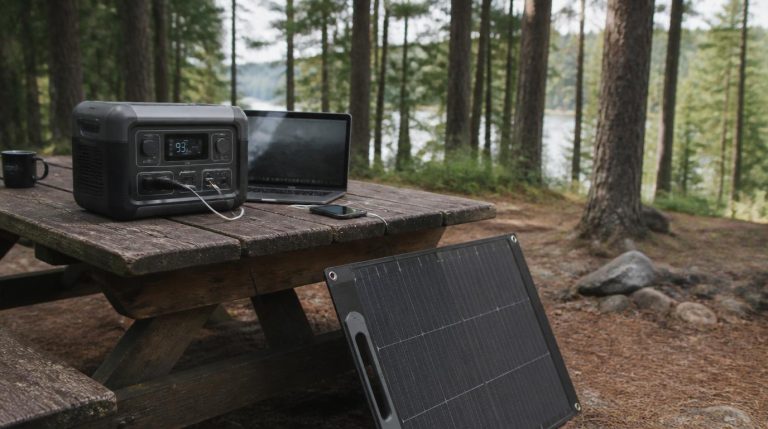
An RV solar system has one job: capture energy from sunlight during the day and store it in the battery bank so it can be used when the panels are not producing. That is the entire purpose. Solar does not power your lights directly – it charges your batteries, and your batteries power your lights.
The path from sunlight to usable power follows four steps:
Each step in this chain has limits. Panels are limited by sunlight and angle. The charge controller is limited by its rated amperage. The battery is limited by its usable capacity. If any one of these is undersized or mismatched, the whole system underperforms – regardless of how much you spent on the other components.
Solar is not a power source – it is a charging source. The battery is the power source. Everything depends on keeping that battery adequately charged.
Solar Components Explained
Solar Panels
Solar panels are rated in watts under Standard Test Conditions (STC) – a controlled lab environment with ideal temperature, angle, and irradiance. These conditions do not exist on a campground roof. Real-world output is typically 70-80% of the rated wattage, sometimes less.
A 200-watt panel does not produce 200 watts for the hours it is in sunlight. It produces a varying output that peaks near 200W around solar noon on a clear day, with lower output in the morning, late afternoon, and any time clouds reduce irradiance. For sizing purposes, a more realistic assumption is 75-85% of rated wattage as average peak output during direct sun hours.
Panel types – monocrystalline panels are the standard for RV use. They are more efficient per square foot than polycrystalline panels and perform better in high heat and low-light conditions. Flexible panels are available for curved or weight-sensitive roofs but degrade faster and are less efficient than rigid monocrystalline panels. For most RV applications, rigid monocrystalline panels are the practical choice.
Common misconception: The watts printed on the panel are the watts you get. In real conditions, expect consistently lower output. Size your system based on realistic production, not the label rating.
Charge Controllers
The charge controller is the component that sits between your panels and your battery. Its job is to take the raw output from the panels – which varies in voltage and current throughout the day – and regulate it into a safe, battery-appropriate charge profile. Without a charge controller, panels would overcharge and damage batteries.
There are two types, and the difference matters:
PWM (Pulse Width Modulation) controllers are simpler and less expensive. They work by connecting the panels directly to the battery when charging is needed, which pulls the panel voltage down to match the battery voltage. This is inefficient when the panel voltage is significantly higher than the battery voltage – energy that could be harvested is simply lost. PWM controllers are adequate for small, simple systems where the panel and battery voltages are closely matched.
MPPT (Maximum Power Point Tracking) controllers are more sophisticated and more expensive. They continuously find the panel’s optimal operating voltage and convert excess voltage into additional current delivered to the battery. In practical terms, MPPT controllers harvest 20-30% more energy from the same panels compared to PWM, especially in cold weather and with higher-voltage panel configurations. For any system with more than 200 watts of solar, MPPT is worth the cost.
Charge controllers are rated by their maximum input current (amps). The controller must be sized to handle the total amperage your panels can produce. Undersizing a controller is a common and limiting mistake – a controller that cannot handle the panel array’s output will cap production at its own rated limit, wasting the excess.
Common misconception: Any charge controller works with any panels and batteries. The controller must be sized and configured to match the specific panel voltage, panel amperage, and battery chemistry in your system. A mismatch reduces performance and can shorten battery life.
Wiring Basics
Wiring is not exciting, but it is where many DIY solar installations lose significant performance. Undersized wire creates resistance, which converts energy into heat instead of delivering it to the battery. The longer the wire run and the higher the current, the more this matters.
Wire gauge must be sized for the maximum current the circuit will carry, with an appropriate safety margin. The runs from panels to charge controller and from charge controller to battery should use appropriately rated wire based on distance and amperage. Most RV solar installations use 10 AWG wire for shorter panel-to-controller runs and heavier gauge for longer runs or higher-current systems.
Fuses or breakers must also be placed correctly – on the positive wire, close to the source – to protect against short circuits. A system without proper overcurrent protection is a fire risk.
The Battery Relationship
Solar panels produce power. Batteries store it. These two components must be sized in relation to each other, not independently. The battery capacity determines how much energy can be stored from a day of solar production. The solar array determines how quickly that storage can be replenished.
The charge controller must also be compatible with the battery chemistry. A controller set to an AGM charge profile will not correctly charge a lithium battery and vice versa. If you have lithium batteries, verify that your charge controller supports a lithium charge profile before purchasing. For more on battery types and their charging requirements, see the RV Batteries Guide.
The Solar and Battery Relationship
This is the section most solar guides skip, and it is the one that explains why so many solar setups underperform.
Solar without adequate battery storage is wasted energy. Battery without adequate solar input is a slow discharge with no recovery. Both failures are common, and both are avoidable with basic system planning.
When Solar Outpaces Battery
A battery can only absorb charge up to its capacity. Once it is full, it stops accepting current – even if the panels are still producing at peak output. A 400W solar array paired with a single 100Ah AGM battery (50Ah usable) will frequently fill the battery by mid-morning. Every watt produced after that point contributes nothing. The panels are running, the charge controller is working, but the energy is being rejected because there is nowhere to store it.
The solution is not to add more panels. It is to add more battery storage until capacity matches or exceeds what the panels can realistically produce in a day.
When Battery Outpaces Solar
The reverse problem is also common. A large battery bank with insufficient solar cannot recover between camping days. If you consume 150Ah per day and your panels only produce 60Ah on a typical overcast day, the bank depletes by 90Ah each day. After three days, you are running on the last reserves of a significantly depleted bank – and the panels are still not enough to pull it back up.
The solution here is either more solar, a generator for backup charging on low-production days, or a reduction in daily consumption. Usually some combination of all three.
The Practical Balance
A well-matched system produces roughly as much energy in a typical day as it consumes – with enough battery buffer to handle one or two low-production days before a generator run or hookup is needed. Getting to that balance requires knowing your daily consumption number and sizing both components around it.
How to Size Your RV Solar System
Step 1: Calculate Daily Consumption
Before choosing any solar component, you need your daily watt-hour consumption. List every device you use, find its wattage, and multiply by hours of daily use. Add them up.
A practical example for a moderate off-grid setup:
- 12V refrigerator: 45W x 10h = 450Wh
- LED lighting: 20W x 5h = 100Wh
- Furnace fan: 30W x 4h = 120Wh
- Water pump: 60W x 0.5h = 30Wh
- Device charging: 60W x 2h = 120Wh
Total: 820Wh per day. This is the number your solar system needs to reliably replenish each day under your typical camping conditions.
Step 2: Estimate Realistic Solar Output
Solar production is measured in peak sun hours (PSH) – the number of hours per day that sunlight is strong enough to equal the panel’s rated output. This varies significantly by location, season, and weather.
- Southwest US in summer: 5-6 PSH is typical
- Pacific Northwest or Northeast: 3-4 PSH is more realistic
- Winter camping at northern latitudes: 2-3 PSH or less
- Partly cloudy conditions: reduce any estimate by 30-50%
A 200W panel in a location with 4 peak sun hours produces approximately 200 x 4 x 0.80 (efficiency factor) = 640Wh per day under reasonable conditions. That is less than the 820Wh example above – meaning this system would run a daily deficit on an average day.
To reliably produce 820Wh per day with 4 PSH and an 80% efficiency factor, you need: 820 / (4 x 0.80) = approximately 256 watts of panels. Round up to 300W to build in margin.
Step 3: Match Panel Size to Battery Capacity
Once you have a panel wattage target, verify it makes sense relative to your battery bank. A general guideline: size solar to replenish your daily consumption within one to two days of good sun, and ensure the battery bank holds at least one to two full days of consumption as a buffer.
| Daily Use | Battery (Lithium) | Battery (AGM) | Solar (4 PSH) |
|---|---|---|---|
| 400Wh (~33Ah) | 50-100Ah | 100-200Ah | 100-150W |
| 800Wh (~67Ah) | 100-150Ah | 200-300Ah | 200-300W |
| 1,200Wh (~100Ah) | 150-200Ah | 300-400Ah | 300-400W |
| 1,600Wh+ (~133Ah+) | 200Ah+ | 400Ah+ | 400-600W+ |
These are starting points, not guarantees. Weather, shading, camping location, and seasonal sun angles all affect actual production. Build in margin and plan for a generator as backup for extended low-production periods.
Real RV Solar Scenarios
Weekend Use
Lights, device charging, water pump. No 12V fridge. 100W panel and 100Ah lithium (or 200Ah AGM) is typically adequate. Simple, low-cost entry point.
Moderate Off-Grid
12V fridge, lights, fans, devices. One to three nights without hookups. 200-300W solar and 100-150Ah lithium (or 200-300Ah AGM). MPPT controller recommended.
Full Boondocking
Extended off-grid stays, inverter use, high consumption. 400-600W solar, 200Ah+ lithium, properly sized MPPT controller. Generator for backup on cloudy stretches.
The right scenario depends on how you actually camp, not how you imagine you might camp. Oversizing a system for aspirational use that never materializes is an expensive mistake. Undersizing for actual use is a frustrating one. Start with an honest consumption estimate and build from there.
What Most People Get Wrong
Overestimating panel output. Rated wattage is a lab number. Real-world output is lower – reduced by heat, angle, partial shading, morning and afternoon sun angles, and anything less than perfect sky conditions. Basing a system design on the number printed on the panel leads to a system that chronically underperforms expectations.
Undersizing the battery. Solar can only do its job if there is enough battery capacity to absorb what the panels produce and store it until it is needed. A small battery fills quickly, wastes midday production, and depletes overnight before the panels can recover it the next day. The battery bank is where most people underinvest, and it is where underinvestment has the most impact on daily usability.
Ignoring shading. Solar panels are sensitive to shading in ways that are not intuitive. Most panels are wired in series, which means one shaded cell reduces the output of the entire string – not just the shaded panel. A single tree branch across one corner of a panel can cut system output by 50% or more. Roof vents, AC units, and antennas all cast shadows that move throughout the day. Before designing a roof layout, spend time observing what shades the roof and when.
Buying panels before knowing consumption. This is the most common sequence error. People choose a panel size – often 200W because it sounds reasonable – before calculating what they actually use. The result is a system that may be significantly over or undersized for the actual load.
Using a PWM controller with a large array. A PWM controller on a 300W or 400W system leaves a significant amount of potential energy on the table every day. The cost difference between a PWM and MPPT controller is modest relative to the value of the additional harvest over months and years of use.
RV Solar Limitations
Weather and Seasonal Variation
Solar output varies dramatically with weather and season. A system sized for summer camping in Arizona will be inadequate for the same rig in Oregon in November. Extended cloudy weather – multiple consecutive days without significant sun – depletes even a well-sized battery bank. Any serious off-grid setup should treat a generator as a necessary complement to solar, not an admission of failure. Solar handles day-to-day energy needs in good conditions. A generator handles recovery after extended low-production periods.
Panel Angle
Flat-mounted roof panels – the most common RV installation – are optimized for summer camping at lower latitudes where the sun is high in the sky. As the sun moves lower in the sky (fall, winter, higher latitudes), the angle of incidence increases and output drops. Tilting panels toward the sun can meaningfully improve output, but most RV roofs do not accommodate adjustable mounts easily. This is worth considering when sizing a system intended for year-round or northern camping.
Roof Space and Weight
RV roofs are finite. Between air conditioners, vents, skylights, antennas, and existing equipment, the available unshaded roof space for panels is often smaller than it looks. Before sizing a system, physically measure the available clear roof space and account for shading from any raised equipment. Weight is also a practical constraint – roof-mounted panels add load to the roof structure, and heavier panel arrays may require reinforcement on older or lighter RVs.
Solar Cannot Run Air Conditioning
This is worth stating directly. A standard rooftop RV air conditioner draws 1,200-1,800 watts while running. Running one for several hours requires more solar and battery capacity than the vast majority of RV systems have. Solar can help offset the power demand of a small portable AC unit in some configurations, but expecting solar to power air conditioning through the afternoon is not realistic for most setups. Generator or shore power is the appropriate solution for high-draw appliances like AC.
Decision Summary
Calculate consumption before buying anything. Your daily watt-hour number is the input everything else depends on. Without it, any panel or battery size is a guess.
Size battery and solar together. Solar replenishes the battery. The battery stores what solar produces. These two components only make sense when sized in relation to each other. A large panel array on a small battery bank wastes energy. A large battery with minimal solar never recovers.
Use realistic production numbers. Assume 75-85% of rated panel wattage, and 3-5 peak sun hours depending on your location and season. Size the system to meet daily consumption under these realistic conditions, not ideal ones.
Choose MPPT over PWM for any system above 200W. The additional harvest pays for the cost difference relatively quickly, and the efficiency advantage compounds over years of use.
Plan for backup charging. A generator is not a failure of the solar system – it is the practical solution for extended low-production periods. Design the solar system to handle typical conditions and size the generator to handle recovery from unusual ones.
Do not overbuild for conditions you rarely camp in. A system sized for full-time desert boondocking is expensive and unnecessary for someone who occasionally dry camps for a night at a time. Match the system to how you actually use it.
For a full understanding of how solar fits into the complete RV electrical system, see the Complete RV Electrical Guide. For guidance on selecting and sizing the battery bank that pairs with your solar setup, see the RV Batteries Guide. For specific solar product recommendations organized by use case, see the Best RV Solar guide.