RV Surge Protector Guide
RV Surge Protector Guide How RV Electrical Protection Actually Works
Most RV owners assume that plugging into a campground pedestal is safe. The pedestal is there, the power is on, and nothing obviously wrong is visible. This assumption is incorrect often enough to matter. Campground electrical pedestals are frequently miswired, undervoltaged, or subject to conditions that can damage RV appliances within minutes of connection – without any visible warning to the person plugging in.
Surge protection and electrical management are not premium accessories for cautious owners. They are the only layer of defense between your RV’s electrical system and the unpredictability of campground power infrastructure. A single bad pedestal connection can damage an air conditioner compressor, a converter, or a refrigerator control board – each representing hundreds to thousands of dollars in repair or replacement costs.
The cost of a quality EMS is a fraction of the cost of a single damaged appliance. For anyone who plugs into shore power with any regularity, electrical protection is not optional.
This guide explains what actually goes wrong at campground pedestals, what the different protection devices do and do not protect against, and how to use them correctly. For broader context on how shore power works in an RV electrical system, see the Complete RV Electrical Guide.
What Can Go Wrong at a Campground
Campground electrical infrastructure ranges from well-maintained modern installations to decades-old wiring that has been repaired piecemeal by maintenance staff of varying qualification. The pedestal that looks functional from the outside may have any number of problems inside – and none of them announce themselves visibly.
Low Voltage
When a campground is at capacity and demand is high, voltage can drop below safe operating range – sometimes well below 110V on a nominal 120V circuit. Air conditioner compressors are particularly vulnerable: they draw higher current at low voltage and overheat. Sustained low voltage damages motors and compressors in ways that may not be immediately apparent but shorten lifespan significantly.
High Voltage
Less common than low voltage but more immediately destructive. Voltage above 130V can damage sensitive electronics, burn out appliance components, and create fire risk. High voltage events can result from utility grid problems, a failed transformer, or wiring errors that connect a higher-voltage circuit to a pedestal rated for lower voltage.
Miswired Pedestal
A pedestal where the hot and neutral wires are reversed, or where the ground is missing or incorrectly connected, can energize the chassis of an RV and create shock hazard at any metal surface. Open ground conditions also allow surge energy to flow through equipment rather than safely to ground. Miswiring is more common than most RV owners assume – studies of campground pedestals have found wiring errors in a meaningful percentage of sites tested.
Open Neutral
In a 50-amp system, an open neutral – a broken or missing neutral connection – causes voltage to redistribute unevenly between the two 120V legs. One leg may see 80V while the other sees 160V. Appliances connected to the high-voltage leg can be destroyed almost instantly. Open neutral is among the most dangerous conditions a 50-amp RV can encounter at a pedestal.
Reverse polarity is another common wiring error where the hot and neutral wires are swapped at the outlet. While some appliances continue to function with reversed polarity, the chassis of the RV may become energized, and protection devices designed to interrupt the hot wire will not function correctly. A device that detects and refuses to connect under reverse polarity conditions is a meaningful safety feature.
What a Basic Surge Protector Actually Does
A basic surge protector – the type sold at hardware stores and many RV retailers – contains metal oxide varistors (MOVs). These components absorb energy from brief, high-voltage transients (surges) by diverting excess voltage to ground. When a lightning strike hits a nearby transformer, or when a large motor in the campground’s system switches off and creates a voltage spike, the MOVs absorb that spike before it reaches the RV’s electrical system.
This is useful protection. Voltage transients are real and do occur. But basic surge protection has limits that many owners do not understand until after a damage event.
What a basic surge protector does not do:
- It does not monitor ongoing voltage levels. If the pedestal delivers sustained low or high voltage (not a brief spike), the protector does not intervene.
- It does not detect wiring problems. Miswiring, open neutral, open ground, and reverse polarity conditions are invisible to a basic surge protector.
- It does not disconnect the RV from a problem pedestal. It absorbs brief transients and passes through everything else.
- MOVs degrade with each surge absorbed and eventually fail – often without visible indication. A surge protector that has absorbed several large events may provide little actual protection while appearing functional.
A basic surge protector is better than nothing, but it does not protect against the most common and damaging campground electrical problems.
EMS vs. Basic Surge Protector
Basic Surge Protector
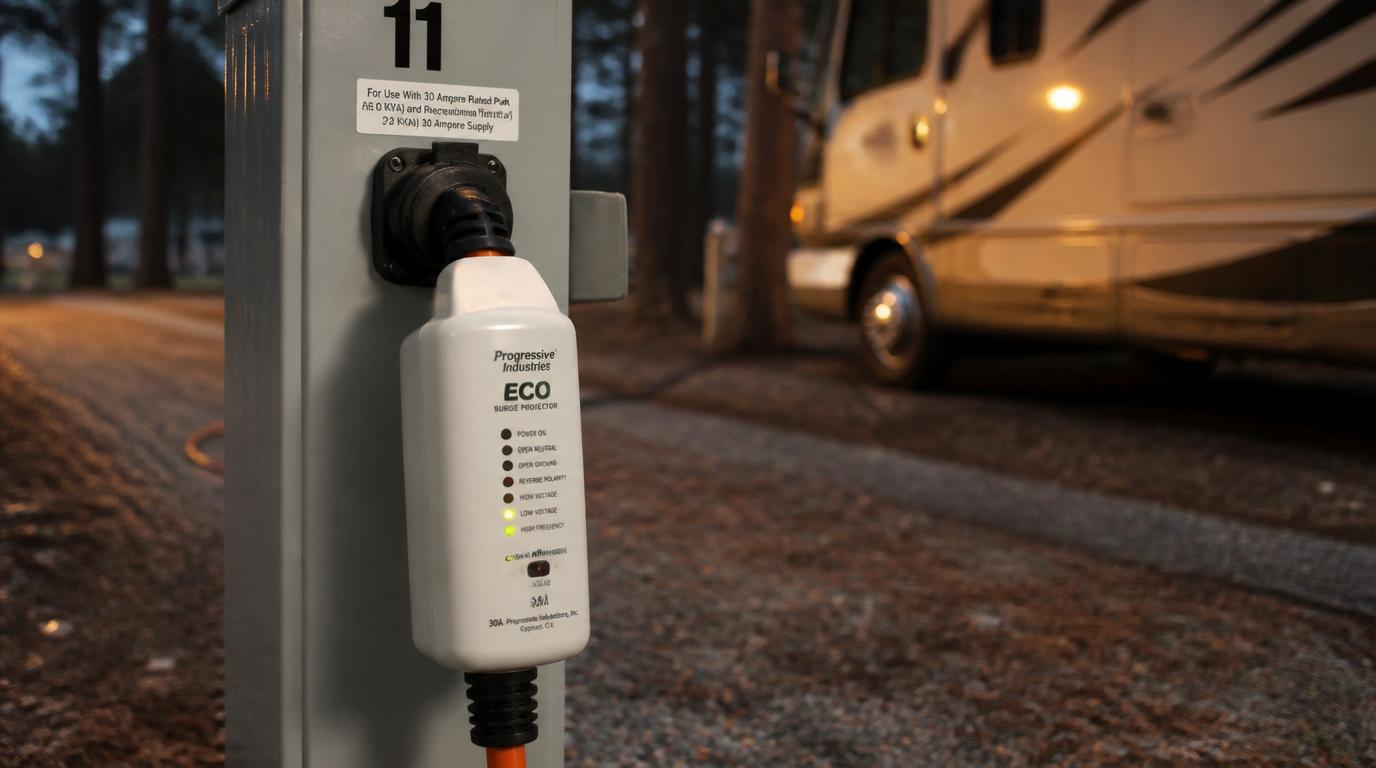
A basic surge protector connects inline between the pedestal and the RV. It contains MOV components that handle transient voltage spikes. It typically includes indicator lights showing that the device is connected and that the basic wiring configuration appears normal (hot, neutral, and ground present). It does not monitor ongoing voltage, does not detect all wiring errors, and does not automatically disconnect from a problem power source.
Cost: typically $30-80. Appropriate for: budget-constrained buyers who need some protection and camp primarily at well-maintained campgrounds. Not appropriate for: anyone who camps regularly at older parks, unknown sites, or wants genuine protection against the full range of campground electrical hazards.
EMS (Electrical Management System)
An EMS is a more capable device that monitors incoming power continuously and responds to problems that a basic surge protector ignores. The core functions that distinguish an EMS from a basic protector:
- Continuous voltage monitoring: The EMS watches line voltage throughout the connection and disconnects automatically if voltage falls outside a safe operating range – typically below 102V or above 132V for a 120V system.
- Wiring fault detection: Quality EMS units detect open neutral, open ground, reverse polarity, and other wiring errors at the pedestal before allowing the RV to connect. If a wiring fault is present, the EMS prevents connection entirely and displays a diagnostic code indicating the problem.
- Automatic reconnection: After a voltage excursion that caused disconnection, the EMS monitors the line and reconnects automatically once voltage returns to safe range – with a brief time delay to prevent rapid cycling.
- Surge absorption: An EMS also includes surge protection for transient spikes, covering the same events a basic protector handles.
| Protection Feature | Basic Surge Protector | EMS |
|---|---|---|
| Transient voltage spikes | Yes | Yes |
| Sustained low voltage | No | Yes – disconnects |
| Sustained high voltage | No | Yes – disconnects |
| Open neutral detection | No | Yes – blocks connection |
| Open ground detection | Partial | Yes – blocks connection |
| Reverse polarity detection | Partial | Yes – blocks connection |
| Automatic reconnection | No | Yes |
| Typical cost | $30 – $80 | $150 – $350+ |
EMS units come in portable (plugged between pedestal and RV) and hardwired (installed in the RV’s electrical panel) versions. Portable units offer the same protection at lower cost and can be moved between rigs. Hardwired units are more secure – a portable unit can be stolen – and integrate into the RV’s electrical system more cleanly. The protection level is equivalent between the two formats; the choice is primarily about security and installation preference.
For specific product recommendations in each category, see the Best RV Surge Protectors guide.
How RV Electrical Damage Actually Happens
Understanding the damage mechanisms makes the value of an EMS concrete rather than theoretical.
Air Conditioner Compressors
The compressor in a rooftop AC unit is the most expensive single component in most RVs and the most vulnerable to power quality problems. At low voltage, the compressor motor draws higher current to maintain torque. That excess current generates heat. Over time – and sometimes within a single connection event – the heat damages motor windings, causing either immediate failure or a shortened lifespan that results in premature compressor failure months later. A replacement compressor or full AC unit replacement runs $500-1,500 or more depending on the unit.
Converters and Inverter/Chargers
The converter charges the 12V battery bank from shore power. Inverter/chargers do the same and also invert battery power to AC. Both contain sensitive electronics that are vulnerable to sustained high voltage and to power quality problems. A voltage excursion that causes component failure in a converter or inverter/charger typically requires complete unit replacement – a cost of $150-600 for a basic converter, or $500-1,500+ for an inverter/charger.
Refrigerators and Control Boards
Modern RV refrigerators and virtually all RV appliances built in the last 15 years contain electronic control boards. These boards are sensitive to voltage anomalies that older purely mechanical appliances would have tolerated. A control board failure from a power event typically costs $100-400 to replace – and requires sourcing a part that may not be readily available for older or less common appliance models.
Electronics and Devices
Laptops, televisions, phone chargers, and other electronics plugged into AC outlets are vulnerable to both transient spikes and sustained overvoltage. A voltage spike that reaches plugged-in devices can destroy them instantly. A sustained high-voltage condition can degrade or destroy power supplies and components more gradually.
When You Actually Need Protection
The short answer: any time you connect to shore power. But the need is more acute in specific situations.
Older campgrounds and RV parks. Infrastructure installed decades ago and maintained with varying levels of care is more likely to have wiring issues, inadequate capacity, and voltage regulation problems. State parks with aging electrical systems, small private parks, and fairgrounds used occasionally as RV sites are higher-risk environments than newer campgrounds with modern electrical infrastructure.
Unknown or unfamiliar sites. Connecting to a pedestal you have never used before means connecting to an unknown quantity. A site that looks well-maintained can still have a wiring error that has gone undetected for years. The first connection is always the highest-risk moment.
Campgrounds at peak capacity. When every site is occupied and demand is high, voltage drops. If the campground’s electrical infrastructure is not sized for full occupancy – which is common at older parks – voltage can fall far enough to damage motor-driven appliances in a sustained way that a basic surge protector does nothing about.
Extended stays. The longer the connection, the longer the exposure window for any ongoing voltage problem. A brief low-voltage event on a one-night stay may not cause damage. The same condition maintained over a week-long stay is far more likely to cause cumulative damage to compressor motors and electronics.
Any connection, full stop. The campground you have visited for years with no problems has a pedestal that could develop a wiring fault between your last visit and your next. Protection is not just for obviously risky environments – it is for every connection, because the risks are invisible until they cause damage.
Common Mistakes
Skipping protection entirely. The most common and most consequential mistake. Many RV owners camp for years without protection and experience no problems, which reinforces the belief that protection is unnecessary. This logic confuses absence of damage with absence of risk. A single bad pedestal connection can produce repair costs that dwarf the cost of an EMS purchased years earlier.
Buying the cheapest option available. A $20 basic surge protector from a hardware store provides minimal protection against a narrow range of events. It does not monitor voltage, does not detect wiring faults, and its MOVs degrade with use. The cost difference between a basic surge protector and a quality EMS is modest relative to the repair costs it prevents.
Assuming a familiar campground is safe. Electrical conditions at a pedestal can change between visits. A tree root that shifts underground wiring, a previous camper who damaged the pedestal, a maintenance error during routine servicing – any of these can introduce a wiring problem between your last stay and your next. Familiarity is not protection.
Misunderstanding what is protected. A surge protector between the pedestal and the RV protects appliances connected to the RV’s AC system. It does not protect devices plugged into extension cords run directly from the pedestal, or devices connected to circuits that bypass the protection device. Everything that needs protection must be downstream of the EMS.
Leaving a portable EMS unattended and unsecured. Portable EMS units are an attractive theft target at campgrounds. A unit left plugged in at an unattended site can be removed easily. Lock cables, security covers, and hardwired units all address this. A stolen EMS is not protecting anything.
Safety and Best Practices
Connect in the Correct Order
The correct connection sequence matters for safety. Connect the EMS or surge protector to the RV first, then plug into the pedestal. This ensures the protection device is in the circuit before power is applied and that any wiring fault detection occurs before the RV’s system is energized. Disconnect in reverse: unplug from the pedestal first, then disconnect from the RV.
Read the Diagnostic Display
Quality EMS units display the incoming voltage and indicate any detected wiring faults before allowing connection. Read the display before walking away from the hookup. If the device is indicating a fault, do not override it or assume it is a false alarm. Report the issue to the campground office and request a different site. Continuing to use a flagged pedestal defeats the purpose of having protection.
Monitor Voltage During Your Stay
Some EMS units display current voltage continuously. Checking the voltage during high-demand periods – weekend afternoons when the campground is at capacity – gives useful information about the park’s electrical health. Sustained readings below 108V or above 126V on a 120V circuit warrant attention. If voltage regularly drops during peak hours, consider limiting use of high-draw appliances (particularly the air conditioner compressor) during those periods.
Do Not Use a Damaged or Degraded Device
A surge protector or EMS that has absorbed a significant voltage event – indicated by a warning light, a blown indicator, or confirmed by the device’s self-diagnostic – should be replaced before relying on it for protection. MOVs that have sacrificed themselves in a large surge event may provide no meaningful protection in a subsequent event. Many quality EMS units include indicators that show when the protection capacity has been compromised.
Decision Summary
Use an EMS, not a basic surge protector. The cost difference is modest. The protection difference is substantial. A basic surge protector handles transient spikes. An EMS handles the full range of campground electrical hazards including sustained voltage problems and wiring faults – which are more common and more damaging than transient spikes alone.
Protection is for every connection, not just sketchy campgrounds. Electrical faults are invisible and can develop at any pedestal between visits. The campground you have used safely for years is not guaranteed to be safe on the next stay. Connect with protection every time.
Read the EMS before walking away from hookup. The diagnostic display is the only way to know if the pedestal has a problem. A device indicating a fault before connection has done its job. Follow through by reporting the issue and requesting a different site.
A hardwired EMS eliminates the theft risk. If security is a concern – camping in areas where theft is more likely, or leaving the RV unattended for extended periods – a hardwired unit installed in the electrical panel is the more secure option. The protection level is equivalent to a quality portable unit.
The cost math is simple. A quality EMS costs $150-350. A single air conditioner compressor replacement costs $500-1,500. One avoided damage event pays for the EMS many times over. There is no reasonable argument for skipping protection if you connect to shore power with any regularity.
For specific EMS and surge protector recommendations organized by use case, see the Best RV Surge Protectors guide. For a broader understanding of how shore power works in an RV electrical system, see the Complete RV Electrical Guide. For how generators interact with RV electrical systems as an alternative or supplement to shore power, see the RV Generators Guide. For how batteries and charging systems are affected by power quality, see the RV Batteries Guide.