RV Kitchen & Cooking Gear Guide
Why RV Kitchen Expectations Usually Miss the Mark
Most people stock their RV kitchen the same way they stock a home kitchen. They bring a full set of pots and pans, a countertop appliance or two, a drawer full of gadgets, and then wonder why nothing fits and the fuses keep tripping. The problem is not effort – it is the mental model. An RV kitchen is not a smaller home kitchen. It is a fundamentally different type of space with its own rules.
This guide is not a product roundup. It is a decision framework. Before you buy anything or pack anything, you need to understand what actually constrains RV cooking – and those constraints are not the ones most people focus on first.
Why RV Kitchens Are Different
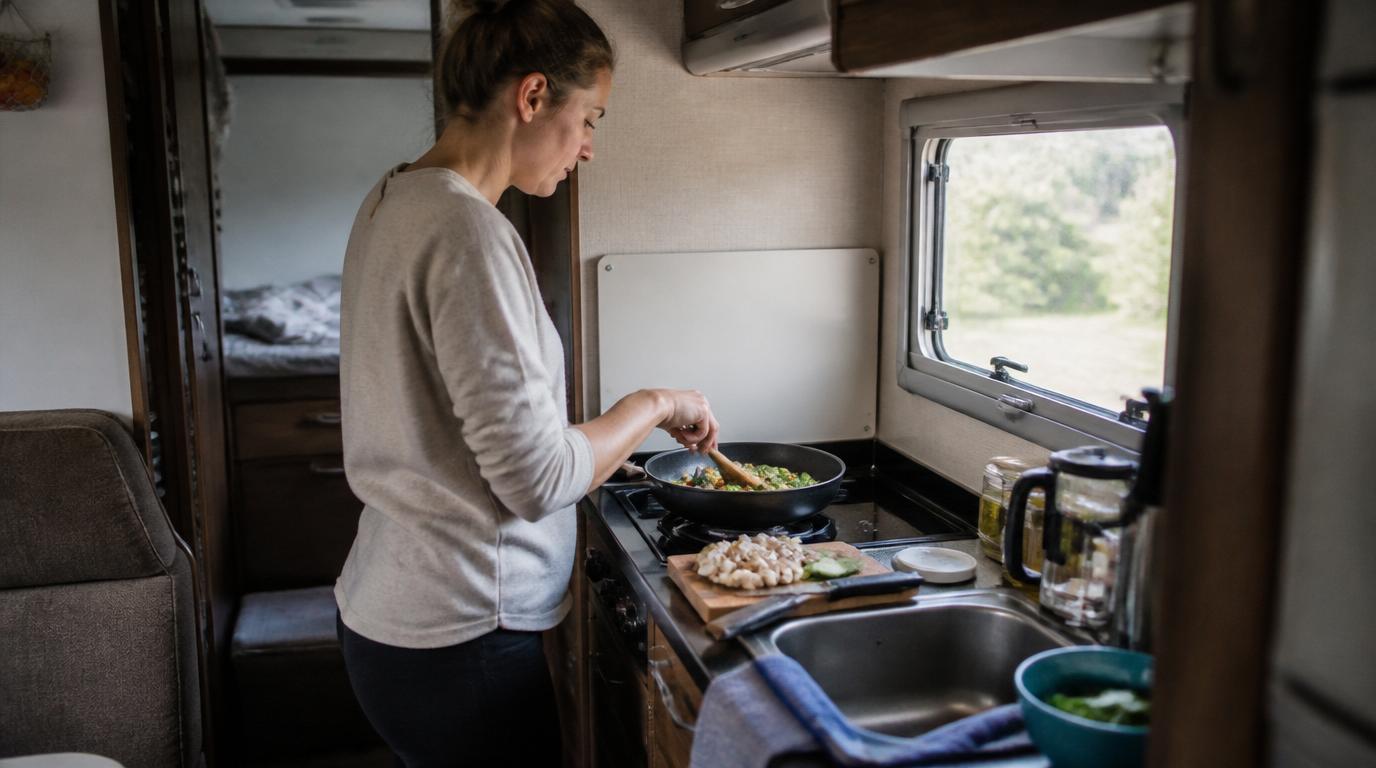
The gap between a residential kitchen and an RV kitchen is wider than it looks on a showroom floor. Four constraints define everything else.
Limited Counter Space
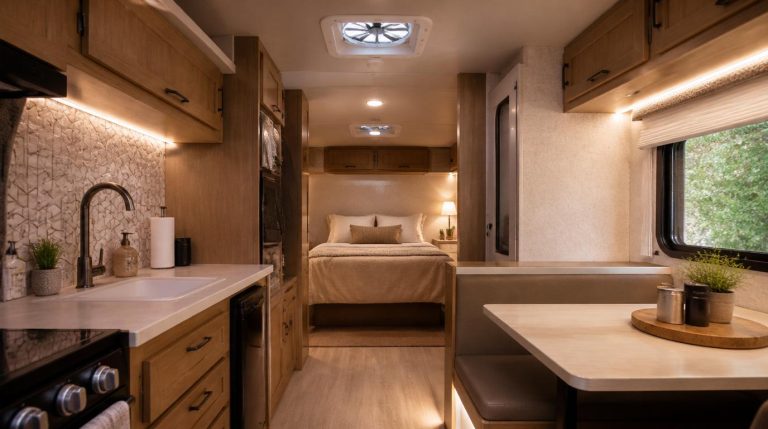
Even a well-designed Class A galley kitchen gives you a fraction of home counter space. In a travel trailer or Class B van, you may have one continuous surface roughly the size of a TV tray. That space has to serve as prep area, staging area, and temporary storage all at once. Everything you put on that counter permanently is space you cannot use to cook.
Limited Storage
RV cabinets are shallow, oddly shaped, and frequently interrupted by plumbing, wiring runs, or slide mechanisms. Standard kitchen storage logic – stacking things vertically, using deep drawers, hanging items on walls – often does not apply. What fits in the cabinet showroom model does not always fit once you are living in the rig.
Power Constraints
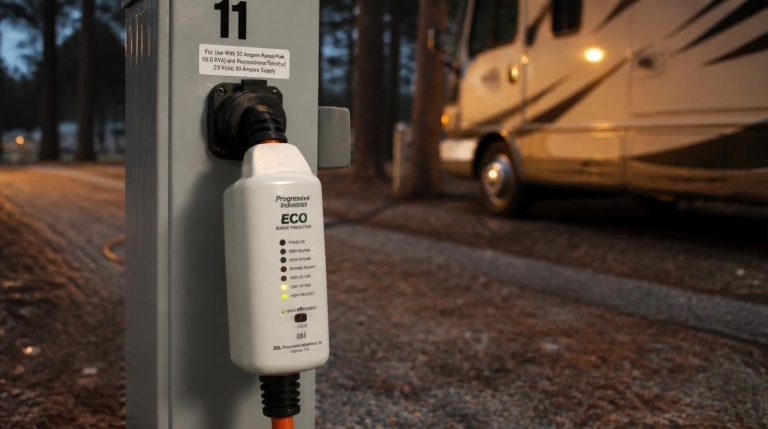
A 30-amp service connection gives you roughly 3,600 watts of total available power across your entire rig. That sounds like a lot until you account for the air conditioner (1,500 watts), the refrigerator cycling on, and the water heater. A 50-amp service doubles the ceiling, but you are still running a shared electrical budget across every device in the coach. High-draw cooking appliances compete directly with climate control, and climate control usually wins by necessity.
Water and Cleanup
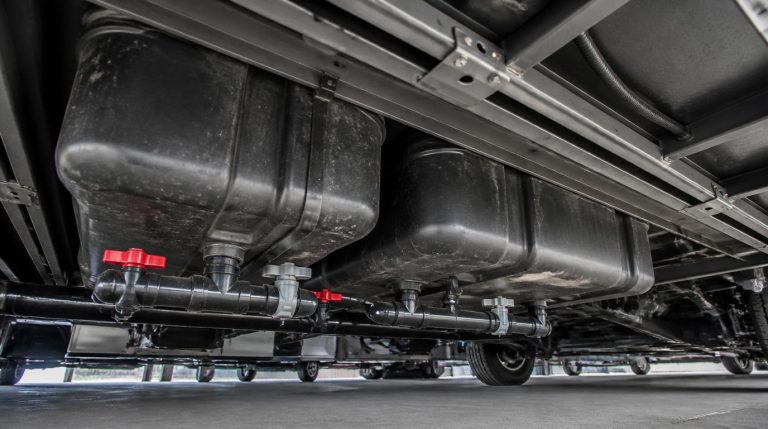
A fresh water tank of 30 to 50 gallons sounds reasonable until you factor in drinking, showering, and toilet use. Washing a full set of pots and pans after every meal depletes that supply faster than most new RVers expect. This is one reason meal complexity directly affects your water budget.
Space and Storage Constraints
The single most common packing mistake is bringing full-size kitchen items and assuming they will fit somewhere. They will not – or if they do, they will crowd out things you actually need every day.
RV cabinet openings are often narrower than the items they appear to be sized for. A cabinet that looks like it holds a full stockpot may have a shelf brace or a wiring chase that cuts the usable depth in half. Measure before you pack, and measure the opening, not the interior.
The practical principle here is straightforward: every item you bring should do at least two jobs. A Dutch oven that works on the stovetop and in a camp oven earns its space. A unitasker gadget – a quesadilla maker, a dedicated egg cooker, a single-use steamer basket – usually does not. The Best RV Cookware Guide goes deeper on this, but the starting point is always asking whether an item can replace something rather than adding to the pile.
Nesting and stackability are not optional features – they are the baseline. Bowls that nest, pots that stack inside each other, lids that share sizes across multiple pots – these details determine whether your cabinet closes at the end of the day.
Power and Appliance Reality
Every appliance you plug in draws watts. Every watt comes from a shared budget. This is the constraint that catches new RVers most off guard, because at home there is effectively unlimited power available for the kitchen. In an RV, there is not.
Instant Pots, air fryers, and electric skillets all draw 1,000 to 1,800 watts. A microwave draws 900 to 1,200. Run two of these simultaneously on a 30-amp connection while the AC is cycling, and you will trip the breaker. On a 50-amp connection you have more room, but you are still making tradeoffs.
The practical consequence is this: choose one high-draw appliance and use it intentionally. Many experienced RVers land on either a quality microwave with convection capability or a single multi-function electric appliance – not both. The ones who bring three or four high-draw options typically end up using only one anyway, because the others trip breakers or simply take up too much space to be practical.
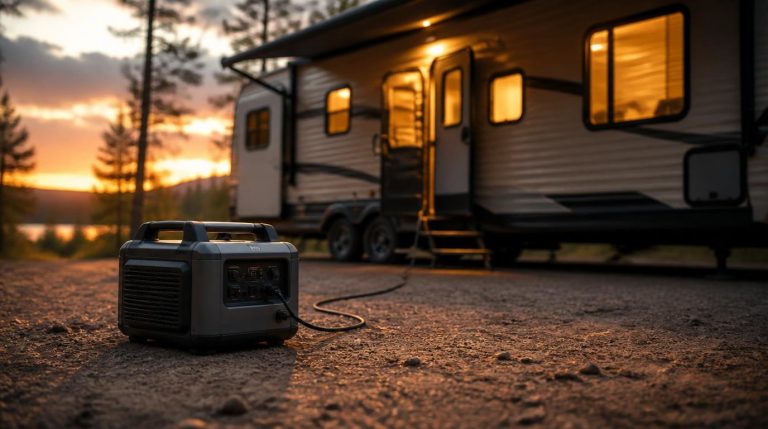
When you are on battery power only – boondocking, dry camping, or parked without hookups – even a 1,000-watt appliance becomes a significant drain. This is the scenario where gas cooking stops being optional and starts being essential.
Cookware That Actually Works in RVs
The cookware that works best in an RV shares a few consistent traits. It is compact or nesting. It is versatile across heat sources. It is easy to clean without a lot of water. And it does not require specialized tools or accessories to use.
A two or three-piece nesting set – typically a small and medium pot with a shared lid – handles most cooking tasks. Add a 10-inch skillet with a lid that fits one of those pots, and you have covered the majority of meals. That is three or four items doing the work of eight or ten single-purpose pieces.
Cast iron is popular in RV communities, and it is genuinely useful, but it comes with real tradeoffs. It is heavy – a 12-inch cast iron skillet can weigh over five pounds, which matters when you are managing weight distribution. It also requires specific care that is harder to maintain on the road. Enameled cast iron splits the difference somewhat. Hard-anodized aluminum or stainless steel with a thick base handles most of the same tasks at half the weight.
For a detailed look at specific cookware that translates well to RV use – including material tradeoffs and practical sizing – see the Best RV Cookware Guide.
Cooking vs Reheating: Know the Difference
There is a meaningful difference between actually cooking in your RV and reheating food you prepared elsewhere – and that difference should drive your gear decisions.
Full cooking means fresh ingredients, multiple steps, active heat management, and significant cleanup. Reheating means leftovers, prepped meals, or simple assembly with minimal heat. Neither is wrong. But if your actual travel pattern involves eating out frequently, stopping at grocery deli sections, or batch cooking before a trip and reheating on the road, your kitchen setup should reflect that reality.
A microwave and a single good skillet covers almost everything in a reheating-focused setup. A full cooking setup needs more: a functional stovetop, proper ventilation, adequate workspace, and time built into the travel day. Most people fall somewhere in between, and the honest question is which direction you actually lean – not which direction you wish you leaned.
Indoor vs Outdoor Cooking
Outdoor cooking is one of the most underutilized tools in an RV kitchen strategy, and it solves several problems at once.
Cooking inside an RV generates heat and moisture. In warm weather, that directly competes with the air conditioner. In any weather, it adds humidity to a sealed space already prone to condensation issues. A propane grill or a camp stove outside moves that heat and moisture out of the equation entirely.
Propane is also not subject to the same electrical constraints as high-draw appliances. A camp stove running on a one-pound canister or connected to the RV’s propane supply gives you consistent, reliable high heat without touching your electrical budget. For boondocking situations especially, outdoor cooking is often the most practical path to a real meal. If you are researching which grill or camp stove setup fits your rig and travel style, the Best RV Camping Grills Guide covers the main options in practical terms.
The limitation is weather and setting. You cannot always cook outside – campground rules vary, rain and wind make it difficult, and some situations call for a quick indoor meal. The practical approach is to treat outdoor cooking as the primary method when conditions allow, and indoor cooking as the backup rather than the other way around.
Water and Cleanup Constraints
Water management is directly tied to how you cook. Complex meals with multiple pots, pans, and prep tools require significant cleanup. Cleanup requires water. Water is finite on the road.
A single-pot or single-pan meal approach is not a sacrifice – it is an adaptation. Sheet pan meals, one-pot pasta dishes, stir-fries, and foil packet cooking all produce real food with minimal cleanup. These are not lesser meals; they are smarter meals for the context.
Paper towels earn their space in an RV kitchen because they handle a lot of the light cleanup that at home you might do with a damp cloth or a rinsed dish. Silicone cutting mats that can be wiped clean and used as trivets or plate stands reduce the number of separate items in circulation. The general principle is to minimize the number of things that need washing after every meal.
Dish soap, a small wash basin, and a clean rinse method – many RVers use a spray bottle or a small secondary basin – handle most cleanup needs without running the tap continuously.
What Actually Improves RV Cooking
After accounting for all the constraints, the honest list of things that genuinely make RV cooking better is short.
- Fewer, better tools. One quality skillet beats three mediocre ones. One sharp knife beats a block of dull ones. Quality over quantity applies more intensely in small spaces than anywhere else.
- Meal planning before departure. Knowing what you are cooking for the next three to five days means you buy only what you need, store only what fits, and avoid the “what’s for dinner” problem when you are tired from a long drive day.
- Adapted expectations. RV cooking is not home cooking made portable. It is its own category. Once that shift happens, the constraint stops feeling like a limitation and starts feeling like a design parameter.
- A reliable morning routine. Coffee is often the first friction point of the day. A compact, efficient coffee setup that does not require a lot of water, power, or cleanup sets a better tone for everything that follows. The Best RV Coffee Makers Guide walks through the options across different power situations – from full hookups to boondocking.
Common Mistakes Worth Avoiding
- Buying too many gadgets before your first trip. You do not know what you actually need until you have cooked in the rig for a few weeks. Start minimal and add only when you identify a real gap.
- Ignoring power draw when buying appliances. Always check the wattage label before purchasing. A 1,800-watt air fryer is not a neutral choice – it is a commitment that affects everything else on your electrical circuit.
- Bringing full-size kitchen items. Full-size baking sheets, large stockpots, and oversized cutting boards do not scale down gracefully. They just take up space that compact alternatives would fill more efficiently.
- Overpacking based on how you hope to cook. Most RVers cook elaborate meals far less often than they planned when they packed. Honesty about your actual habits before departure saves significant cabinet space.
- Underestimating ventilation needs. Cooking smells and steam accumulate quickly in a sealed RV. A range hood that actually works – and the habit of running it – makes a real difference in day-to-day livability.
If You Only Remember This
- Space is the primary constraint. Every item you bring has to justify the cubic inches it occupies. Multi-use, nesting, and compact wins every time.
- Power limits what you can use. Know your service level, know your appliance wattage, and plan your kitchen around what you can actually run – not what you wish you could.
- Simple setups work best. The RVers who cook well on the road are almost never the ones with the most gear. They are the ones who figured out how to do more with less, planned their meals, and adapted to the space they actually have.
The goal is not to recreate your home kitchen in a smaller box. The goal is to build something that works reliably, fits the space, respects the power budget, and makes cooking on the road something you look forward to – rather than something you manage around.
Further Reading & Next Steps
- Best RV Cookware Guide – A deeper look at nesting sets, material tradeoffs, and sizing decisions for real RV use.
- Best RV Coffee Makers Guide – Options across every power situation, from full hookups to off-grid mornings.
- Best RV Camping Grills Guide – Portable and mounted grill options for outdoor cooking that keeps heat outside the rig.
These guides are part of the RV Outdoor Life kitchen series – each one goes deeper on a specific category covered in this overview.