Best RV Camping Grills
How to Choose the Right Grill for Your Setup
There is no single best RV camping grill. That framing – “best overall,” “top pick,” “editor’s choice” – flattens a decision that is actually quite personal. The right grill for a couple in a 19-foot travel trailer parked at a full-hookup site is completely different from the right grill for a solo traveler in a converted van boondocking in the desert. Same product, wrong context, and you end up with a grill you hate.
This guide is built around a different question: what grill makes sense for how you actually travel? That means taking stock of your rig size, your storage situation, whether you cook for two or a group, and how much setup friction you are willing to tolerate on a Friday night after a long drive.
RV cooking comes with real constraints. You are working with limited propane capacity, limited storage, and outdoor conditions that are not always ideal. The right grill respects those constraints. A bad purchase ignores them. If you are also putting together a full outdoor kitchen, the RV Kitchen and Cooking Gear Guide covers how grills fit alongside camp stoves, cookware, and compact food storage.
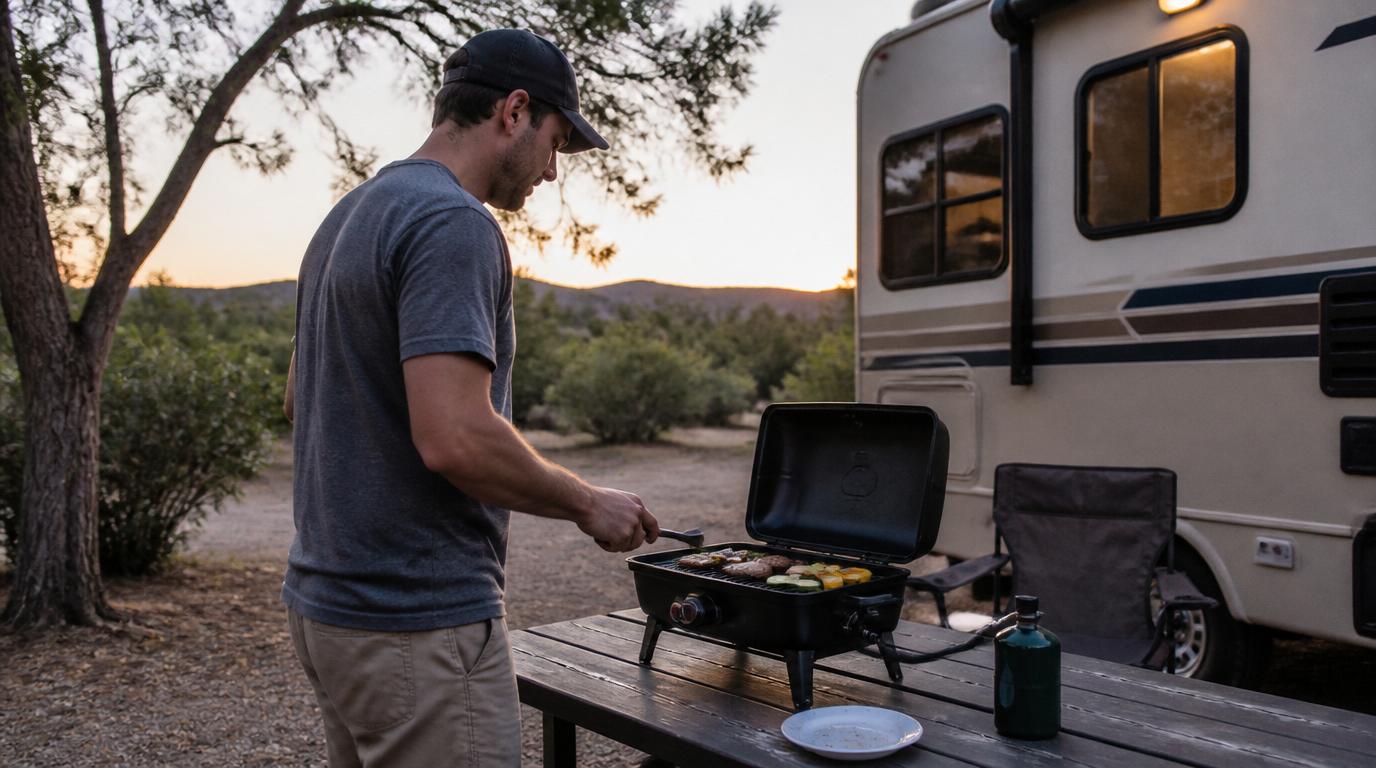
How to Choose an RV Camping Grill
Size and Portability
The most common mistake RV campers make is buying a grill sized for a backyard, not a campsite. In a backyard, you set up a grill once and leave it. On the road, you are loading it, securing it, unloading it, and finding a flat surface to set it on – every single trip.
Measure your storage space before you buy anything. A compact grill that fits in a pass-through bay or cargo area is worth far more than a large grill that requires strapping to an exterior rack or leaving at home. Most RVers overestimate how much cooking surface they need and underestimate how much storage they have.
A good rule: if you cannot carry it comfortably with one hand, it is going to become a burden.
Propane vs. Charcoal
Propane wins in nearly every RV scenario, not because charcoal is inferior, but because propane is practical. You can regulate the heat immediately, start cooking within two minutes, and clean up without dealing with ash disposal. Most RV parks have restrictions on open charcoal fires, and many campgrounds prohibit ground charcoal ash disposal entirely.
Charcoal makes sense if you camp in open spaces where fire restrictions are minimal and you genuinely care about the flavor difference. But most RV campers who buy charcoal grills end up defaulting to propane anyway after a few inconvenient nights.
If your RV runs on propane for cooking and heating, adding a grill that uses the same fuel source is a practical choice. Many tabletop and portable grills use the same 1-pound disposable canisters or can connect via hose adapter to a larger tank.
BTU Explained Simply
BTU (British Thermal Unit) measures heat output. Higher BTU does not always mean better cooking. It means the burner can generate more heat. What matters is whether that heat is distributed evenly and whether the grill can reach and hold a useful cooking temperature.
For RV grilling, 10,000 to 12,000 BTU is sufficient for most meals. You are not searing steaks for eight people at a restaurant. You are cooking burgers, chicken, vegetables, and the occasional fish fillet. A 12,000 BTU single-burner tabletop grill will handle nearly everything a typical RV camper needs.
Be skeptical of low-cost grills with very high BTU claims. BTU output without consistent heat distribution just means some spots burn and others undercook.
Storage Footprint
Think about this in three dimensions, not just cooking surface area. A grill with folding legs and side shelves might have a small footprint when folded, or it might be oddly shaped and difficult to fit anywhere. Check the folded dimensions – length, width, and height – before buying.
Cast iron grates add significant weight and can crack if not stored carefully. Porcelain-coated grates are easier on storage but require gentler handling. Stainless steel grates are the most durable and travel-friendly option.
Setup and Cleanup
Every extra step in setup is a step you will eventually skip. The ideal RV grill ignites quickly, stabilizes fast, and cleans up in under five minutes. Grease traps that are difficult to access or grates that require soaking will erode your enthusiasm over a season.
Look for grills with removable grease collection trays and grates that fit in a standard kitchen sink. Avoid designs where grease channels run through hidden interior spaces.
Mounted vs. Portable
RV-mounted grills bolt to the exterior of your rig and fold out from a bracket. They stay with the RV, which is convenient. However, they are fixed in position, require your rig to be level to work well, and limit where you can grill relative to your setup. They also add wear points to your exterior and can be difficult to replace if discontinued.
Portable grills go where you go – to the picnic table, to a site that has better shade, to a friend’s campsite. The flexibility almost always wins in real-world use.
Reality CheckThe grill you will actually use on a tired Friday evening is the one that sets up in under two minutes and cleans up without drama. A technically superior grill that stays in the storage bay because setup feels like a chore is a waste of money. Prioritize friction-free over feature-rich.
Types of RV Grills
Portable Tabletop Grills
These sit on a table or flat surface and are the most practical option for the majority of RV setups. They are compact, easy to store, and require no mounting hardware. Most weigh between 10 and 25 pounds. They are appropriate for 1 to 4 people and handle everyday camping meals without difficulty.
Best suited for: travelers with limited storage, those who move campsites frequently, and anyone who values simplicity.
RV-Mounted Grills
These attach to your rig’s exterior – typically to a standard hitch receiver or a dedicated mount on the bumper or exterior frame. Brands like Suburban and Camco have made popular versions of these for decades. They are a good fit if you almost always stay at the same campsite arrangement and want a permanent outdoor kitchen setup.
Best suited for: seasonal campers who park in one spot for extended periods, or those with a dedicated outdoor kitchen area on a larger fifth wheel or motorhome.
Compact Propane Grills
Single-burner or dual-burner propane grills designed for camping are the workhorses of RV cooking. They heat quickly, control easily, and store compactly. Many use standard 1-pound propane canisters, though a hose adapter to connect to a larger tank is worth buying to reduce canister waste and cost over time.
Best suited for: most RV campers, especially those on shorter trips with limited setup time.
Charcoal Grills
Portable charcoal grills – particularly kettle-style or folding designs – are genuinely capable cookers. They produce better flavor for certain foods, and some campers find the ritual enjoyable. The trade-off is time: 20 to 30 minutes to reach cooking temperature, ash disposal requirements, and more involved cleanup.
Best suited for: boondockers who camp in areas without fire restrictions, those who cook longer meals on relaxed trips, or anyone who simply prefers charcoal and is prepared for the extra process.
Recommendations by Use Case
The following recommendations are organized by traveler type. Each one reflects a specific scenario. Read the descriptions honestly and choose based on where you actually fit, not where you wish you fit.
Coleman RoadTrip 225
Small RVs and VansWho it is for: Van campers, teardrop trailer owners, or anyone with minimal storage who still wants real cooking capacity.
The RoadTrip 225 has a swing-out design that folds flat, making it easier to store than many grills with comparable surface area. It uses standard 1-pound propane canisters or connects via hose adapter. The cast iron grates hold heat reasonably well, and the grill reaches cooking temperature in about 10 minutes.
The fold-flat design is genuinely storage-friendly. It has two independently controlled burners, which allows you to run a two-zone cook – one side high for searing, one side low for holding. This is more useful than it sounds when you are cooking a mixed meal outdoors.
Not particularly lightweight at around 23 pounds assembled. The legs are less stable on uneven ground than some competitors.
If you are solo or cooking for only two people, this is more grill than you need. A single-burner tabletop unit will be lighter, cheaper, and easier to manage.
Weber Q1200
Most RV OwnersWho it is for: The largest segment of RV campers – couples or small families on mixed campground trips who want consistent results without complexity.
The Weber Q1200 has earned its reputation through consistent performance rather than impressive specs. It runs on a single burner producing 8,500 BTU and has a 189 square inch cooking surface. That is enough for four burgers, two chicken breasts, or a reasonable spread of vegetables. It is not a large grill, but it is well-engineered for what it does.
Build quality is noticeably better than comparably priced grills. The lid holds heat well, the grates are cast iron with porcelain coating, and the ignition is reliable. It is also lighter than it looks at around 29 pounds, and the legs fold under for storage.
One burner means no two-zone cooking and no gradual heat management if you are cooking items with different needs simultaneously.
If you regularly cook for more than three people, the cooking surface will feel too small. Also avoid if you are working with very limited storage – it is not the most compact option in its class.
Cuisinart CGG-180T Petit Gourmet
Compact TravelWho it is for: Travelers who prioritize portability above everything else and want something that fits into a gear bag or small storage compartment.
This tabletop grill weighs about 14 pounds and folds to roughly the size of a large laptop bag. It uses a 1-pound propane canister, runs a single burner at 5,500 BTU, and has a 145 square inch cooking surface. That is genuinely small, but sufficient for two people cooking simple meals.
The price point is low, the weight is low, and the setup takes about 60 seconds. It is a sensible secondary grill for people who have a larger unit at home and want something they can throw in the van without thinking about it.
The BTU output is low by grill standards. In cold weather or wind, reaching and holding adequate cooking temperatures can be frustrating. The cooking surface also limits you to cooking one thing at a time if that thing is larger than a burger.
This is not a primary grill for regular cooking. If you grill four nights a week at camp, the limited surface and heat output will become annoying quickly.
Camp Chef Everest 2X
Groups and Extended TripsWho it is for: Families, groups of four or more, or those who cook elaborate outdoor meals and want genuine cooking power.
The Everest 2X is technically a camp stove rather than a grill, but it accepts grill box accessories and is one of the most versatile high-output cooking setups available for RV use. Two 20,000 BTU burners produce more cooking power than most portable propane grills combined. The modular design allows you to use griddle plates, grill boxes, or wok grates depending on what you are making.
The BTU output means you are not waiting. Water boils fast, the grill accessory reaches searing temperature, and the two-burner layout lets you cook a full meal simultaneously. For groups who camp frequently, the versatility reduces how much other cooking gear you need to bring.
Larger and heavier than dedicated tabletop grills, and the accessory system adds cost. Total setup is more involved than a plug-and-play grill.
If you cook simple meals for one or two people, this is significant overkill. The size and weight are difficult to justify for lighter use cases.
Blackstone 17-Inch Tabletop Griddle
Budget-Conscious BuyersWho it is for: Cost-conscious campers who want a capable outdoor cooking surface without spending much.
The Blackstone 17-inch griddle is a flat-top propane unit rather than a traditional grill, which changes what you can cook (eggs, pancakes, stir fry, smash burgers) but expands versatility considerably. It runs around 12,000 BTU across the cooking surface, costs significantly less than comparable grills, and has a large cooking area for the price.
For the money, the cooking surface-to-cost ratio is difficult to beat. Cleanup is straightforward with regular seasoning and a scraper. The flat top is genuinely more versatile than a grate for many common camp meals. For a full picture of how a griddle fits into your camp kitchen, see the Best RV Cookware guide.
A griddle does not replace a grill for everything. You cannot achieve the same sear marks or smoke behavior on a flat top, and some foods simply cook better on a grate.
If you specifically want charcoal or traditional grill results, this will not deliver them. Also a poor choice if weight and storage are critical constraints.
Trade-offs Worth Understanding
Propane wins on convenience, consistency, and campground compatibility. Charcoal wins on flavor. Most RV campers should choose propane. Those who camp in open terrain and enjoy the process can make charcoal work, but go in knowing the trade-offs.
Portable grills offer flexibility – go where you want, store them when not in use. Mounted grills suit fixed setups but sacrifice flexibility and add a permanent attachment point. For most people, portable is the right call.
Higher BTU output generally comes with a larger and heavier grill. For most RV meals, moderate BTU output is plenty. Do not buy more power than your cooking actually demands.
A propane grill that heats in two minutes will get used far more often than a charcoal setup requiring 30 minutes of prep. For everyday camp cooking, convenience usually leads to better meals simply because you will actually cook.
What We Avoided
This guide deliberately excludes certain categories that come up frequently in RV grill searches.
- Oversized backyard grills Full-size kettle grills, large gas grills, and anything designed to live on a patio do not belong in an RV storage bay. They are heavy, awkward to transport, and take up space that should go to other gear.
- Heavy units that don’t travel well Several well-reviewed grills are excellent at a fixed campsite but impractical in an RV context. Weight matters when you are loading and unloading every few days.
- Low-quality cheap grills The $25 to $40 propane grill segment is largely unreliable. Thin metal, poor ignition, and uneven heat distribution make these frustrating to use. A modest budget increase – to the $60 to $80 range – typically buys a meaningfully better product.
Common Buying Mistakes
- Buying too large The majority of people who feel they need a large grill are imagining occasional large gatherings rather than their actual day-to-day cooking. A grill that works well for everyday meals is a better investment than one sized for an event that happens twice a season.
- Ignoring storage dimensions Cooking surface gets attention. Stored dimensions are what actually matter. Measure your storage space and match the grill to it before browsing product features.
- Choosing charcoal when you won’t realistically use it Charcoal sounds appealing in theory. In practice, on a weeknight after a day of driving, most people do not want to wait 30 minutes for coals to be ready. Be honest about this before buying.
- Overestimating cooking needs Two burners and 200 square inches of cooking surface is enough for four people eating standard camp meals. You do not need restaurant-grade equipment to cook outdoors well.
- Skipping the hose adapter If you buy a propane grill that uses 1-pound canisters, purchase a hose adapter that connects to a standard 20-pound tank. Over a season of camping, the cost savings and reduced waste are substantial.
If You Only Remember This
- Choose based on your actual storage space. Measure first. Browse second. A grill that does not fit your rig does not matter how good it is.
- Portable almost always wins. Flexibility beats convenience for most RV campers, and mounted grills trade away more than they give back.
- Simple setups work best on the road. Prioritize a grill that sets up in under two minutes and cleans up without drama over cooking surface, BTU output, or features you will use twice a season.
The best grill for your RV is the one that fits where you store it, works for how many people you feed, and gets used instead of staying in the storage bay.