💡The #1 Rule
Remove all fresh food the night before you cross, and have your documents ready 72 hours out – not the morning of. These two steps alone eliminate the most common causes of delay.
The Reality of RV Border Crossings
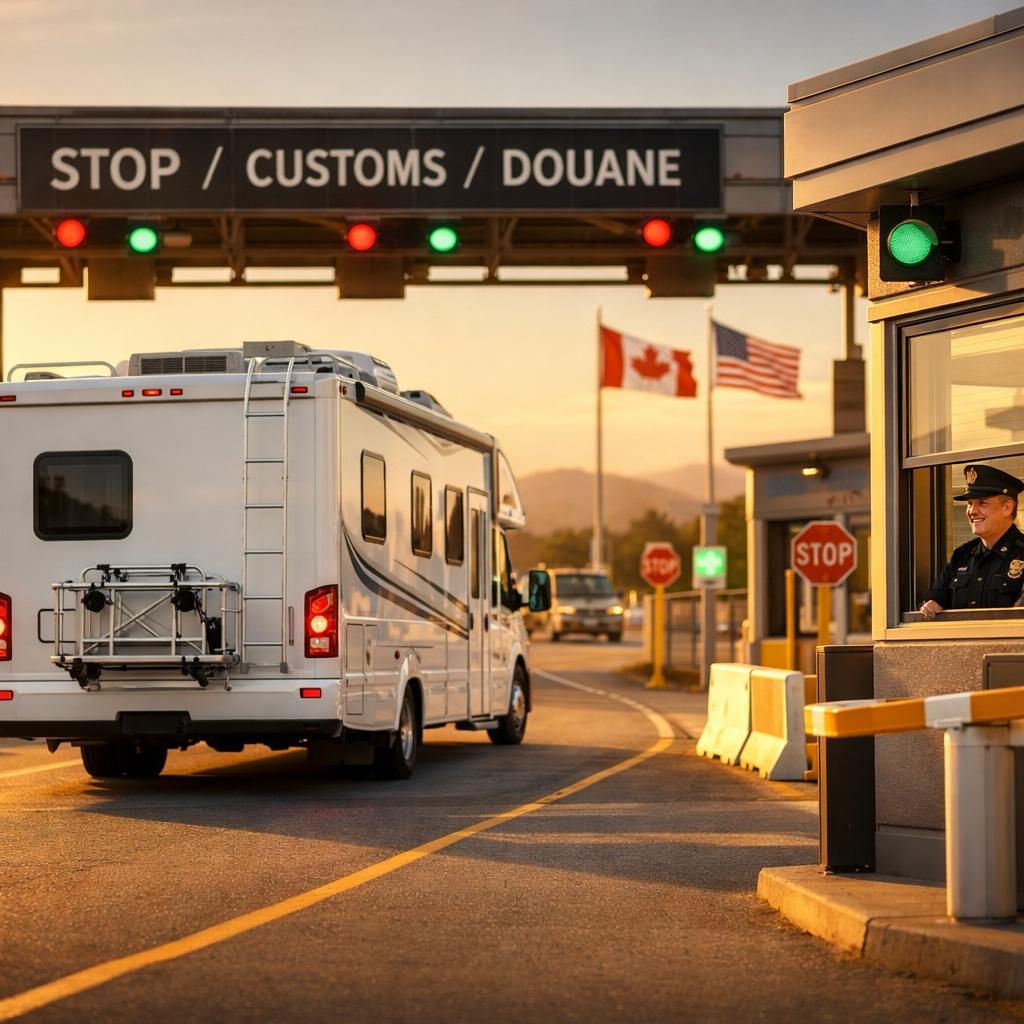
Here’s something most first-time international RVers don’t realize until they’re sitting in a secondary inspection bay: crossing a border in an RV is nothing like crossing in a car. Customs agents see your rig as a mobile residence -with a kitchen, bedroom, storage compartments, and months’ worth of gear – and they treat it accordingly. Secondary inspections affect roughly 1 in 6 RV crossings, and they routinely run 4 to 8 hours.
The frustrating part? The vast majority of those delays are caused by the same handful of preventable mistakes: fresh produce that triggers an agricultural hold, undeclared valuables that look suspicious, prescription bottles without pharmacy labels, or compartments so stuffed that inspectors can’t easily see what’s inside. None of these require bad luck – they just require not knowing what to expect.
This guide is written for people who’d rather spend those hours at a campsite than in a customs lot.
🧠 The Right Way to Think About It
Think of your border crossing like a job interview where the interviewer can open every drawer in your house. You’re not hiding anything – but if your “house” looks chaotic and disorganized, it raises questions. The goal isn’t just to have the right documents; it’s to make an inspector’s job easy. When they can quickly see what you have, find what they need, and verify your story without digging, they move you through. When they can’t, they dig deeper.
🎯The Three Things That Matter Most
A clean inventory of valuables. For anything worth over $500 – electronics, cameras, bikes, outdoor gear – write it down with serial numbers and keep the purchase receipts. Without this, an agent who finds an expensive drone or camera kit might assume it was bought abroad and needs to be declared. With it, you can prove in 30 seconds that you’ve had it for years.
An inspection-ready interior. This doesn’t mean your RV needs to look like a showroom. It means an inspector can open a compartment and actually see what’s inside. Clear bins, logical groupings, and a bit of breathing room go a long way. The goal is that nothing looks hidden – because nothing is.
One folder with everything they’ll ask for. Passports, vehicle registration, insurance, driver’s licenses, prescription labels, pet certificates, and any special permits – all in one place, organized and easy to hand over. Fumbling through glove boxes and under seat cushions for a registration card signals disorganization, and disorganization signals risk.
The Full Preparation Guide
Let’s walk through this chronologically, because the timing matters as much as the content.
30 days out: Research your specific crossing. Every country – and sometimes every crossing point – has its own rules. Don’t assume that what worked on a US–Canada crossing applies to Mexico or Europe. Look up the specific prohibited items list, the duty-free thresholds, the pet entry requirements, and whether your RV needs a Temporary Import Permit (mandatory in Mexico, for example). Government websites are the most reliable source; RV forums are useful for real-world tips but shouldn’t substitute official rules.
One week out: The walkthrough. Go through your entire RV with the destination country’s prohibited items list in hand. Treat it like you’re packing for a flight – but everything you own is already in the bag. This is when you find the forgotten jar of homemade salsa, the hunting knife tucked in a side pocket, or the unlabeled prescription bottles. It’s also when you create or update your valuables inventory.
72 hours out: Documents. Assemble your folder. Check every expiration date. If your pet’s health certificate was issued more than 10 days ago, you may need a new one – some countries require them issued within a very tight window. If you’re crossing into Mexico, verify your Temporary Import Permit is in order. If a prescription label has worn off, get a new printout from the pharmacy. Fix these things now, not at the border.
The night before: Food. This is the step people skip most often, and it’s the one that causes the longest delays. Remove everything fresh: fruits, vegetables, meat, dairy. Yes, including that one avocado and the leftover chicken in the fridge. Agricultural inspections aren’t quick – agents are thorough and they have tools to detect what you might have missed. Canned and sealed commercial goods are almost always fine. Homemade preserves in unmarked jars are not.
Morning of: The exterior check. Clean the mud off your wheel wells and undercarriage. It sounds minor, but dirty undercarriages flag potential contact with agricultural areas. Check that your license plate is clearly visible and your registration sticker is current. Make sure all your exterior lights work and your compartment latches close properly. An unkempt exterior signals an unkempt interior — and that triggers more scrutiny.
Step-by-Step Timeline
Step 1 – 30 Days Before: Research
Look up entry requirements for your specific destination: prohibited items, duty-free limits, pet documentation requirements, and any permits your RV type or equipment might need. Note specific deadlines – some certificates must be issued within a certain number of days of crossing.
Step 2- 1 Week Before: The Walkthrough
Go through your entire RV with the prohibited items list. Remove anything questionable. Create or update your valuables inventory with serial numbers. Organize compartments so contents are clearly visible. This is also the time to schedule a vet visit if your pet needs a fresh health certificate.
Step 3 – 72 Hours Before: Documents
Assemble your document folder. Check every expiration date – passports, insurance, vehicle registration, pet certificates. Complete any online pre-registration if your crossing offers it. If anything is missing or expired, you still have time to fix it.
Step 4 – The Night Before: Food and Final Check
Remove all fresh produce, meat, and dairy. Verify all passengers have their documents. Confirm all compartments can be opened quickly and contents are easy to see. Brief everyone on what to expect at the checkpoint – consistency in answers matters.
At the Checkpoint: What Actually Happens
Your first 30 seconds set the tone. Have your document folder on the seat next to you before you reach the window. Roll down your window, be friendly but not over-eager. Answer what’s asked directly and briefly – destination, how long, purpose of visit. Don’t volunteer information they didn’t ask for, but don’t be evasive either.
If you’re waved through to secondary, stay calm. Secondary inspection doesn’t mean you’ve done something wrong. Sometimes it’s random. Sometimes it’s the size of the RV. Sometimes it’s a quiet day and they’re being thorough. Your job is to be cooperative and make it easy for them. Open compartments before they ask. Offer to move things so they can see better. Answer questions with the same directness you’d use at the initial window.
All passengers should be on the same page. Before you arrive, make sure everyone in the RV knows your travel plan: where you’re going, for how long, what you’re planning to do. Inconsistent answers – even innocent ones – are a red flag that invites more questioning.
Timing matters more than most people realize. Weekdays between 10 AM and 2 PM are typically the best window: full staffing, no shift-change pressure, lighter recreational traffic. Friday afternoons and Sunday evenings are the worst. Use a real-time border wait app to check conditions before you commit to a crossing time.
💰What Does It Actually Cost to Prepare?
The basics (document folder, sleeves, labels, inventory supplies): $25–$50. This is the DIY approach using government websites and a bit of time. Most people don’t need anything more.
Add required permits and applications (e.g., Mexico Temporary Import Permit, NEXUS application fee): $45–$165, depending on your destination and how often you cross.
Professional border preparation consultant: $150–$300 if you want someone to review your specific documents and route. Worth it for first-time Mexico or EU crossings; probably unnecessary for repeat US–Canada travelers.
NEXUS or Global Entry membership: $120–$170 for five years. If you cross the US–Canada border more than once or twice a year, this pays for itself quickly in time saved.
The real cost of not preparing: A secondary inspection that causes you to miss a non-refundable campsite reservation can easily cost $100–$300 in lost bookings alone – before you factor in spoiled food or a stressful day.
🌍It Depends Where You’re Going
US–Canada: The most straightforward international crossing for most American RVers, but don’t get complacent. Firearms must be declared precisely — type, make, model, serial number. Duty-free limits on alcohol are lower than many people expect (1.5 liters of wine or 1.14 liters of spirits). Agricultural products are taken seriously. If you cross regularly, NEXUS is a genuine game-changer.
US–Mexico: More paperwork than Canada, but very manageable if you prepare. A Temporary Import Permit (TIP) for your RV is mandatory beyond the border zone and must be obtained before you enter the interior – not after. Firearms are strictly prohibited and the penalties are severe. Some US-prescription medications (including certain painkillers and anxiety medications) require a special permit in Mexico; check your prescriptions against Mexico’s controlled substances list before you go.
Europe: Requirements vary significantly by country, and some EU border crossings are unmanned. Key considerations are emissions compliance (some cities have low-emission zones that may restrict older rigs), camping equipment regulations, and the 90-day limit for most non-EU visitors within the Schengen Area. Pet entry requires a valid EU pet passport or equivalent – an ordinary vet certificate won’t do.
📋 What Went Wrong (Real Examples)
The rifle declaration mistake. A couple crossing from Washington into British Columbia had their hunting rifles with them – legal, and something they’d done before. But this time they hadn’t written down the serial numbers, and their prescription medications were in bottles without pharmacy labels (they’d refilled into a weekly pill organizer). Six hours in secondary inspection. The rifles were eventually cleared; the medications required a call to their doctor to verify. Both problems were entirely avoidable.
The undeclared electronics at Texas–Mexico. An RV family had purchased new cameras and a drone on the US side and packed them in with their existing gear without keeping the receipts. When agents found over $800 in electronics they couldn’t account for, plus camping equipment that required a permit they didn’t have, the delay hit four hours. The family wasn’t trying to smuggle anything – they just hadn’t thought it through.
The solar panel specs and the expired pet certificate. A couple entering a European country had a solar panel installation that didn’t match the specs on their vehicle documentation (they’d upgraded after registration). Combined with a pet health certificate missing the required vaccination dates from within the past 12 months, they spent three hours being held while officials verified details that should have been straightforward.
📊Things People Get Wrong
📊DIY vs. Professional Preparation
Do it yourself ($25–$50 + time): For most US–Canada crossings and repeat travelers, government websites and a methodical checklist get you 95% of the way there. The main risk is missing a recently changed regulation or a country-specific requirement you didn’t know to look for.
Use a professional service ($150–$300): Worth considering for your first Mexico or Europe crossing, or if your situation is complicated — unusual equipment, multiple pets, firearms, or a rig with aftermarket modifications. A consultant who does this regularly will catch things a first-timer won’t.
Apps and digital checklists ($12–$45): Useful as a supplement, not a substitute. Good for real-time wait time data and quick-reference lists. Less reliable for country-specific edge cases or recent regulatory changes.
🔧What You Actually Need
A document folder that travels with you. Waterproof, with clear protective sleeves. Keep it in the same spot every time -driver’s side door pocket or the cabinet directly above the passenger seat. You should be able to grab it in five seconds.
A digital backup. Photos of every document stored in a cloud folder you can access offline. If the folder gets lost or soaked, you still have everything. Some agents will accept digital copies; most won’t – but it’s there if you need it.
A border wait app. Apps like CBP One (US–Mexico) or the CBSA app (US–Canada) show real-time wait times at specific crossings. Five minutes of checking before you leave can save two hours of sitting in line.
⏱️ Time & Cost Summary
Total prep time: 6–8 hours spread over 2–3 weeks. Most of that is the one-time setup of your document system and valuables inventory. Subsequent crossings take significantly less.
Ongoing cost: $23–$48/year to maintain documents, renew permits, and update your inventory after major purchases.
What you’re protecting: Campsite reservations, perishable food, your travel schedule, and several hours of your trip that are much better spent somewhere else.
📅Keep It Current
⚠️A Few Important Notes
FAQ
What documents should I prepare in advance to avoid RV border crossing delays?
How can I organize my RV to speed up secondary inspections?
What items should I remove from my RV before crossing borders to prevent delays?
When is the best time to cross RV borders to minimize wait times?
How should I prepare my RV’s exterior to avoid triggering secondary inspections?
What’s the proper way to declare items when crossing borders in an RV?
How can I prepare for RV border agent questioning to avoid red flags?
What RV modifications or equipment might cause border crossing complications?
How should I handle pet documentation to prevent RV border delays?
What’s the best way to pack my RV to facilitate quick border inspections?
How can I use technology to reduce RV border crossing wait times?
What should I do if my RV is selected for secondary inspection despite preparation?
How do I prepare my RV’s food storage to avoid agricultural inspection delays?
What common RV packing mistakes lead to extended border inspections?
How far in advance should I start preparing my RV for border crossings?
👨💼 Expert Insights
“The travelers who get through fastest aren’t the ones with the most paperwork – they’re the ones who can answer every question confidently and point to exactly what I’m looking for. Preparation isn’t about having perfect documents. It’s about knowing your own RV.” -Former US Customs and Border Protection officer
“I tell every client the same thing: treat the border like a business meeting. You wouldn’t walk into a meeting without knowing your material. Know your itinerary, know what’s in your rig, and have everything organized before you need it.” – RV travel consultant, 12+ years
“My first Mexico crossing took 4 hours because I hadn’t gotten the Temporary Import Permit in advance. My second took 25 minutes. Same border, same rig – completely different experience because I knew what was expected.” – RV traveler, 8 international trips
📚 Related Topics
- International RV insurance requirements and coverage verification for border crossings
- Pet travel documentation and health certificate requirements for cross-border RV trips
- Duty-free allowances and customs declaration strategies for RV travelers with extended stays