Best RV Cookware
How to Choose the Right Set for Your RV Kitchen
The cookware aisle at any kitchen store is designed for people with full cabinet space, a large range, and no plans to move. Most of what is sold there – bulky sets of eight or ten pieces, heavy Dutch ovens, oversized stockpots – is completely wrong for an RV kitchen. Not because the quality is bad, but because the context is different in every way that matters.
An RV kitchen typically has two or three burners, a small oven if any, and enough storage for what fits in a single cabinet. You are also dealing with vibration during travel (which rattles loose anything stored carelessly), limited water for cleanup, and cookware that needs to survive being packed and unpacked repeatedly across a season.
The right approach is not finding the best cookware set. It is finding the right pieces for how you actually cook, in a rig your size, with the storage you actually have. This guide is built around that decision. If you are assembling a full outdoor kitchen alongside your RV cooking setup, the RV Kitchen and Cooking Gear Guide covers how cookware fits alongside camp stoves, grills, and compact food storage.
How to Choose RV Cookware
Size and Nesting
The most important question is not what brand the cookware is – it is whether it fits in your cabinet when stored. Nesting cookware stacks inside itself, which can reduce a five-piece set to the footprint of a single pot. That matters enormously in an RV where every cubic inch of storage is accounted for.
Measure your cabinet opening and your shelf depth before buying. A set that cannot fit through the cabinet door or requires removing shelves to store is not the right set, regardless of how well it cooks. Standard cookware sets do not nest. Lids sit separately, handles stick out, and pots and pans compete for the same shelf space. For most RV setups, a nesting or compact set is worth the small trade-off in cooking capacity.
Weight
Weight matters for two reasons in an RV: it contributes to your rig’s total load, and it makes cooking more physical than it needs to be. A heavy cast iron skillet is excellent cookware, but if you are cooking in a small galley kitchen and need to move things around frequently, the weight becomes a daily friction point.
For most RV owners, the practical weight target is cookware you can lift comfortably with one hand when full. That typically rules out full cast iron sets and heavy stainless collections for primary use.
Multi-Use vs. Single-Use
Every piece of cookware you bring should do at least two jobs. A 10-inch skillet that works on a gas burner, a portable induction plate, and an outdoor camp stove earns its space. A single-use egg pan or a specialty crepe skillet does not.
Think in terms of cooking tasks rather than cooking tools. Most RV meals require sauteing, boiling, simmering, and occasionally baking. A 2-quart saucepan, a 10-inch skillet, and a larger pot cover nearly every meal most campers cook. Everything beyond that should justify itself clearly before making the packing list.
Ease of Cleaning
Cleanup in an RV is rarely easy. Water is often limited, sinks are small, and dishwashers are uncommon. Cookware that requires soaking, special scrubbers, or extended hand-washing adds friction to every meal. Nonstick surfaces clean quickly but require careful handling. Stainless steel is more durable but can require more scrubbing after sticky dishes. Hard-anodized aluminum sits in between.
The best cookware for your RV is the kind you will actually clean properly on the road. If you know you will not baby a nonstick coating, do not buy nonstick.
Compatibility
Check that your cookware works across every surface you plan to use – the RV stovetop, an outdoor camp stove, a portable induction plate, and a grill if applicable. Some nonstick coatings are not safe at high grill temperatures. Some lightweight pans warp over high-output burners. Induction cooking requires magnetic-bottom cookware, which excludes standard aluminum.
If you use an induction cooktop as a backup or primary cooking surface (common in RVs where the propane range is supplemented or replaced), confirm induction compatibility before buying.
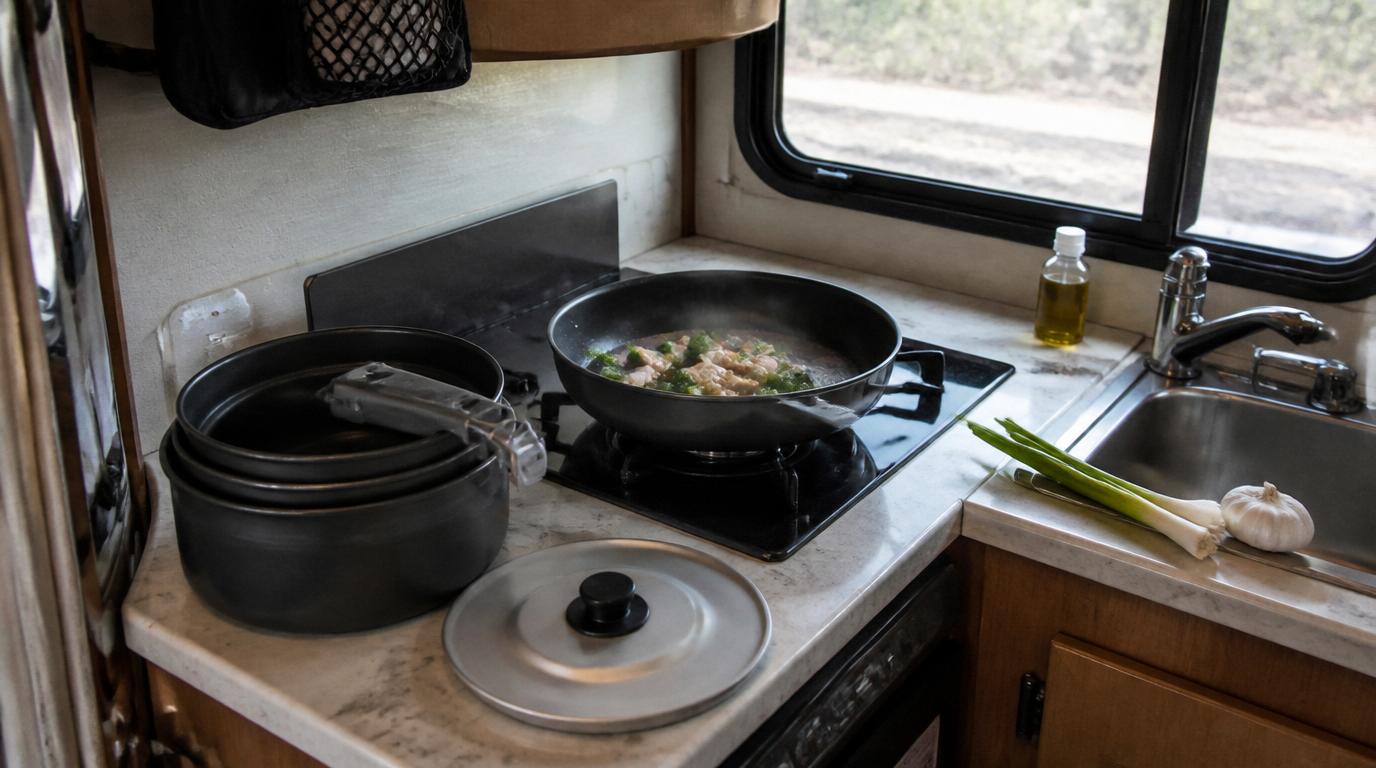
Less is moreMost RV cooks use two or three pieces for 90 percent of their meals. A skillet, a saucepan, and a larger pot cover nearly everything. Start with less and add only when a genuine gap becomes clear – not before you leave home.
Cookware Materials Explained
Stainless Steel
Stainless steel is durable, inert, and nearly indestructible under normal use. It handles high heat, goes from stovetop to oven, and does not have a coating to protect. For RV use, the advantages are real: it travels well, cleans with basic scrubbing, and lasts indefinitely.
The trade-off is cooking performance. Stainless steel has poor heat distribution unless it has a bonded aluminum or copper core, and food sticks more readily than on nonstick surfaces. For RV cooks who make eggs, fish, or other delicate proteins regularly, a stainless-only kit is frustrating. Pairing one or two stainless pieces with a single nonstick skillet covers most situations without the downsides of a full nonstick set.
Nonstick
Nonstick cookware is the most practical choice for everyday RV cooking – eggs slide off, cleanup is fast, and it requires minimal oil. The limitation is longevity and care requirements. Nonstick coatings scratch easily with metal utensils, degrade at high heat, and have a shorter lifespan than stainless or cast iron. In an RV context where cookware gets packed, stacked, and moved frequently, protecting the coating requires using felt pan protectors between pieces.
Modern ceramic nonstick coatings are more durable than older PTFE-based coatings and handle slightly higher heat, but still require the same basic care. For RV use, nonstick is excellent as long as you go in understanding the trade-offs and pack accordingly.
Cast Iron
Cast iron is the most durable cookware material available and the worst choice for most RV setups. A single 10-inch cast iron skillet weighs around 5 pounds. A 12-inch skillet is closer to 8 pounds. A Dutch oven adds 10 to 15 more. That is a significant weight addition for a rig where every pound matters, and cast iron requires careful drying and seasoning after each use to prevent rust – a difficult routine to maintain on the road.
The exception is RVers who boondock frequently, cook over open fires or camp stoves regularly, and prioritize cooking performance over convenience. For those use cases, a single well-seasoned cast iron skillet earns its weight. For weekend warriors and full-hookup campers, it usually does not.
Hard-Anodized Aluminum
Hard-anodized aluminum is the practical middle ground for RV cookware. It is significantly lighter than stainless steel or cast iron, heats quickly and evenly, and is more durable than standard nonstick. The anodizing process hardens the aluminum surface, making it more resistant to scratching and more durable than bare aluminum. It does not have the coating vulnerability of nonstick, though it is not as easy-release as a coated surface.
For most RV owners who want a durable, lighter-weight set that handles everyday cooking without constant babying, hard-anodized aluminum is the most practical choice.
Recommended Sets by Use Case
These recommendations reflect specific traveler types and real cooking habits. The right choice depends on how you cook, how many people you feed, and how much storage you realistically have.
Sea to Summit Frontier Ultralight Two Pot Cook Set
Small RVs and Minimal SetupsWho it is for: Van campers, teardrop trailer owners, and anyone operating out of a genuinely small kitchen with almost no storage to spare.
The Sea to Summit Frontier Ultralight Two Pot Cook Set is built around hard-anodized aluminum construction with a nesting design that keeps both pots and lids together in a single compact bundle. The set is genuinely lightweight and packs into the footprint of the larger pot. It handles camping-scale cooking well – one-pot meals, boiling water, soups, and simple stovetop cooking – without the silicone-wall trade-offs of collapsible designs.
Two pots without a dedicated frypan means you are limited for anything requiring a flat cooking surface – eggs, pancakes, or searing protein. A separate lightweight skillet rounds the set out if those meals matter to you.
If you cook varied meals for more than two people regularly, the pot capacity will feel limiting. Step up to the Tramontina or GSI set if you have even moderate cabinet space to work with.
Tramontina 5-Piece Hard-Anodized Set
Most RV OwnersWho it is for: The largest segment of RV campers – couples or small families who cook most nights and want cookware that performs well without complexity or excessive cost.
The Tramontina hard-anodized set includes an 8-inch skillet, a 10-inch skillet, a 2-quart saucepan, and a 5-quart Dutch oven with lids. The pieces nest acceptably, the hard-anodized surface is durable, and the set handles gas, electric, and induction surfaces. The 2-quart saucepan and 10-inch skillet cover 80 percent of everyday RV meals between them. The Dutch oven doubles as a stockpot and an oven-safe braising vessel.
The set does not nest as compactly as purpose-built camping cookware. You will need a dedicated cabinet shelf for storage, and the lids require a separate storage solution – a silicone lid organizer works well.
If your storage is critically limited, this set takes up more space than it might appear. Also avoid if you strongly prefer nonstick for all cooking – the hard-anodized surface requires more oil than a coated pan.
GSI Outdoors Pinnacle Camper Cookset
Lightweight TravelWho it is for: RVers who move campsites frequently, keep weight minimized, and do most cooking on a camp stove rather than an indoor range.
The GSI Pinnacle Camper set nests tightly into a compact stuff sack. The set includes two pots, two insulated mugs, two bowls, two lids, and a frypan lid that doubles as a skillet. Total packed size is roughly the footprint of a 2-quart pot. Construction is hard-anodized aluminum throughout. The nesting system is genuinely impressive – the entire set disappears into a single bundle that fits in a day pack.
The cooking surface area is smaller than comparable kitchen cookware. The included skillet-lid is functional but limited – it works for simple pan cooking but not for anything requiring significant surface area or heat retention.
If you primarily cook indoors on your RV range and want cookware that behaves like kitchen cookware, this set will feel like a step down in performance. It is optimized for portability, not indoor cooking experience.
All-Clad D3 3-Piece Set
Durable Long-Term UseWho it is for: Full-time RV travelers or serious cooks who spend extended periods on the road and want cookware that performs at a high level and lasts indefinitely.
The All-Clad D3 three-piece set (a 10-inch skillet, a 2-quart saucepan, and a 3-quart saute pan) is kitchen-grade stainless steel with a bonded aluminum core for even heat distribution. It handles every cooking surface including induction, goes oven-safe to 600 degrees, and will outlast every other set on this list. For full-timers who cook serious meals and treat their RV kitchen as their primary kitchen, the compromise of lighter or nesting cookware is not worth it.
Price is significantly higher than other options on this list. Weight per piece is higher than hard-anodized or camping-oriented cookware. The set does not nest.
If you camp occasionally and cook simple meals, this level of cookware is more than the use case demands. Also avoid if storage space is tight – three All-Clad pieces take up meaningful cabinet space.
T-fal Initiatives Nonstick 8-Piece Set
Budget-Conscious BuyersWho it is for: Campers who use their RV seasonally, cook simple meals, and want functional cookware without significant investment.
The T-fal Initiatives set is an entry-level nonstick collection that covers basic cooking needs at a low price. It includes multiple skillets and saucepans, is lightweight, and cleans easily. For short-season camping or occasional trips where the cookware budget is limited, it gets the job done. The nonstick coating performs well for everyday cooking, and the price point means replacing individual pieces is not a significant expense. For more on pairing this kind of setup with outdoor cooking gear, see the RV Kitchen and Cooking Gear Guide.
Build quality reflects the price point. Handles can loosen over time, the nonstick coating is less durable than hard-anodized options, and the set does not nest compactly. It is not a long-term solution for full-time or frequent RV use.
If you RV frequently or full-time, the coating will degrade faster than you want and you will be replacing it within a season or two. Invest slightly more in a harder-wearing set if your rig gets regular use.
Trade-offs Worth Understanding
Nesting cookware saves significant storage space but almost always involves some cooking performance trade-off – smaller surfaces, lighter construction, or materials that behave differently from metal. Traditional cookware performs better but requires more storage. The right choice depends on how much space you have.
Lighter cookware is easier to handle and adds less to your rig’s load, but typically involves thinner walls and shorter lifespan. Heavier cookware lasts longer and often performs better. For most RVers, a mid-weight hard-anodized set strikes the right balance.
Nonstick wins on ease of cooking and cleanup. Stainless wins on durability and heat tolerance. A single nonstick skillet paired with one or two stainless or hard-anodized pieces gives you the best of both without committing fully to either.
Cast iron and heavy stainless perform at the highest level but require more care and add weight. Hard-anodized and nonstick are more convenient but demand gentler handling. Choose based on how much you cook and how long you plan to keep the set.
What We Avoided
This guide deliberately excludes certain categories that come up frequently in RV cookware searches.
- Full kitchen sets Ten-piece and twelve-piece cookware sets are designed for kitchens with full cabinet space. In an RV, most of those pieces will go unused while taking up storage that other gear needs. Three to five well-chosen pieces outperform a ten-piece set in a small kitchen every time.
- Heavy cookware Full cast iron sets, heavy stainless collections, and oversized stockpots all fail the basic RV test of fitting and storing without consuming half a cabinet. Weight adds up in a rig where every pound matters for driving dynamics and legal load ratings.
- Single-use gadgets Egg cookers, quesadilla presses, specialty pans, and similar items are tempting in a store and useless on the road. Every piece of cookware in an RV must do at least two jobs.
Common Buying Mistakes
- Bringing too many pieces More cookware does not mean more cooking flexibility in an RV – it means more storage problems. Most RV cooks use two or three pieces for 90 percent of their meals. Start with less and add only if a genuine need becomes clear.
- Ignoring actual storage dimensions Cookware sets list cooking surface dimensions prominently. Stored dimensions are rarely listed and are what actually matter for your cabinet. Measure before buying, and look specifically for folded or nested dimensions on sets that claim to be compact.
- Choosing heavy cookware for durability reasons The instinct to buy heavy, robust cookware makes sense in a fixed kitchen. In an RV, the durability benefit rarely justifies the weight cost, especially for occasional campers. Hard-anodized aluminum is durable enough for most RV use without the weight penalty.
- Overestimating cooking needs Most people imagine they will cook elaborate meals on the road. Most people end up making pasta, eggs, grilled protein, and one-pot dishes. Cookware decisions should be based on what you actually cook – at home, on previous trips, on a realistic weeknight – not on what you cook for a special occasion.
- Skipping pan protectors If you use nonstick cookware, felt or silicone pan protectors between stacked pieces are not optional. One trip without them and the coating is scratched. They weigh almost nothing and cost very little.
If You Only Remember This
- Fewer pieces are better. The right three pieces will serve you better than a ten-piece set crammed into a cabinet. Start with a skillet, a saucepan, and a larger pot. Add only when a specific gap becomes clear.
- Multi-use wins every time. Every piece of cookware in your RV should handle at least two cooking tasks and work on at least two surfaces. Anything more specialized than that needs a very good reason to make the trip.
- Size matters more than brand. A well-known brand in the wrong size for your cabinet is worse than a mid-range brand that fits and stores cleanly. Measure your storage first. Then shop.
The best cookware for your RV is the cookware that fits where you store it, handles the meals you actually cook, and comes out of the cabinet without a problem on a Tuesday night when you are tired and hungry.
Affiliate Disclosure: This page contains affiliate links. If you purchase a product through one of these links, we may earn a small commission at no extra cost to you. We only recommend products we have researched and believe are genuinely useful for RV use. Our editorial opinions are our own and are not influenced by affiliate relationships.