Best RV Coffee Makers
How to Choose the Right Option for Your Setup
Coffee is the first thing most people want in the morning and one of the first things that goes wrong in a new RV setup. The machine that worked fine on a kitchen counter draws too much power for your inverter. The pod machine runs through its water reservoir before you have a signal to check the weather. The pour-over you packed gets knocked over in transit and breaks on the first trip.
None of these are fringe problems. They are predictable failures that come from applying home coffee logic to an RV context. The constraints are genuinely different: you may be working with 120V shore power, a 12V battery system, a small inverter, or no electricity at all. Water may come from a fresh tank you are conserving, a campground hookup, or a jug you filled in town. Storage is limited, and anything that breaks or proves inconvenient enough will simply stop getting used.
This guide is not about finding the best coffee maker. It is about finding the right brewing method for how you travel, how you use power, and how you actually want to start your morning on the road. Those answers look different for a full-timer on 50-amp service than for a weekend van camper boondocking in the desert. If you are building out a full RV kitchen alongside your coffee setup, the RV Kitchen and Cooking Gear Guide covers how small appliances, cookware, and compact storage work together in a limited space.
How to Choose an RV Coffee Maker
Power Draw – The Most Important Factor
Wattage is the first question, not the last. Most standard drip coffee makers draw between 800 and 1,200 watts. A single-serve pod machine typically draws 1,000 to 1,500 watts. Running either of these on a battery-based system with a standard 1,000-watt inverter will either trip the inverter immediately or drain your battery bank faster than expected.
Before buying any electric coffee maker, know your power situation:
Most electric coffee makers will work fine.
Most coffee makers will run – check wattage against your generator’s rated capacity.
Confirm your inverter’s continuous wattage. A 1,500W inverter running a 1,200W coffee maker leaves almost no headroom.
Manual brewing methods are your only practical option.
If you do not know your power setup, find out before shopping. Buying a 1,100-watt coffee maker for a 1,000-watt inverter is a common and completely avoidable mistake.
Water Usage
Electric coffee makers that require a reservoir to be filled and emptied each use add complexity in an RV. Pod machines in particular have reservoirs that sit with standing water between uses – a minor issue at home and an inconvenience in an RV where you may be moving every day or managing a limited fresh water supply.
Pour-over and French press methods use exactly as much water as the coffee you are making and nothing more. If water conservation matters on your trips, manual methods have a practical advantage beyond just power.
Size and Storage
Most countertop coffee makers are designed for kitchen counters with ample surrounding space. In an RV galley kitchen, a standard drip machine can take up a third of the usable counter surface. Compact and manual brewing tools – a French press, a pour-over dripper, a moka pot – store in a drawer, fit inside a cabinet easily, and do not require protecting from vibration during transit the way a glass-carafe drip machine does.
Setup Time
A coffee maker that requires more than five steps to use on a tired morning will get replaced by the gas station down the road. Simplicity matters more in an RV than at home because you are often operating in a smaller space, possibly in dim light, possibly before full caffeine has been consumed. The best setup is the one you will actually use every day.
Cleanup
Drip machines and pod machines have internal components – water lines, heating elements, reservoirs – that accumulate mineral deposits and require descaling. In an RV where you may be using water from different sources with varying mineral content, this happens faster. Manual methods (French press, pour-over, moka pot) have no hidden components. You can see everything, clean everything in a basic sink, and know the equipment is clean.
Check wattage firstBefore looking at any electric coffee maker, check the wattage label on the box or product page. Then check what your inverter or shore power connection can reliably handle. If those two numbers do not align, move on to a different option – no amount of convenience makes up for a machine that trips your breaker every morning.
Types of RV Coffee Makers
Drip Coffee Makers
Standard drip machines are familiar and produce consistent results. The issues for RV use are wattage (typically 800 to 1,200 watts), counter footprint, carafe fragility, and the requirement for shore power or a capable inverter. Compact drip machines designed for travel are a reasonable option for RVers who always camp with hookups and want a familiar brewing experience.
Best suited for: Full-hookup campers who prioritize convenience and familiarity over all other factors.
Single-Serve Pod Machines
Pod machines (Keurig and similar) are convenient but come with several RV-specific problems: high wattage draw (often 1,000 to 1,500 watts), a standing water reservoir that needs emptying between trips, pod storage requirements, and per-cup cost that adds up over a season. They work well on shore power for people who drink different beverages and want no-thought brewing.
Best suited for: Shore power campers who drink varied hot beverages and value speed over cost or complexity.
Pour-Over
Pour-over coffee requires hot water (from any source – a stovetop kettle, a camp stove, a standard electric kettle) poured over coffee grounds in a filter. No electricity required for the brewer itself. The resulting coffee is clean, bright, and adjustable to taste. The only equipment is a dripper (often foldable or compact) and filters. Setup and cleanup take under two minutes each.
Best suited for: Coffee-focused travelers who prioritize quality and simplicity, especially those on battery power or off-grid.
French Press
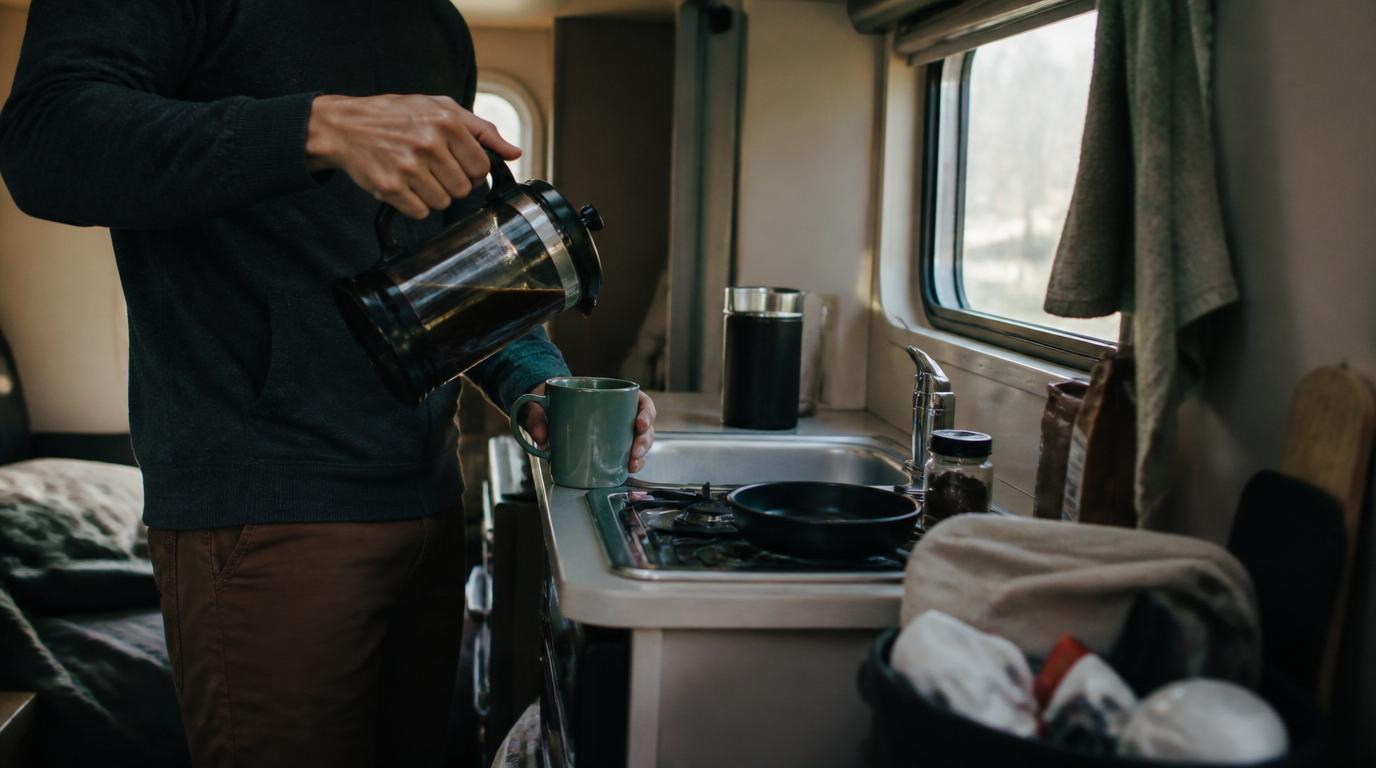
A French press requires only hot water and coarsely ground coffee. There are no filters to pack, no electricity, and no moving parts. A quality stainless steel French press is nearly indestructible and stores compactly. The brewing process takes four minutes of steeping. Cleanup requires rinsing grounds – slightly more involved than pour-over, but manageable with limited water.
Best suited for: Off-grid campers, boondockers, and anyone who wants a no-electricity option that produces genuinely good coffee for one or two people.
Stovetop (Percolator and Moka Pot)
Stovetop coffee makers sit directly on a burner. A moka pot produces espresso-style concentrated coffee using steam pressure – strong, rich, and done in about five minutes. A percolator brews larger quantities of regular coffee through a cycling process. Both use only propane or whatever fuel your stove runs on, with no electricity required at all.
Best suited for: Campers who want no dependency on electrical power, particularly those who cook primarily on a propane range or camp stove.
Recommendations by Use Case
These recommendations are organized by how you travel and how your rig is powered. Read your actual setup honestly before choosing.
Black+Decker Brew ‘n Go CM618
Shore Power – Single ServeWho it is for: RVers who always camp with electrical hookups, drink one or two cups at a time, and want a drip machine that does not dominate the counter.
The Black+Decker CM618 is a single-serve drip machine that brews directly into a 15-ounce travel mug. It draws around 900 watts – on the lower end for electric drip machines – and has no carafe to break. The compact footprint is genuinely small for a drip machine, and the travel mug doubles as a cup and a storage container for the brewer itself on some models.
Single-serve capacity only. If two people want coffee in the morning, you are running two full brew cycles back to back, which doubles both the time and the power draw window.
If you boondock or dry camp regularly, the 900-watt draw will strain a typical inverter setup. Also avoid if you regularly make coffee for two or more people simultaneously.
Wacaco Nanopresso
Low Power / Battery / Off-GridWho it is for: Van lifers, boondockers, and solar-powered RVers who want quality coffee without any electrical draw from the brewer.
The Wacaco Nanopresso is a handheld manual espresso maker that requires only hot water and finely ground coffee (or a compatible pod with an optional adapter). You pump the device manually to generate pressure. It produces a genuine espresso-style shot with crema. The unit is roughly the size of a water bottle, weighs under a pound, and requires no electricity whatsoever.
It is small enough to fit in a jacket pocket, durable enough for daily use, and requires only that you can boil water – which is possible on any camp stove, propane burner, or even a 12V kettle. For the off-grid coffee drinker who does not want to sacrifice quality, this is the most practical solution.
Single-shot output means making multiple drinks requires multiple pump cycles. It also requires finely ground coffee – a hand grinder or pre-ground espresso is needed, which adds one more piece of gear to the kit.
If you drink large-volume coffee (a full 12-ounce mug of drip-style coffee rather than espresso), the Nanopresso output will not satisfy. It is an espresso tool, not a drip replacement.
Bodum Chambord French Press
No Electricity – One to Two PeopleWho it is for: Any RV traveler who wants reliable, good-quality coffee with zero electrical dependency and minimal equipment.
The Bodum Chambord is a classic stainless steel and borosilicate glass French press available in multiple sizes. The 34-ounce (8-cup) version makes enough coffee for two people in a single press. It requires only coarse-ground coffee, hot water from any source, and four minutes of patience. There are no filters to buy, no electricity required, and cleanup is straightforward.
A French press is arguably the best value-per-dollar coffee tool available for any context, and particularly for RV use where simplicity and durability matter. The stainless steel frame survives transit well. The glass carafe is the only fragile component – storing it wrapped in a dish towel or in a soft sleeve eliminates the risk.
The glass carafe can break. Several travel-specific French presses use fully stainless or insulated stainless construction, which eliminates this concern but costs more.
If you want espresso-style concentration rather than full-cup drip-style coffee, a French press will not deliver that. Also consider a fully stainless travel French press if your storage situation puts glassware at risk.
Aeropress Go
Ultracompact – Any Power SituationWho it is for: Solo travelers, minimalist packers, and anyone who wants the smallest possible coffee footprint without sacrificing brew quality.
The Aeropress Go is the travel version of the Aeropress, a brewing device that uses air pressure to produce concentrated coffee quickly. The entire kit – brewer, stirrer, filters, and a small quantity of paper filters – packs into a mug the size of a large coffee cup. It weighs under half a pound. It produces a clean, low-acidity cup that can be drunk straight or diluted with hot water for an Americano-style drink. It works at altitude, in cold weather, and in any conditions where you can boil water. The included mug doubles as a travel cup.
Single-serve output only. Filters are consumable and need to be restocked – though a small pack lasts a long time, it is one more item to track. Metal reusable filters are available as an upgrade.
If you regularly make coffee for two or more people, the single-serve limitation becomes tedious quickly. It is best suited to solo travelers or as a personal brewer for one person in a couple where each has different coffee preferences.
Cuisinart DCC-3200NAS 14-Cup Coffee Maker
Shore Power – Couples and Daily UseWho it is for: Couples or pairs who drink multiple cups each morning and are primarily camped on shore power.
The Cuisinart DCC-3200NAS is a programmable drip coffee maker with a 14-cup carafe capacity, a brew-strength control selector, and a 24-hour programmable timer – useful for waking up to fresh coffee without any morning effort. It draws around 1,000 to 1,100 watts, which is manageable on 30-amp or 50-amp shore power. For couples who want to make a full pot in the morning without running multiple brew cycles, it covers the need in a familiar format. For two people who each drink two or three cups in the morning, a full-pot drip machine is more practical than running a single-serve or manual method multiple times.
The 1,100 to 1,200 watt draw is too high for most inverter-based systems. The glass carafe is fragile during transit – it should be stored padded or removed and packed separately. Counter footprint is larger than compact options.
If you ever boondock, dry camp, or rely on a battery and inverter setup, this machine will not work reliably. It is a shore-power-only solution. Also avoid if counter space is critically limited.
Trade-offs Worth Understanding
Electric coffee makers offer familiarity and convenience but require power – sometimes more than your setup can reliably provide. Manual methods require slightly more participation but work everywhere, cost less, and have no components to fail.
Pod machines and auto-drip require almost no skill or attention. Pour-over and French press give you more control over strength and flavor but require slightly more engagement. The convenience of a pod machine is partly offset by pods, the reservoir, and higher power draw.
The lowest-wattage brewing methods are manual – zero watts. Every step up in convenience adds wattage. That trade-off is worth making if you have reliable shore power. It is not worth making if your power situation is variable or limited.
For RVers who mix hookup camping with boondocking, a manual method that works everywhere is more practical than an electric method that only works sometimes. One tool that works 100% of the time beats two tools that each work 50% of the time.
What We Avoided
This guide deliberately excludes certain categories that come up frequently in RV coffee maker searches.
- Large home coffee machines Fully automatic espresso machines, bean-to-cup grinder systems, and full-size commercial-style drip machines all draw too much power and take up too much space to be practical in an RV. They belong in a fixed kitchen.
- High-wattage single-serve machines Several pod-based systems draw 1,500 watts or more. That wattage requirement eliminates them from any battery-inverter setup and pushes the limits of 30-amp shore power when other appliances are running simultaneously.
- Bulky or fragile setups Large thermal carafes, multi-component systems, and anything requiring careful packing and unpacking every trip adds friction that erodes daily use over time.
Common Buying Mistakes
- Ignoring wattage The single most common mistake. A coffee maker that draws more watts than your inverter can handle is not useful regardless of how good the coffee is. Check wattage before anything else.
- Buying too large A 12-cup coffee maker for one or two people means making a partial pot every morning or making more coffee than you want. Brewing equipment should match actual daily consumption – not theoretical maximum capacity.
- Choosing pods without storage planning Pod machines require storing pods – which take up more cabinet space than ground coffee and produce more waste. If storage is already tight, a bag of ground coffee and a French press takes up less space than a box of pods and a bulky machine.
- Overcomplicating the setup A camp stove, a small kettle, and a French press or pour-over dripper is a complete coffee system that costs under $50, works anywhere, and produces excellent coffee. There is no version of a $200 electric machine that produces proportionally better results in an RV context.
- Not accounting for altitude and temperature At higher elevations, water boils at a lower temperature, which affects extraction in certain brewing methods. French press and pour-over are more forgiving of this than espresso methods. If you camp frequently at elevation, keep this in mind when choosing a method.
If You Only Remember This
- Power determines your options first. Before looking at any coffee maker, know whether you have reliable shore power, an inverter with known wattage limits, or no electricity at all. That single factor narrows the field significantly.
- Simple setups work best on the road. A French press, a pour-over kit, or a moka pot covers most real-world RV coffee needs with no electricity, minimal storage, and nothing to break. The convenience of an electric machine is only worth the trade-off if your power situation reliably supports it.
- Match your coffee method to your actual travel style. If you camp exclusively on hookups, a compact drip machine is a reasonable choice. If you mix hookups with boondocking, a manual method that works everywhere is more practical than an electric method that only works half the time.
The right coffee setup is the one that works on a cold morning when you have not slept well and just want a decent cup before starting the drive.
Affiliate Disclosure: This page contains affiliate links. If you purchase a product through one of these links, we may earn a small commission at no extra cost to you. We only recommend products we have researched and believe are genuinely useful for RV use. Our editorial opinions are our own and are not influenced by affiliate relationships.