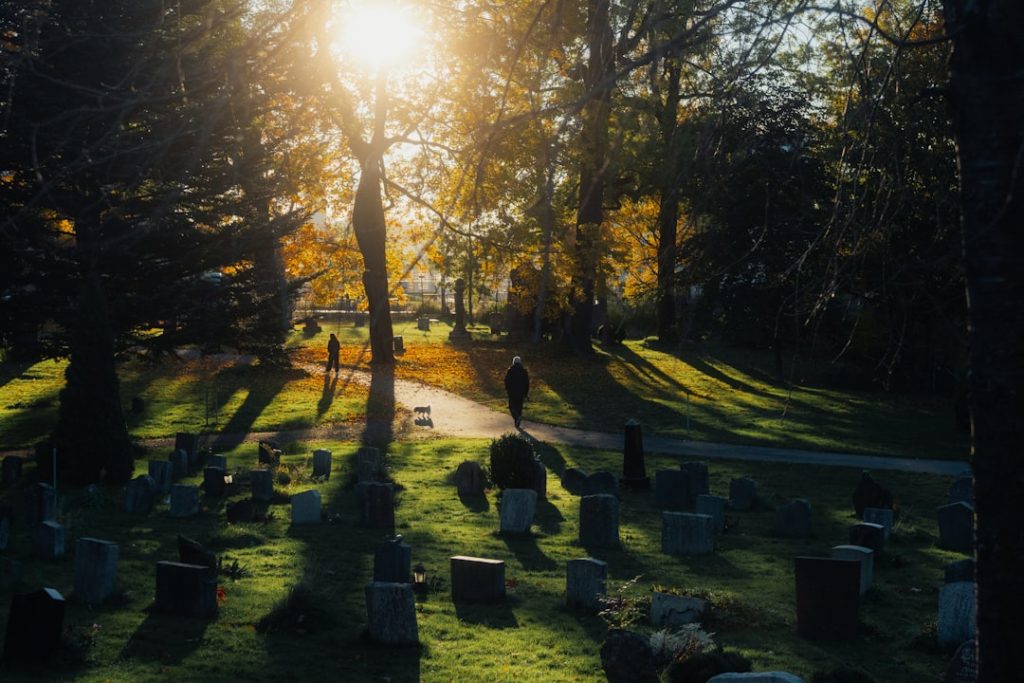
Historic cemeteries are among the most overlooked navigation tools in an RVer’s toolkit. They anchor small towns to their origins, sit near walkable downtowns, and often come with wide perimeter streets built for funeral processions. More than just a parking clue – they’re a doorway into local history.
Why It Works
Most RVers think in terms of Walmart lots, truck stops, and commercial campgrounds. But apps like Find A Grave and BillionGraves reveal something more useful: the original centers of small towns, mapped through the people who built them.
Historic cemeteries were established when towns were walkable. That means they’re typically within a few blocks of a main street, a local diner, and a hardware store. The wide streets around them were designed for horse-drawn hearses – which happens to work well for 35-foot rigs, too.
“The headstones don’t just tell you who lived here. They tell you what kind of place this is – and whether the town is worth a longer visit.”
This isn’t about parking in cemeteries. It’s about using them as cultural anchors to identify the right towns, then finding legal nearby parking. Always verify local regulations before staying overnight.
How to Do It
Open Find A Grave or BillionGraves and look for historic cemeteries in towns of 1,500–8,000 people along your path. Larger cities enforce parking too strictly; smaller ones may lack services.
Pull up Google Earth or Maps.me to assess street width around the cemetery perimeter. Look for wide residential streets, church lots, or municipal areas that can accommodate your rig.
Call the town hall or check the municipal website before you arrive. Overnight parking rules vary widely, and assumptions will get you towed.
Walk the cemetery before dark, find your spot on a side street away from the main entrance, keep generators off after 8 PM, and pull out early before local activity picks up.
The Apps Worth Using
Largest database. Broad coverage across the U.S. Free basic version works for most research; premium adds offline access.
GPS-precise grave locations and photo documentation. Smaller database than Find A Grave, but more accurate in the field.
Essential companion for evaluating street width, access points, and RV maneuverability before you commit to a location.
Download offline maps before entering rural areas. Many historic small towns have spotty or nonexistent cellular coverage.
Regional Notes
Rich in colonial-era cemeteries with well-documented records – but historic town centers often have narrow streets. Measure your clearances carefully before committing.
Pioneer cemeteries frequently sit on town outskirts where agricultural layouts leave generous street widths. Generally more space, fewer restrictions.
Many cemeteries reflect historical segregation, with separate sections by race or denomination. Research local context before visiting – it matters for how you engage with the community.
Common Misconceptions
Cemetery-adjacent parking is universally disrespectful or prohibited. In reality, some small towns welcome quiet visitors who show genuine interest in local history – as long as you follow basic etiquette.
These apps only show burial data. They also surface obituaries, family connections, migration patterns, and in some cases links to local newspaper archives – useful for understanding a town before you arrive.
All small towns are fine with overnight parking. They’re not. Always verify. A two-minute call to the town hall can save you a knock on the door at midnight.
Park only in well-lit public areas adjacent to cemeteries – never inside the grounds unless explicitly permitted. Avoid blocking access roads or emergency routes. Tell someone where you’re staying when cellular coverage is limited.
Frequently Asked Questions
Is this actually legal?
It depends entirely on local ordinances – which is why Step 3 exists. There’s no universal rule. Some small towns actively welcome overnight visitors; others prohibit it. The cemetery itself is never the parking spot; it’s the discovery tool that gets you to the right neighborhood.
What’s the best population range for target towns?
Towns between 1,500 and 8,000 residents tend to offer the right balance: enough infrastructure (a grocery store, a café, a working gas station) without the parking enforcement that comes with larger cities.
How do I approach locals without seeming strange?
Lead with genuine curiosity about the history. If you’ve done your cemetery research, you’ll already know something specific about the town – a founding family, a notable grave, an old industry. That knowledge signals respect, and locals notice it.
Do I need to spend money on premium app versions?
Not necessarily. The free tiers of Find A Grave and BillionGraves are sufficient for most route planning. Premium versions ($3–$9) add offline access and enhanced historical data, which is useful if you’re frequently in areas without cell service.
What etiquette matters most?
Generator silence after 8 PM, lights pointed away from residential areas, no lingering beyond early morning, and waste disposed of properly – never near the grounds. A small donation to a cemetery maintenance box, if one exists, is a genuinely appreciated gesture.
Cemetery mapping apps are discovery tools first, parking tools second. Used well, they connect you to the towns that guidebooks miss – places with real history, welcoming locals, and the kind of quiet that makes for a genuinely restful night. Treat the approach with the respect it deserves, and it pays back in kind.