Best RV Water Filters for Boondocking
Not all RV water filter systems are built for off-grid use. Here’s exactly what you need when the source is a well, stream, or unknown fill station.
Wrong guide? If your problem is RV water that smells bad from a campground hookup, this isn’t it.
See: Why Your RV Water Smells Bad – And the Simple Fix Most People Miss →
This guide covers RV water filters for boondocking specifically – wells, streams, tanks, and unknown fill stations where a basic inline RV water filter isn’t enough.
Why Boondocking Needs
a Different RV Water
Filter System
At a campground, a basic inline RV water filter handles chlorine and odor in seconds – that’s all you need. But when you’re truly off-grid, drawing from wells, rivers, or backcountry fill stations, a standard water filter for RV camping won’t protect you from what’s actually in that water.
Campground Water Problems
- Chlorine taste and smell
- Minor sediment from aging pipes
- Occasional mineral content
- Basic taste issues
Boondocking Water Problems
- Bacteria & protozoa (Giardia, Cryptosporidium)
- Heavy sediment, rust, particulates
- Agricultural or industrial runoff
- High mineral content from ground sources
- Unknown chemical contamination
The Micron Rating Scale
Lower = better filtration. This is the single most important number to understand before buying.
Important: For natural water sources (streams, wells, rivers), you must use a filter rated at 0.1–0.2 microns or lower. Standard carbon inline filters at 5–20 microns do NOT remove bacteria or protozoa. This is a health risk, not just a taste issue.
Match the RV Water
Filter to Your Style
The right RV water filter system depends on where you get your water – not just your budget. Here’s how each boondocking scenario maps to the right filtration approach.
You’re mainly connected to campground spigots with occasional dry camping. The water is municipally treated. Your problem is chlorine taste, sediment, and minor odors – a simple inline RV water filter solves this immediately.
You sometimes draw from wells, fill stations, or backcountry sources. Water quality is uncertain. A standard water filter for RV camping won’t cut it – you need filtration rated for biological contamination, especially for your RV drinking water filter.
You’re drawing from questionable sources regularly and need the highest long-term water quality. A dedicated whole-RV water filter system is worth the investment – and it covers every tap in the rig, not just drinking water.
Filter Comparison at a Glance
| Filter | Type | Micron Rating | Removes Bacteria? | Best For |
|---|---|---|---|---|
| Camco TastePURE | Inline carbon + KDF | 20μ | No | Campground hookups |
| Clear2O RV Marine Inline | Carbon block inline | 1μ | No | Better campground filtration |
| RVGUARD Inline | Inline carbon | 5μ | No | Budget option, hookups |
| ClearSource Premium | Multi-stage whole-RV | 0.2μ | Yes | Full-time boondocking |
| Katadyn BeFree | Portable hollow fiber | 0.1μ | Yes | Natural sources, backcountry |
| Sawyer Micro Squeeze | Portable squeeze filter | 0.1μ | Yes | Emergency backup, remote use |
| Reverse Osmosis (under-sink) | RO membrane | 0.0001μ | Yes (all) | Drinking water, extreme cases |
The Two-Layer Strategy
How serious boondockers combine an inline RV water filter with a dedicated RV drinking water filter
Every drop entering your RV passes through an inline RV water filter. This removes sediment, chlorine, and odors – protecting your entire plumbing system and tank from contamination at the source. Use this for all water: showers, cooking, washing.
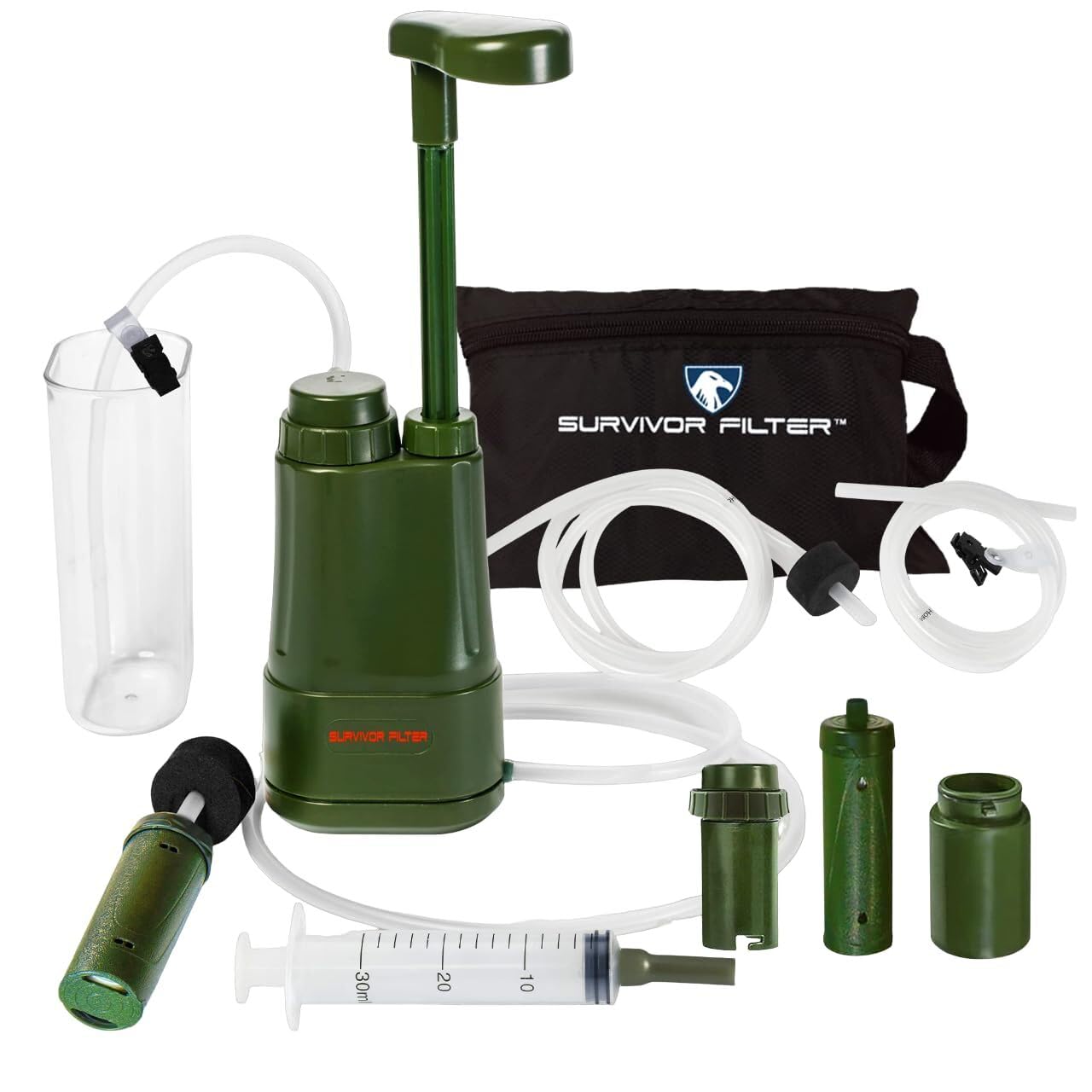
When drawing from wells, streams, or unknown fill stations, add a portable 0.1-micron RV drinking water filter (Katadyn or Sawyer) for your drinking water specifically. This secondary layer catches bacteria and protozoa that inline water filters for RV camping cannot touch – and works without any hookup or power.
What to Look For in an
RV Water Filter System
Micron Rating
5+ = basic. 1μ = better particulate. 0.1-0.2μ = bacteria and protozoa. Go this low for any natural source.
Certification
NSF 42 (taste/odor), NSF 53 (health contaminants). For portable filters: EPA/NSF Guide Standard 12729 for biological removal.
Flow Rate (GPM)
Critical. A filter perfect for a water bottle won’t supply an RV shower. Check gallons-per-minute ratings against your RV’s demand.
Filter Lifespan
Most inline filters: 2-3 months or ~3,000 gallons. Sawyer Micro Squeeze: up to 100,000 gallons with backflushing. Write the install date on the filter.
Common Mistakes with
RV Water Filters for
Boondocking
Using a campground-style water filter for RV camping off-grid
Basic inline filters don’t remove bacteria or protozoa. This is a real health risk when sourcing from wells or streams. You need 0.1μ or lower for natural sources.
Skipping tank sanitization before filling
Even filtered water introduces bacteria if your tank is contaminated. Sanitize your freshwater tank at least twice per season.
Not replacing filters on schedule
A carbon filter past its date doesn’t just stop working – it can release trapped contaminants back into your water. Mark the install date with a marker.
Not carrying a backup portable filter
If your inline filter fails or you’re drawing from a questionable source, a Sawyer or Katadyn deploys in seconds. It can be a literal lifesaver off-grid.