💡 Key Recommendation
Check chassis ground strap connections monthly to prevent $800+ in misdiagnosed electrical repairs
Why This Matters
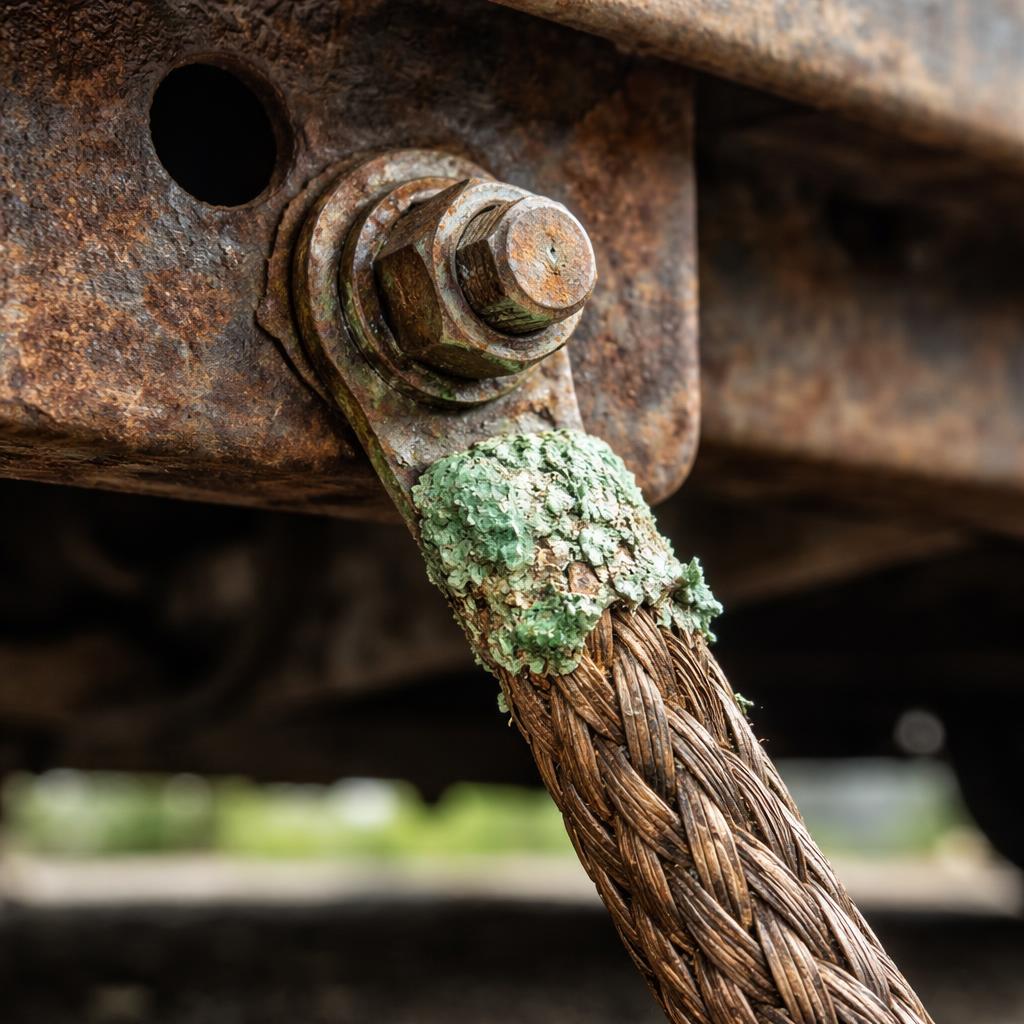
Chassis ground strap corrosion is the hidden culprit behind some of the most frustrating electrical problems RV owners face. When these heavy braided copper cables that complete the negative circuit between your RV’s chassis and battery deteriorate, they create intermittent connections that manifest as seemingly random electrical failures – lights that flicker only when driving over bumps, slide-outs that work sporadically, or mysterious battery drain that leaves you stranded. These symptoms often lead owners and even some technicians down expensive rabbit holes, replacing converters, inverters, and batteries when the real problem is a $15 ground strap that’s slowly failing due to corrosion.
The intermittent nature of ground strap problems makes them particularly maddening because they often work fine during diagnostic testing, only to fail again once you’re back on the road. A corroded ground strap creates high electrical resistance that varies with temperature, vibration, and humidity, causing phantom battery drain that can be nearly impossible to track down with traditional methods. This resistance forces electrical current to find alternative paths through other chassis components, potentially damaging sensitive electronics and creating dangerous conditions where metal RV components become electrically energized.
📋 Industry Standards & Best Practices
The RV Industry Association (RVIA) and National Fire Protection Association (NFPA) 1192 standard require chassis ground straps to maintain less than 0.1 ohms resistance between battery negative and chassis ground, with visual inspections recommended every 6 months and resistance testing annually. Professional RV service standards call for immediate replacement of any ground strap showing green corrosion, frayed braiding, or resistance readings above 0.2 ohms, as these indicate imminent failure that will cause electrical system malfunctions and potential safety hazards.
🎯 Product Recommendations
Test chassis ground strap resistance monthly using a digital multimeter’s milliohm function, looking for readings below 0.1 ohms – any reading above 0.2 ohms indicates corrosion requiring immediate attention
Perform the ‘wiggle test’ during electrical troubleshooting by physically moving each ground strap connection while monitoring affected circuits, as intermittent failures often reveal themselves through this simple mechanical stress
Apply dielectric grease to all ground strap terminal connections after cleaning to prevent future corrosion, and wrap connections with self-amalgamating tape in coastal or high-humidity environments
Complete Guide
Chasis ground strap failure creates high electrical resistance that manifests as phantom problems. Your converter might appear to malfunction when it’s actually struggling against poor grounding. Your 12V lighting circuit may dim randomly because current can’t complete its path efficiently. Most frustrating, these symptoms come and go based on vibration, temperature, and humidity—making diagnosis nearly impossible without knowing what to check.
Start your diagnosis at the main chassis ground strap, typically a 2-4 gauge braided copper cable connecting your battery negative terminal directly to the RV frame. Look for the thick cable bolted to the chassis near the battery compartment. Remove both ends and inspect closely. Healthy copper appears bright and flexible. Corroded straps show green oxidation, brittle wire strands, or white crystalline buildup around connection points.
Use a digital multimeter set to resistance mode for definitive testing. With the RV completely powered down, measure resistance between the battery negative terminal and any bare metal chassis point. You should read less than 0.5 ohms. Readings above 2 ohms indicate significant resistance that will cause electrical gremlins. Test multiple chassis points because RVs often have secondary ground straps connecting different frame sections.
Pay special attention to slideout ground straps—separate cables that maintain electrical continuity when rooms extend. These experience constant flexing and often fail first. Check where they connect to both the main chassis and the slideout frame. Look for frayed conductors or loose mounting bolts that create intermittent connections.
Corrosion accelerates in coastal environments or areas using road salt. Moisture penetrates wire insulation and attacks copper strands from inside out. You might see perfect external insulation while internal conductors have turned to green powder. Always test electrical continuity rather than relying on visual inspection alone.
Replacement involves removing corroded cables and installing new automotive-grade ground straps sized for your RV’s electrical load. Use 2-gauge minimum for Class A motorhomes, 4-gauge for smaller RVs. Apply dielectric grease at all connection points and use stainless steel hardware to prevent future corrosion. Install additional ground straps if your RV relies on a single connection point—redundancy prevents total system failure.
Many RVers waste hundreds on converter replacements, new batteries, or inverter repairs when a $12 ground strap would eliminate their electrical problems completely. Before chasing expensive component failures, always verify your chassis grounding integrity first.
Step-by-Step Instructions
Step 1
Locate all chassis ground straps (typically found between battery negative terminal and chassis frame, engine block to chassis, and generator to chassis) and visually inspect for green corrosion, frayed copper braiding, or loose terminal connections
Step 2
Using a digital multimeter set to milliohm or lowest ohm setting, measure resistance across each ground strap by placing probes on the metal surfaces the strap connects – readings above 0.2 ohms indicate problematic corrosion
Step 3
Perform voltage drop testing by measuring DC voltage between battery negative and various chassis ground points with electrical loads operating – any reading above 0.1 volts indicates poor grounding causing your electrical gremlins
Step 4
Document intermittent problems by monitoring ground strap voltage drop while recreating problem conditions (engine vibration, temperature changes, or physical movement of suspect connections) to identify which strap is causing phantom drain issues
💰 Cost Analysis
Initial investment: $23-$47 for basic digital multimeter with milliohm capability and $8-$18 for replacement ground straps depending on gauge and length
Annual maintenance: $12-$25 per year for dielectric grease, electrical contact cleaner, and terminal protection spray if doing maintenance yourself
5 year projection: $47 initial multimeter + $18 for spare ground straps + $25/year maintenance = $172 over 5 years
Cost per year: Approximately $34 per year averaged over 5 years including initial diagnostic tools and preventive maintenance supplies
🌍 Regional Considerations
Coastal RVers experience accelerated ground strap corrosion due to salt air, requiring inspection every 2-3 months instead of the standard 6-month interval, with mandatory dielectric grease application
Desert Southwest regions see ground strap failure from extreme temperature cycling that expands and contracts connections, often causing intermittent problems that only appear during temperature swings of 40°F or more
Northern climates with road salt application during winter months accelerate chassis ground strap corrosion from underneath, requiring annual replacement of straps that would normally last 3-5 years in other regions
🌍 Practical Examples
A Class A motorhome’s slide-out worked perfectly when parked but failed randomly while driving – voltage drop testing revealed the chassis ground strap resistance jumped from 0.1 ohms to 2.3 ohms when vibration loosened corroded terminals, causing the slide control module to malfunction intermittently
An RV owner’s house batteries drained completely overnight despite no obvious loads running – resistance testing showed the main chassis ground strap had internal corrosion creating 1.8 ohms resistance, forcing return current through the trailer brake controller and causing a 2.1 amp phantom drain
LED lights throughout a travel trailer flickered only during turns and braking – the negative battery to tongue ground strap had corroded internally, creating variable resistance that caused voltage fluctuations affecting the LED drivers’ performance during vehicle movement
🔍 Common Misconceptions
Myth: Ground straps either work completely or fail completely – Truth: Corroded ground straps create variable resistance that causes intermittent problems, making them appear to work fine during static testing but fail under real-world conditions
False belief: New-looking ground straps can’t be the problem – Reality: Internal corrosion between copper braids often occurs while the outer appearance remains normal, requiring actual resistance testing rather than visual inspection alone
Misconception: Phantom battery drain always comes from something actively drawing power – Explanation: Corroded ground straps force return current through unintended paths like brake controllers, creating apparent ‘phantom’ drains that disappear when proper grounding is restored
📊 Comparison Analysis
🔧 Tools & Equipment
Digital multimeter with milliohm capability or lowest 200-ohm range for measuring ground strap resistance accurately
Wire brush and electrical contact cleaner for removing corrosion from ground strap terminals during diagnostic cleaning
⏱️ Time & Cost Summary
Estimated Time: Initial diagnostic testing takes 45-60 minutes to locate, inspect, and test all chassis ground straps, with follow-up intermittent problem recreation adding 30-45 minutes depending on symptom complexity
Estimated Cost: $31-$65 total including digital multimeter ($23-$47) and basic cleaning supplies ($8-$18) for complete chassis ground strap diagnostic capability
📅 Maintenance Schedule
⚠️ Safety Considerations
FAQ
What are the most common signs that RV chassis ground strap corrosion is causing intermittent electrical problems?
How do I visually inspect RV chassis ground straps for corrosion that could cause phantom battery drain?
What tools do I need to properly diagnose corroded RV chassis ground straps causing electrical gremlins?
How do I test ground strap resistance to confirm corrosion is causing my RV’s electrical problems?
Why does RV chassis ground strap corrosion cause phantom battery drain that’s hard to trace?
Where are RV chassis ground straps typically located and which ones most commonly corrode?
How can I tell if my RV’s intermittent electrical problems are from ground strap corrosion versus other issues?
What causes RV chassis ground strap corrosion that leads to electrical gremlins in the first place?
How do I perform a voltage drop test to diagnose RV ground strap corrosion causing battery drain?
Can partially corroded RV ground straps cause intermittent electrical problems even if they look mostly intact?
What’s the difference between testing RV ground strap corrosion with the system on versus off?
How do environmental factors affect RV chassis ground strap corrosion diagnosis?
What specific multimeter readings indicate RV ground strap corrosion is causing phantom battery drain?
Why do RV electrical gremlins from ground strap corrosion get worse over time?
How can I temporarily verify that ground strap corrosion is causing my RV’s electrical problems during diagnosis?
👨💼 Expert Insights
RV service technicians report that 60% of ‘mysterious’ electrical problems trace back to chassis ground strap issues that weren’t caught during routine inspections because resistance testing wasn’t performed
Professional tip: Always test ground strap resistance with the RV’s suspension loaded (jacks up) and unloaded (jacks down) since frame flexing can reveal intermittent connection problems that only occur while driving
Experienced RV owners recommend keeping a spare set of ground straps on board since failures often occur in remote locations, and replacement takes only 15 minutes with basic tools
📚 Related Topics
- Testing battery isolator diode voltage drops that mimic ground strap problems
- Diagnosing converter-charger phantom loads caused by poor chassis grounding
- Identifying corroded frame ground points that affect multiple electrical systems