RV Fire Safety Guide
RV Fire Safety Guide
How Fires Start, How to Prevent Them, and What to Do
Why RV Fire Risk Is Different
A house fire is devastating. An RV fire is categorically faster, and the difference matters in ways that most RV owners have not fully considered.
The average American home gives occupants roughly three minutes to escape once a fire becomes established. An RV – with its compact dimensions, lightweight synthetic construction, and multiple fuel sources packed into a small space – can become fully engulfed in under two minutes from ignition. That is not a hypothetical worst case. It is a realistic timeline based on how RV materials burn and how quickly fire moves through a small enclosed space.
This does not mean RV travel is unsafe. It means the margin for error is narrower, and understanding that margin is the foundation of managing fire risk well. Prevention is the most important layer of protection. Detection is the second. And knowing what to do in the first sixty seconds of a fire – before hesitation costs you the window to act – is the third.
This guide covers all three in practical terms.
How RV Fires Actually Start
Most RV fires are not mysterious. They trace back to a small set of causes, almost all of which are preventable with consistent habits and basic maintenance.
Cooking-Related Fires
Cooking is the leading cause of RV fires, and the mechanism is usually simple: an unattended burner, a grease splatter that reaches a flame, or a towel or paper bag left too close to an active stovetop. RV kitchens are compact, which means the clearance between a burner and surrounding cabinetry, overhead cabinet faces, and stored items is minimal. What would be a manageable flare-up in a larger kitchen can catch cabinet material or window treatments within seconds.
The risk is elevated when cooking in an unfamiliar rig, when cooking while tired or distracted, and when the stovetop area has accumulated grease over time. A clean stovetop is not just a hygiene consideration – it is a fire risk management habit.
Outdoor grilling adds its own variables. A grill positioned too close to the RV, used on a windy day, or left unattended while the user goes inside introduces ignition risk to the exterior – particularly slide-out seals, awning fabric, and the underside of slideouts themselves.
Electrical Faults
Electrical fires in RVs develop from several distinct sources, and each requires a different preventive approach.
Shore power connections at campground pedestals are an underappreciated risk. Pedestals vary widely in age, condition, and wiring quality. A pedestal with reversed polarity, an open ground, or unstable voltage can send unsafe power into your RV’s electrical system. Over time, or under certain conditions, this can generate heat at connection points, degrade wiring insulation, and create arc faults – all of which are fire precursors.
Onboard wiring degrades with age and vibration. RVs travel on rough roads, and that movement works connections loose over time. A connection that is slightly loose generates resistance, resistance generates heat, and heat in the right location is a fire. This is especially common in older rigs, in RVs that have had DIY electrical modifications, and in any vehicle where aftermarket components were added without proper attention to wire gauge and fusing.
Overloaded circuits are another common cause. Running multiple high-draw appliances – an air conditioner, a microwave, an electric skillet, and a space heater simultaneously – on a circuit not rated for that load causes breakers to trip in the best case, and wiring to overheat in worse cases. Breakers that trip repeatedly are not an annoyance. They are a signal that the circuit is being asked to carry more than it should.
Lithium and AGM battery systems, if improperly installed or charged with incompatible chargers, can also generate significant heat. Battery fires are slow to detect and difficult to extinguish.
Propane System Failures
Propane is the fuel source for stoves, ovens, water heaters, refrigerators, and furnaces in most RVs. It is efficient, reliable, and well-understood – but it requires a system that is properly maintained and regularly inspected.
The most common propane-related fire causes are: damaged or aging hoses, fittings that have worked loose through vibration, regulators that are past their service life, and connections that were not properly tightened after a tank change. Propane is heavier than air, which means a leak does not dissipate upward – it settles at floor level and accumulates in low areas of the RV, under cabinetry, in the basement storage area, and in bilge spaces. Any ignition source – a pilot light, a thermostat clicking on, a light switch – can ignite that accumulated gas.
The risk is highest immediately after tank changes or system reconnections, when fittings have been disturbed. It is also elevated in spring when an RV is taken out of winter storage and the propane system has not been run or inspected in months.
Heater and Furnace Issues
RV furnaces are combustion appliances that cycle on and off hundreds of times through a season. They draw air from inside the RV, combust propane, and vent exhaust outside through a sidewall vent. When functioning correctly, they are safe. When something is wrong – a cracked heat exchanger, a blocked vent, a dirty burner, or a failing ignition system – they can produce carbon monoxide, incomplete combustion, and in some cases localized heat buildup that reaches surrounding materials.
Portable space heaters introduced inside an RV carry their own risk profile. Units that are not rated for indoor use, heaters placed too close to bedding or curtains, and heaters left running unattended in sleeping areas are a consistent source of preventable fires.
Generator-Related Risks
Generators produce heat, exhaust, and in some cases sparks. A generator mounted in a compartment with inadequate ventilation generates heat that has nowhere to go. Fuel leaks in the generator system – whether from the generator’s own fuel supply or from nearby propane lines that have been subjected to heat and vibration – create fire conditions that are difficult to detect until a problem is already developing.
Portable generators placed outside the RV carry lower fire risk to the coach itself, but introduce carbon monoxide risk if positioned where exhaust can enter through a window, vent, or door. The fire and the gas risk interact: CO accumulation may incapacitate occupants before a fire-related issue becomes visible.
Why RV Fires Are More Dangerous
Understanding the physics of an RV fire helps explain why reaction time matters so much.
RVs are built for weight savings, which means the structural and interior materials are mostly lightweight synthetics – fiberglass, foam insulation, plastic paneling, thin wood composites, and fabric. These materials ignite more readily than the drywall, plaster, and solid wood found in residential construction, and they burn faster once ignited. They also produce dense smoke and toxic gases quickly, which affects visibility and respiratory safety within seconds of a fire establishing itself.
The floor plan of most RVs means that a fire starting in the kitchen or at the shore power connection is close to the sleeping area, the primary door, and all of the stored gear that feeds combustion. There is no firewall, no compartmentalization between living zones, and often only one primary exit. Slide-outs, when extended, can complicate egress if a fire disrupts electrical or manual retraction.
Smoke moves through a small enclosed space faster than most people expect. A fire at one end of an RV can make the other end untenable from smoke within thirty to sixty seconds. The practical implication is that once a fire is established, evacuation is the priority – not assessment, not gathering belongings, and not fighting a fire that has already grown beyond a small, contained stage.
Fire Prevention That Actually Works
Prevention is the highest-value activity in RV fire safety. No amount of extinguisher capacity or detector sensitivity replaces the habits that keep fires from starting.
Cooking Habits
Never leave an active burner unattended – not even briefly. The most common kitchen fires start during the thirty seconds someone stepped away. Keep the stovetop and surrounding area free of grease buildup, paper, towels, and anything that could catch a spark or contact a flame. Know the clearances in your specific RV kitchen and position items accordingly.
When grilling outside, maintain at least three feet of clearance between the grill and any part of the RV. Do not grill under the awning. Do not leave a lit grill unattended. Extinguish coals or shut off gas before going inside.
Electrical Management
Use a quality electrical management system (EMS) at every shore power hookup. This single habit addresses the most common shore power risks – overvoltage, undervoltage, reversed polarity, and open grounds – before they can affect your system. Check your shore power cord and connections regularly for heat discoloration, melting, or burn marks, which are signs of a connection problem.
Avoid running multiple high-draw appliances simultaneously. Know the amperage capacity of your shore power connection and manage appliance use within that limit. If your breakers trip repeatedly under normal use, the cause needs to be investigated – not reset and ignored.
Do not use extension cords as permanent wiring. Do not exceed the rated capacity of any power strip. Inspect your battery charging setup and confirm that the charger is compatible with your battery chemistry.
Propane System Checks
Inspect all accessible propane hoses and connections at the start of each season and after any period of extended storage. Hoses should be free of cracks, brittleness, or visible damage. Fittings should be snug. Use a soap solution on connections to check for bubbles, which indicate a leak.
Know where your propane shutoff is and make turning it off part of your departure routine when leaving the RV for an extended period. After any tank change or connection disturbance, check fittings before operating any appliance.
Have your propane system professionally inspected every two to three years, or any time you suspect a problem. Regulators have a recommended service life and should be replaced on schedule.
Maintenance Routines
The fire risks that catch people off guard are almost always maintenance failures that developed gradually. Build a regular inspection habit that includes: checking the stovetop and oven area for grease accumulation, inspecting the shore power cord for physical damage, looking at accessible wiring for signs of heat or abrasion, confirming that all vents are clear and unobstructed, and verifying that detector batteries and units are current.
After any trip with unusual electrical behavior – repeated breaker trips, appliances behaving strangely, outlets that feel warm – have the system inspected before the next trip. These are warning signs, not inconveniences to work around.
Essential Fire Safety Equipment
Equipment does not prevent fires. It gives you information faster and extends your response window. Understood correctly, each piece of equipment serves a specific function in that response window.
An RV should carry at least one fire extinguisher rated for the types of fires most likely to occur: Class A (ordinary combustibles), Class B (flammable liquids and gases), and Class C (electrical). An ABC-rated dry chemical extinguisher covers all three categories and is the standard choice for RV use.
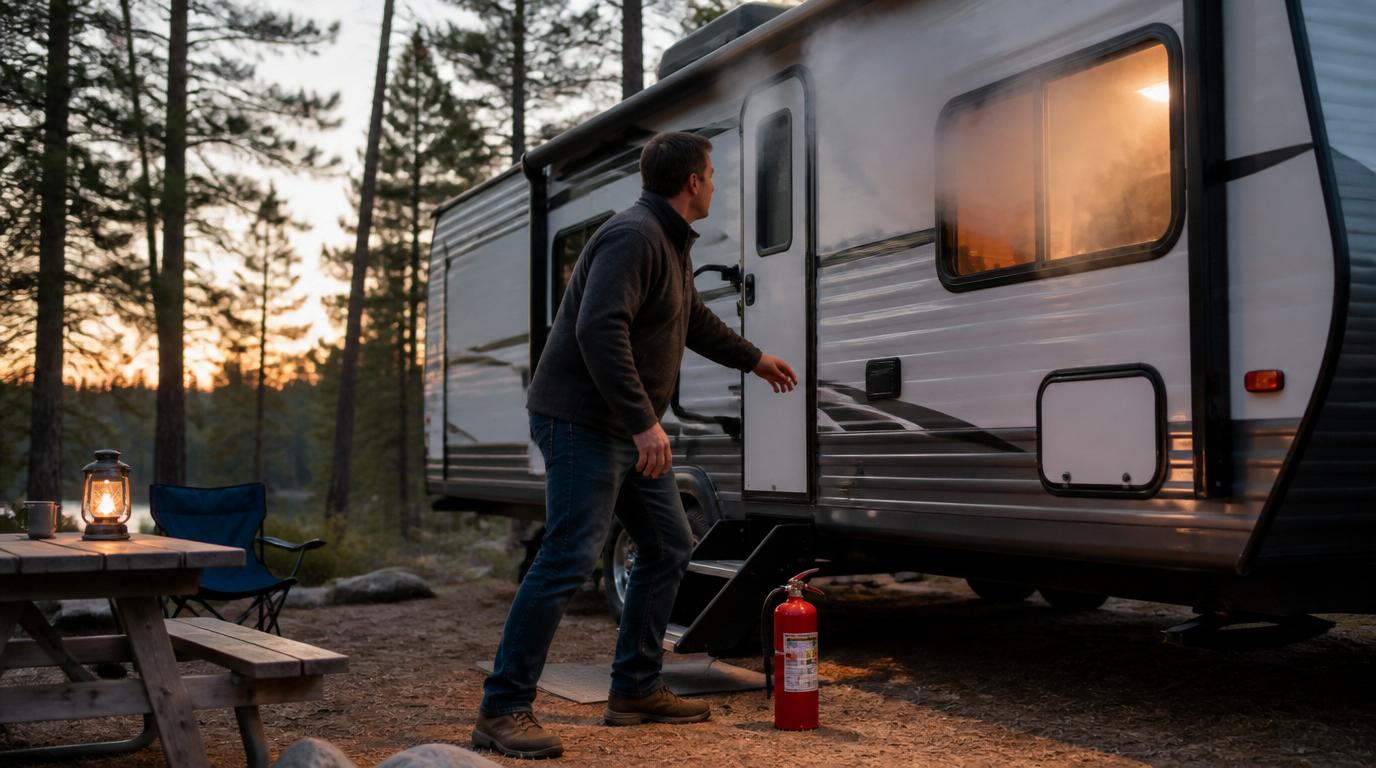
Placement matters as much as capacity. An extinguisher stored under the bed, inside a cabinet, or behind stored gear provides almost no practical value in an emergency. It needs to be immediately accessible from the kitchen area – the highest-risk zone – and a second unit near the exit door is a sound practice. Every adult who travels in the RV should know where the extinguisher is, know how to operate it (Pull, Aim, Squeeze, Sweep – PASS), and have practiced at least once. Check the pressure gauge monthly. Have it inspected annually.
Smoke detectors should be positioned in sleeping areas and near the kitchen. Test them monthly. Replace batteries annually on a fixed schedule, regardless of the low-battery warning – by the time the warning sounds, you may be in a situation where a replacement battery is not on hand.
Combination smoke and CO detectors are practical for the space constraints of an RV, but confirm that the unit you have is rated for both functions and is within its stated service life. Many combination units have separate sensor elements with different service lives.
A propane detector monitors for gas accumulation at floor level, where propane settles. A CO detector monitors for carbon monoxide from combustion appliances. Both should be present, functional, and within their service life.
Factory-installed detectors are often the first thing overlooked in a used RV purchase. Confirm the installation date, check the manufacturer’s stated service life (typically five to seven years), and replace any unit that is expired or of unknown age. A detector past its service life may still emit an alarm test tone – that tests the alarm circuit, not the sensor’s ability to detect gas.
What to Do If a Fire Starts
The most important thing to understand about fire response is that the window for action is short. A decision made in the first twenty seconds can mean the difference between a contained incident and a total loss – or worse.
The moment you smell smoke, hear a detector, or see flame or heavy smoke, alert everyone in the RV immediately. Do not investigate quietly. Do not assume the detector is a false alarm.
If the fire is small – a burning dish towel, a small grease flare on the stovetop, a localized flame that has not spread – and you have an extinguisher immediately in hand, you have a brief window to act. If the fire has spread to cabinetry, is producing heavy smoke, or involves upholstery or wall materials, skip directly to evacuation.
Pull the pin. Aim at the base of the flame, not the top. Squeeze the handle. Sweep side to side across the base. Most handheld extinguishers discharge in eight to twelve seconds. If the fire is not out within one discharge, stop and evacuate. Do not attempt a second pass.
Everyone out. Leave belongings. If the door is hot, use an alternate exit. Once outside, move away from the RV – fuel tanks, propane, and battery systems can all contribute to secondary events. Do not re-enter.
Call emergency services immediately upon evacuating, even if the fire appears to be out. Fires that appear extinguished can smolder in walls and re-ignite.
Common Mistakes That Make Fires Worse
One extinguisher stored behind other gear fails at the most basic requirement: being reachable in the first ten seconds of a fire.
An RV with gear piled near the exit door, a door latch that sticks, or a slide-out that blocks the primary egress path creates a problem that compounds under stress. Practice your exit. Know your secondary options.
A detector with a dead battery or past its service life is not a safety device. It is an object that creates false confidence. Test monthly. Replace on schedule.
A fire that has moved beyond a small, contained flame to involving structural material or producing heavy smoke is not manageable with a handheld extinguisher. Every second spent attempting to fight it is a second not spent evacuating. The threshold for evacuation should be set low, not high.
An extinguisher stored in a bedroom or rear bathroom requires you to move toward a fire to retrieve it. Placement near the kitchen and near the exit door means you can access it on the way out, not on the way in.
For Further Reading
The principles in this guide sit within a broader framework of RV safety that is worth understanding fully. If you have not already reviewed the fundamentals of how to prioritize safety gear across all risk categories – not just fire – the RV Safety and Emergency Gear guide covers that ground clearly, including the common mistake of preparing for unlikely events while underinvesting in high-probability risks.
For building out a complete emergency response capability – including what to carry, how to organize it, and what actually gets used in a real situation – the RV Emergency Kit Guide is the practical next step.
If You Only Remember This
Fires in RVs happen fast – faster than most people expect, and faster than the residential fire experience most people use as their reference point. The timeline from small flame to uncontrollable fire can be under two minutes.
Prevention matters more than gear. The habits that keep fires from starting – clean cooking surfaces, managed electrical loads, inspected propane systems, and regular maintenance – are worth more than any combination of extinguishers and detectors. Gear is the backup layer, not the primary one.
Detection and reaction time are everything. A working detector that gives you thirty additional seconds of warning, combined with a clear plan and an accessible extinguisher, meaningfully changes your options. A detector with a dead battery and an extinguisher behind a closed cabinet change nothing.
Know your exit. Know where your extinguisher is. Know when to fight and when to leave – and set that threshold earlier than feels necessary, because fires grow faster than the instinct to stay and manage them.