Finding the Best High Pressure RV Showerhead for Your Adventure
Why Is RV Water Pressure So Low in the First Place?
Before you blame your showerhead, it helps to understand what’s actually limiting your shower pressure. RV plumbing is a fundamentally different system than a home – and it has several built-in constraints that no showerhead alone can fully overcome.
🔧 The Four Real Causes of Low RV Shower Pressure
- Small-diameter supply lines. Most RV plumbing uses ½-inch or even 3/8-inch lines throughout – far narrower than the ¾-inch lines standard in residential homes. Narrower pipes mean less volume can move through at any moment, which translates directly to lower pressure at the fixture.
- Long hose runs with multiple bends. Every foot of pipe and every elbow fitting creates friction that bleeds off pressure before the water ever reaches your showerhead. RVs are compact, but the plumbing routes are rarely straight.
- Onboard pump limitations. When running on fresh water tank (not connected to city water), most standard RV water pumps are rated at 3.5 GPM at a maximum of 55 PSI – and that’s under ideal conditions. In reality, aging pumps, low battery voltage, and a partially depleted tank all push real-world output significantly lower.
- Campground pressure variability. Even on city water hookup, campground supply pressure is inconsistent. RVIA guidelines recommend RVers use a pressure regulator set to 40–50 PSI at the hookup – a safe level for RV plumbing but noticeably lower than the 60–80 PSI typical in a home.
This is why a quality showerhead upgrade makes such a meaningful difference: it’s engineered to work within these constraints, wringing the best possible experience out of modest pressure – rather than requiring more than your system can deliver.
Pump Mode vs. City Water Hookup: What’s the Difference for Your Shower?
Your RV has two completely different water delivery systems, and they behave very differently in the shower. Understanding which one you’re using – and its specific limitations – helps you set realistic expectations and choose the right showerhead for how you actually camp.
Your 12V demand pump pulls water from the fresh tank and pressurizes it on demand – it only runs while a fixture is open. Typical specs:
- Pressure: 35–55 PSI (drops as tank empties)
- Flow: 3.0–4.0 GPM max at the pump, but this is before line losses
- Variability: High – pressure pulses rhythmically as the pump cycles on and off, creating the characteristic “RV shower stutter”
- Battery draw: ~7–10 amps while running; a weak battery means a weak pump
Best showerhead for pump mode: One with a lower flow rate (1.5–2.0 GPM) so your pump never has to work at its limit, and with internal flow regulation to smooth out pressure pulses.
At a campground hookup, your fresh water tank is bypassed and the campground’s pressurized supply feeds directly into your RV’s lines. This is more consistent but not without its own issues:
- Pressure: 40–80 PSI at the pedestal (highly variable by campground and time of day)
- You must use a pressure regulator – spikes above 60 PSI can damage RV fittings and appliances
- Peak hours (morning/evening) cause noticeable pressure drops as multiple rigs shower simultaneously
- Water quality varies – hard water and mineral buildup is a bigger issue on city hookups than from your own tank
Best showerhead for city water: One with a non-stick or rubber nozzle coating to resist mineral buildup, plus a flow limiter to protect against high-pressure spikes.
Pressure vs. Flow Rate: What Actually Makes a Shower Feel Good?
Most people assume that higher GPM (gallons per minute) means a better shower. In an RV, that thinking gets you into trouble. Pressure and flow are two different things – and in a resource-constrained RV environment, they work against each other in ways that matter.
Pressure is the force behind the water – it determines how hard the spray hits your skin. This is what you feel as “shower intensity.” It’s set by your pump or campground hookup, and a showerhead’s job is to make the most of whatever pressure arrives at the head.
Flow rate is the volume of water moving through per minute. Higher GPM doesn’t automatically mean more pressure – it just means more water. A high-flow head at low pressure gives you a dribble with lots of volume. A low-flow head engineered well gives you a strong, satisfying spray using less water.
This is exactly the engineering insight behind the Oxygenics technology: by injecting air into the water stream, the showerhead increases the velocity of the water without increasing the volume. You get the sensation of stronger pressure with the same – or even lower – GPM. It’s not marketing; it’s basic fluid dynamics (Bernoulli’s principle applied to nozzle design).
📊 What the Numbers Actually Mean for Boondockers
A typical 5-minute shower at different flow rates:
- Standard home head (2.5 GPM): 12.5 gallons used per shower
- Oxygenics Body Spa / Fury (2.0 GPM): 10 gallons – a 20% saving
- High Sierra (1.5 GPM): 7.5 gallons – a 40% saving vs. standard
A typical RV fresh water tank holds 40–60 gallons. That’s the difference between 3 showers and 8 showers between fill-ups – purely from the showerhead choice.
Why the Oxygenics Body Spa RV Shower Head Stands Out
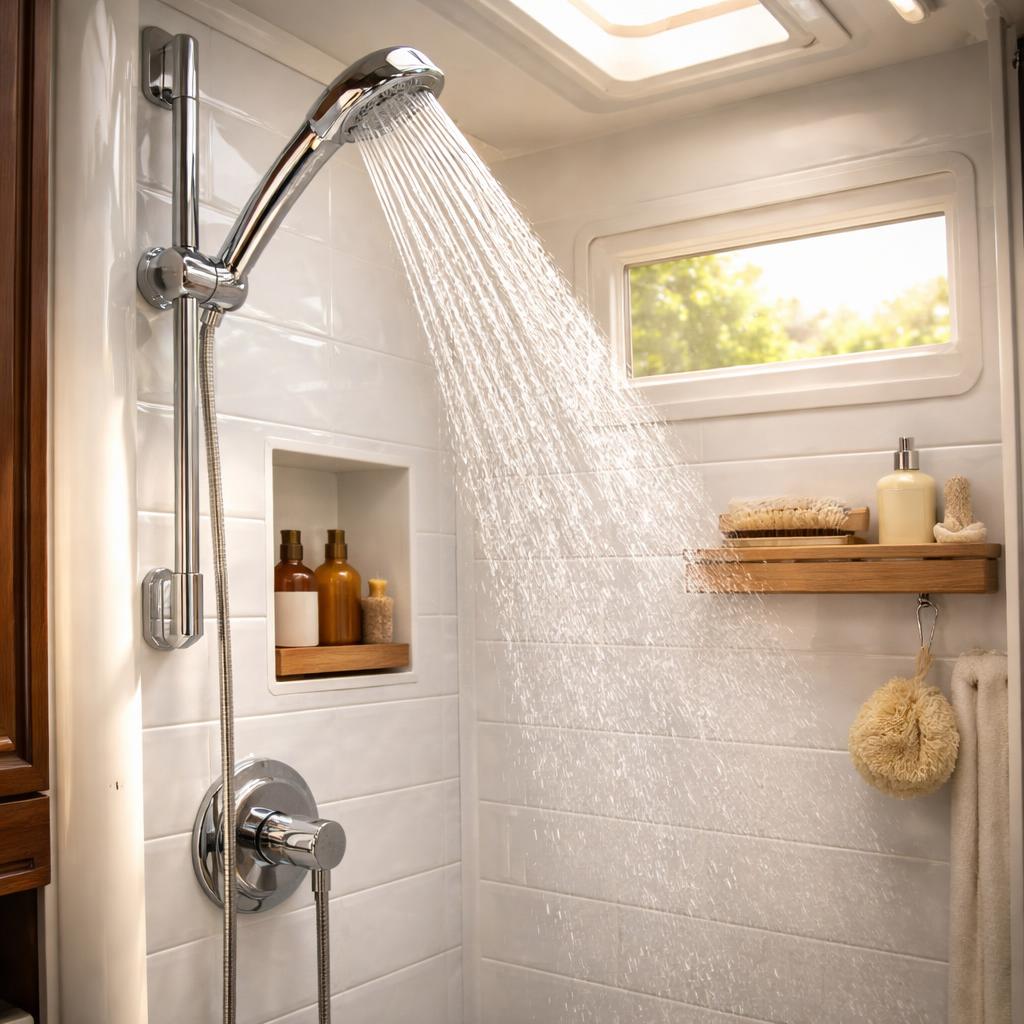
The Oxygenics Body Spa RV shower head is built around one core idea: deliver home-quality shower pressure even when the campground water supply is weak or inconsistent. It does this through Oxygenics’ patented air-injection technology – mixing oxygen into the water stream to accelerate flow and boost perceived pressure without increasing water consumption.
Unlike the Oxygenics Fury shower head – which is designed for maximum pressure versatility with 5 spray modes – the Body Spa focuses on a more luxurious, spa-like experience. It’s the choice for RVers who want a softer, wider spray that feels less like a camping shower and more like home.
🏆 Oxygenics Body Spa RV Shower Head – Editor’s Choice
The Body Spa is the top pick for RVers who want a consistently satisfying shower experience on the road. Its air-injection technology delivers strong, invigorating pressure even at campgrounds with notoriously weak water supply – and at a flow rate that won’t drain your fresh water tank prematurely.
- Patented Oxygenics air-injection technology – mixes oxygen into the stream for spa-like pressure
- 2.0 GPM flow rate – WaterSense certified, water-efficient without sacrificing feel
- Non-stick finish – resists mineral buildup and soap scum in hard-water campgrounds
- 60-inch hose – long enough to reach all areas of the RV shower stall comfortably
- 2 spray settings – full body spray and a focused Oxygenics power setting
- Compatible with all standard RV shower arms and hoses – installs in minutes

- Dramatically better pressure than stock RV heads
- Spa-like spray feels more like a home shower
- Non-stick coating is easy to clean
- Efficient 2.0 GPM – great for boondocking
- WaterSense certified
- Only 2 spray settings vs. 5 on the Fury
- Not ideal if you want maximum customization
Oxygenics Body Spa vs. Oxygenics Fury – Which One Is Right for You?
Both the Oxygenics Body Spa and the Oxygenics Fury RV shower head use the same patented air-injection technology and deliver noticeably better pressure than stock RV heads. The difference comes down to what kind of shower experience you’re after.
| Feature | Oxygenics Body Spa | Oxygenics Fury RV |
|---|---|---|
| Spray Settings | 2 (full body + power) | 5 (wide, massage, jet, mist, combo) |
| Shower Feel | Softer, wider, spa-like | More versatile, powerful jet options |
| Flow Rate | 2.0 GPM | 2.0 GPM |
| Hose Length | 60 inches | 72 inches |
| Best For | Comfort, daily use, home-like feel | Versatility, pressure control, customization |
| Price Range | Mid-range | Mid-range (slightly higher) |
Oxygenics Fury RV Shower Head
The Oxygenics Fury shower head is the pressure-focused sibling of the Body Spa. With 5 spray settings – including a powerful massage mode and a wide coverage option – it gives you more control over your shower experience while delivering the same air-injection pressure boost. The 72-inch hose and rubber finger grips make it easy to handle even when wet.
- 5 spray settings – wide, massage, focused jet, mist, and combination
- 72-inch hose – more reach than the Body Spa’s 60-inch
- Rubber finger grips prevent slipping during use
- 2.0 GPM – same water-efficient flow as the Body Spa
- Rubber nozzles resist mineral buildup in hard-water areas
- More spray options than Body Spa
- Longer hose for easier reach
- Same great Oxygenics pressure technology
- Anti-clog rubber nozzles
- Spray feel is more powerful, less “spa-like”
- Slightly heavier than Body Spa
3 More Top-Rated RV Shower Head Options
High Sierra Classic Plus 1.5 GPM
If water conservation is your top priority – particularly for off-grid camping – the High Sierra Classic Plus is the most efficient option on this list. Its patented single-nozzle design delivers a dense, firm spray at just 1.5 GPM, outperforming most filters at a fraction of the flow rate. The all-metal build makes it one of the most durable RV shower heads available.
- 1.5 GPM – lowest flow rate on this list, ideal for boondocking
- Solid metal construction – significantly more durable than plastic alternatives
- Patented single nozzle – no internal screens to clog
- Most water-efficient on this list
- Extremely durable metal build
- Feels stronger than 1.5 GPM suggests
- Only one spray pattern
- More focused – not as wide or spa-like as Body Spa
Aqua Elegante 6-Function Luxury Shower Head
For RVers who want maximum spray variety at an affordable price, the Aqua Elegante 6-Function delivers six distinct settings – including power massage, gentle rain, and high-pressure jet. Its self-cleaning silicone nozzles resist mineral buildup, and the lightweight BPA-free ABS body is easy to handle for extended showers.
- 6 spray settings – most variety on this list
- Self-cleaning silicone nozzles – prevent calcium buildup
- Lightweight and easy to install – no tools required
- Most spray options of any model here
- Affordable price point
- Good balance of pressure and coverage
- Plastic body – not as durable as metal options
- Pressure not as strong as Oxygenics models
Camco RV/Marine Shower Head with On/Off Switch
The Camco RV/Marine shower head is the most practical budget upgrade on this list. Its standout feature is the built-in on/off pause switch – letting you stop water flow while lathering without losing your temperature setting. It won’t match the pressure of the Oxygenics Body Spa RV shower head, but for weekend campers who want a simple, reliable upgrade, it gets the job done.
- Built-in pause switch – saves water during lathering
- Lightweight handheld design – easy for all ages
- Compatible with all standard RV hose connections
- Very affordable
- Simple and reliable
- Great pause switch for water conservation
- Noticeably lower pressure than Oxygenics models
- Basic plastic build
Full Comparison – All 5 RV Shower Heads
| Shower Head | Pressure | GPM | Spray Modes | Build | Best For |
|---|---|---|---|---|---|
| Oxygenics Body Spa ⭐ | Excellent – spa-like | 2.0 | 2 modes | High | Comfort & daily use |
| Oxygenics Fury RV | Excellent – powerful | 2.0 | 5 modes | High | Versatility & control |
| High Sierra 1.5 GPM | Strong, focused | 1.5 | 1 mode | Excellent (metal) | Water conservation |
| Aqua Elegante 6-Function | Good | 2.5 | 6 modes | Good (ABS) | Customization |
| Camco RV/Marine | Moderate | Varies | Basic | Average | Budget everyday use |
Tips to Maximize Pressure with Any RV Shower Head
Even the best RV shower head can only work with the water pressure your system delivers. These tips help you get the most out of any upgrade:
- 💧 Keep your fresh water tank at least 50% full – a low tank directly reduces pump pressure output
- 🔧 Check your water pump – an aging or weak pump limits pressure throughout the entire RV. A pump upgrade may be needed if pressure is consistently poor.
- 🧽 Clean the showerhead monthly – soak in white vinegar to dissolve mineral buildup, especially in hard-water campgrounds
- 🚫 Don’t run multiple fixtures simultaneously – running the sink while showering splits your pump’s output
- ⚙️ Install a water pressure regulator at the hookup – protects your plumbing and ensures consistent pressure inside the RV
- 🔍 Inspect hoses for kinks and leaks – even a small kink reduces shower pressure noticeably
How to Install Your New RV Shower Head
- Gather your tools – adjustable wrench, Teflon tape, and pliers if needed to remove the old head.
- Turn off the water supply to your RV.
- Unscrew the old showerhead from the arm or hose. Use pliers if needed – be careful not to damage the fitting.
- Remove old Teflon tape from the threads of the shower arm or hose connection.
- Wrap new Teflon tape clockwise around the threads – 2–3 wraps is enough for a watertight seal.
- Hand-tighten the new showerhead, then snug with a wrench. Don’t overtighten.
- Turn on the water and check for leaks – tighten slightly if needed.
FAQ – Oxygenics Body Spa & RV Shower Heads
- Low water tank level – keep it above 50% for optimal pump output
- Aging or underpowered water pump – may need upgrading
- Mineral buildup inside supply lines or fittings
- A kinked or partially blocked hose
Final Thoughts
If you’re looking for the best RV shower head for a genuine home-quality shower experience, the Oxygenics Body Spa RV shower head is the clear top pick. Its air-injection technology delivers spa-like pressure even in low-pressure campgrounds, at a water-efficient 2.0 GPM that won’t drain your tank.
If you want more spray variety or a longer hose, the Oxygenics Fury shower head is an excellent alternative using the same proven technology. Either way, you’ll wonder why you waited so long to upgrade.