Field guide · Atwood / Dometic, Suburban
RV Furnace Not Lighting? 7 Causes to Check, in Order
The blower runs, but there is no flame and only cold air from the vents. Here is how to find the cause in under an hour, starting with the most likely one.
On this page
Match what you hear to where to look
Most RV furnaces (Atwood, now Dometic, and Suburban, plus older Hydro Flame units) use the same Direct Spark Ignition sequence, so what the furnace is doing tells you where it is failing.
| What the furnace does | Most likely cause |
|---|---|
| Blower runs, clicking, no flame, and the stove won’t light either | 1. Propane supply |
| Blower runs continuously, no clicking at all | 2. Sail switch |
| Clicking at the burner, but no flame | 3. Igniter electrode |
| Lights, gives some heat, shuts off after 15-30 seconds | 4. Limit switch / 5. Blocked vents |
| Cycles on and off, weak heat output | 5. Blocked exhaust or return air |
| No response, or erratic behavior | 6. Control board |
| Spark fires, faint propane smell at the vent, no sustained flame | 7. Gas valve |
How an RV furnace ignites
You don’t need to be an HVAC technician. Knowing the seven steps lets you see exactly which one is failing.
- Thermostat calls for heatA signal goes to the control board.
- Control board starts the blowerThe blower motor spins up.
- Sail switch closesAirflow confirms the blower is running.
- Gas valve opens and the spark firesThe DSI igniter attempts ignition.
- Burner ignitesThe flame sensor confirms combustion.
- Heat exchanger warms upThe limit switch monitors its temperature.
- Warm air flows through the ductsThe cycle repeats until the set temperature is reached.
Five quick checks before you open anything
These take about five minutes and rule out a large share of “dead furnace” calls.
- Propane level. Below a quarter tank in freezing weather, pressure can drop too low even with gas left, because propane vaporizes poorly in the cold. Refill before diagnosing anything else.
- Thermostat mode. Set to HEAT, not FAN, with the set point above the current cabin temperature.
- 12V house battery. The furnace is propane-fired but electrically controlled. Below about 10.5V under load the board can’t open the gas valve or fire the igniter.
- Furnace fuse. Check the 12V fuse panel. If the fuse is blown, find out why before replacing it.
- Lockout reset. Turn the thermostat all the way down, wait 30 seconds, then turn it back up.
The 7 causes, in order of likelihood
Work through them from the top. They are ordered by how often they cause real failures, not by how easy they are to fix.
Propane supply problem
Symptom: blower runs, clicks, no ignition. Other propane appliances act the same.
The tank gauge shows how much liquid propane is left, not the pressure it delivers. A tank reading 25% at 35°F may not deliver enough pressure at 10°F.
Fast test: light a stove burner. If the stove lights normally, propane supply is fine and you can move to cause 2. If it doesn’t, check:
- Frozen regulator. Moisture freezes in the diaphragm. Warm it with warm (not hot) water or a hair dryer on low, never an open flame. If it keeps freezing, replace it ($18-45).
- Both tanks empty. Cheap gauges are unreliable, and an auto-changeover regulator can switch over without you noticing.
- Tank valve not fully open. Turn the valve on top of the tank counter-clockwise until it stops.
- Relief valve venting. A propane smell near the tanks with nothing running means a relief valve may be venting. Call a propane service company.
Sail switch failure
Symptom: blower runs continuously, no clicking, no ignition attempt.
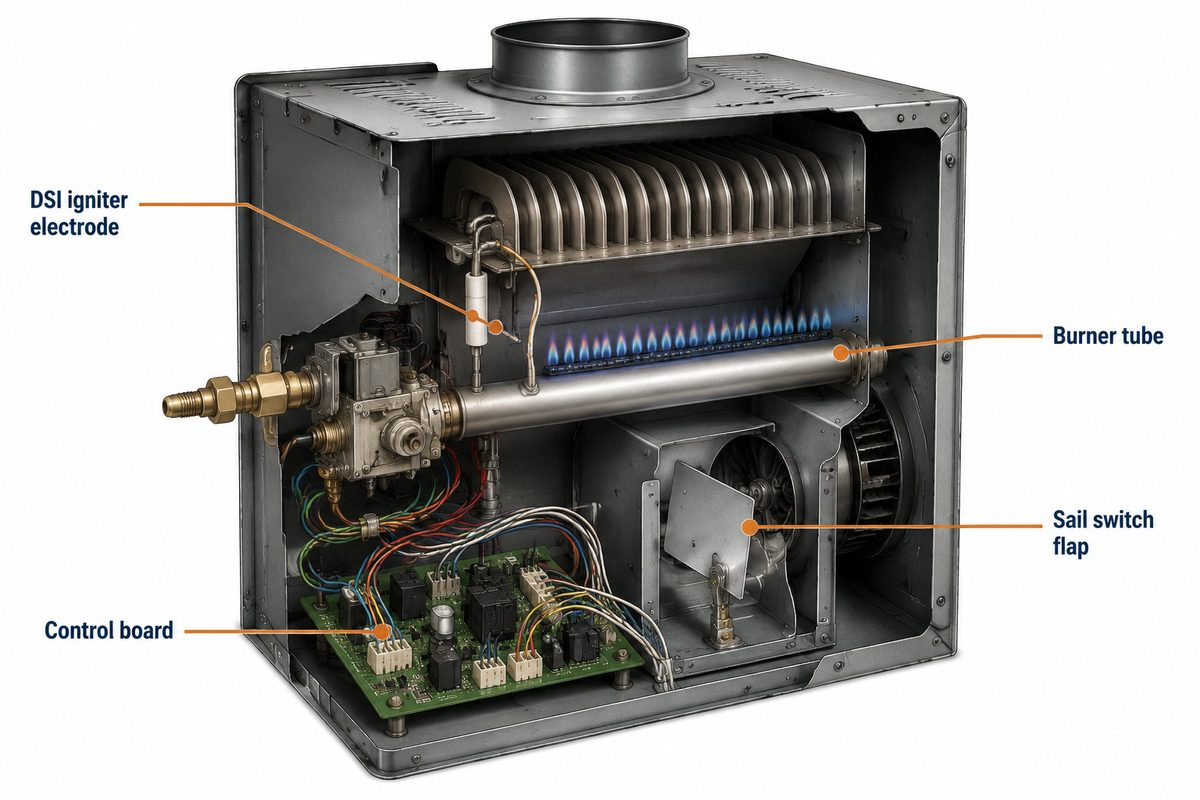
The sail switch is a small flap in the blower’s airflow. When the blower reaches speed, air pushes the flap closed and tells the control board it is safe to open the gas valve. If it is stuck, corroded or bent, the board never tries to ignite.
How to test it (remove the furnace cover from the exterior access panel, usually 4-6 screws):
- Look: a small flap in the airflow path connected to a two-wire switch.
- Feel: with the furnace and propane off, push the flap gently. It should click. Stiff, stuck or loose means trouble.
- Measure: with a multimeter on continuity, the switch should read closed when pressed and open when released.
Igniter electrode fouling
Symptom: you hear clicking near the burner, but no flame.
The DSI electrode works like a spark plug. Over a few seasons, carbon builds up on the ceramic, the tip corrodes, or the gap drifts, and the spark gets weak or disappears.
- Carbon buildup (black coating on the ceramic or tip): clean it gently with 220-grit sandpaper and wipe it off. This is a two-minute job that is often billed as a full service call.
- Cracked ceramic: hairline cracks let the spark short to ground. Replace the electrode ($15-25).
- Wrong gap: the tip should sit about 1/8 inch (3 mm) from the burner’s grounding surface. Bend the bracket gently to adjust.
Limit switch tripping
Symptom: the furnace lights, you feel some warmth, then it shuts off after 15-30 seconds.
The limit switch shuts the burner down if the heat exchanger overheats. When it trips repeatedly, the switch is usually doing its job. Find out why the exchanger is overheating before replacing it:
- Blocked return air (the most common cause). Bags, boxes, a mat or a pet bed in front of the furnace’s intake inside the RV will overheat it within seconds.
- Blocked exhaust vent. Check the louvered vent on the outside wall with a flashlight. Mud dauber wasps build nests there quickly.
- Cracked heat exchanger. If there is no blockage and it still trips, stop using the furnace and have it inspected. A cracked exchanger can push carbon monoxide into the cabin.
Blocked exhaust or return air
Symptom: the furnace cycles on and off repeatedly and heat output is weak.
- Exterior exhaust vent: remove the louvered cover if you can and clear debris or nests with a long, thin brush. Check that the inner baffle moves freely.
- Interior return-air grill: usually at floor level near the furnace. Keep it clear, and check the filter if your unit has one.
Control board failure
Symptom: no response at all, or erratic behavior that matches none of the causes above.
Boards do fail, usually from moisture or a voltage spike, but “bad board” is also one of the most common misdiagnoses. Before replacing it, confirm 12V or more at the board’s power terminals, good propane supply, a working sail switch and a clean, correctly gapped igniter.
Replacement boards cost about $60-120 for most Suburban and Atwood/Dometic models and are plug-and-play. Order by the model number on the data plate inside the access panel.
Gas valve failure
Symptom: the spark fires and there is a faint propane smell at the vent, but no sustained flame.
A failing valve opens partly or not at all. It is relatively rare on furnaces under 10 years old, and is usually caused by debris in the line after a regulator swap or refill, corrosion, or age.
The annual 20-minute checklist
Almost every cause above is preventable. Do this once a year, ideally in early fall before you need heat.
- Inspect and clear the exterior exhaust vent (flashlight and brush, 2 minutes)
- Clear the interior return-air grill (1 minute)
- Fit insect screens on the vents if you don’t have them
- Check the sail switch moves freely and clicks
- Inspect the electrode and clean it with fine sandpaper if needed (5 minutes)
- Check house battery voltage: 12.2V or more at rest
- Test propane pressure with an inline gauge if you have one
- Run a full ignition cycle and listen for a clean light-off
- Check the limit switch shows continuity when cold
- Inspect propane connections at the furnace for corrosion or damage
| Item | Typical cost | Notes |
|---|---|---|
| Insect vent screens (set of 4) | $8-12 | One-time purchase |
| 220-grit sandpaper | $2 | For cleaning the electrode |
| Replacement electrode | $15-25 | If the ceramic is cracked |
| Sail switch | $8-15 | If the contacts are corroded |
| Limit switch | $10-20 | Model-specific |
| Inline propane pressure gauge | $8-12 | Reusable |
Total prevention cost: under $30. A typical service call costs $150-450.
When to stop and call a technician
Frequently asked questions
Why does my RV furnace blower run but not ignite?
The blower always starts first and runs for 30 to 40 seconds to purge the burner chamber. If it keeps running with no clicking, the sail switch is not closing. If you hear clicking but get no flame, look at propane pressure, the igniter electrode or the gas valve.
How do I reset an RV furnace that has locked out?
After two or three failed ignition attempts most control boards lock out. Turn the thermostat all the way down, wait about 30 seconds, then turn it back up. This resets most Atwood/Dometic and Suburban furnaces.
Can low battery voltage stop an RV furnace from working?
Yes. The furnace burns propane but is controlled by 12V. Below roughly 10.5V under load, the control board cannot open the gas valve or fire the igniter reliably.
Why does my RV furnace light and then shut off after 15 to 30 seconds?
That is usually the limit switch protecting an overheating heat exchanger. The most common reason is blocked return air inside the RV, followed by a blocked exterior exhaust vent. A cracked heat exchanger can also cause it and needs a technician.
How much does it cost to fix an RV furnace that won't light?
Most fixes are cheap parts: a sail switch is about $8-15, an electrode $15-25, a limit switch $10-20, a control board $60-120 and a gas valve $80-140. A service call typically costs $150-450.
Safety and disclaimer. This guide is general information, not professional advice. Work on propane, gas and electrical systems carries real risk; when in doubt, stop and call a qualified RV technician, and always follow your unit's service manual. If a carbon monoxide or propane alarm goes off, get everyone out of the RV first. How we research.
2 Comments