Field guide · Propane furnace safety
Carbon Monoxide From an RV Furnace: 5 Risks and How to Check Them
How CO from a propane furnace gets into an RV, the five ways it happens, what to check before every heating season, and what to do if the alarm goes off.
On this page
How carbon monoxide gets from the furnace into the RV
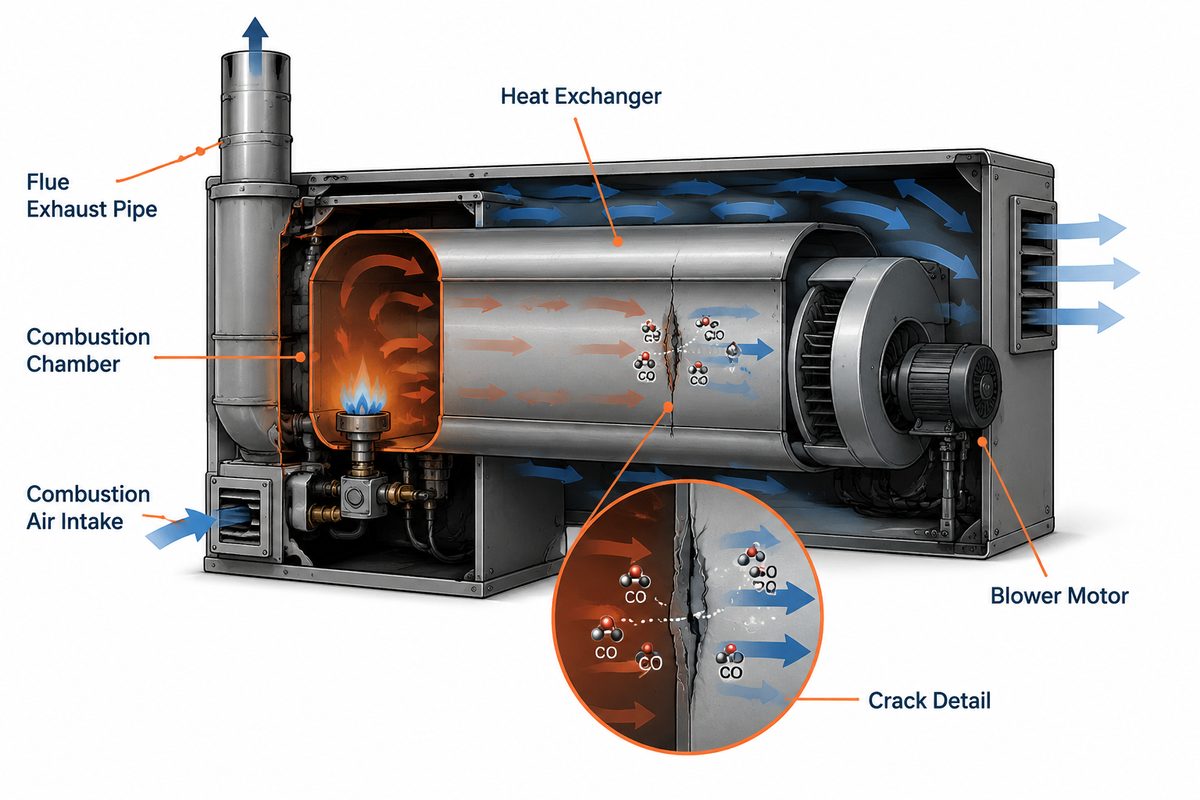
Carbon monoxide (CO) forms when fuel burns incompletely. An RV propane furnace is designed to keep combustion gases sealed inside the heat exchanger and vent them outside. When any part of that path fails, CO ends up in the air you breathe.
- Propane burns in the combustion chamberProducing heat and exhaust gases, including CO.
- The heat exchanger separates two airstreamsExhaust stays inside the sealed exchanger.
- Exhaust leaves through the exterior flueCO is vented outside.
- The blower pushes cabin air over the exchangerWarm air enters the living space and should contain no CO.
- Failure: the separation breaks downThrough a crack, a blocked vent or backdraft, CO enters the heated air.
- The RV slowly fills with COIt has no color and no smell.
Two things make this especially dangerous in an RV. The living space is small, so a leak that a house would dilute can reach dangerous levels much faster. And CO causes drowsiness and confusion before it causes alarm, so by the time you feel seriously unwell, your ability to react is already impaired. Prevention and a working detector are the only reliable protection.
Symptoms to take seriously
| Approximate level | Typical symptoms |
|---|---|
| Mild exposure | Headache, slight nausea, fatigue. Easy to mistake for altitude, dehydration or a cold. |
| Moderate exposure | Severe headache, dizziness, vomiting, confusion. |
| Severe exposure | Loss of consciousness; can be fatal within minutes. |
Five quick checks (about 10 minutes)
- Detector function and age. Press TEST: it should alarm. Then find the manufacture date on the back. CO sensors wear out silently; replace any unit past its stated service life (commonly 5-7 years) or that fails the test, and don’t sleep in the RV until you do.
- Detector location. Near where people sleep and installed as its manufacturer specifies. See the placement section below.
- Symptoms right now. Unexplained headache, nausea or fatigue that eases outside? Leave the RV, open the door and call 911.
- Exterior exhaust vent. Find the furnace exhaust on the outside wall. Any obstruction, including a wasp nest built during storage, can push exhaust back into the unit.
- Combustion air intake. The separate opening the furnace uses to draw outside air for burning. A blocked intake causes incomplete combustion and more CO. Check both openings together.
The 5 risk scenarios
These are the main ways CO from a propane furnace reaches the living space, starting with the most common.
Cracked heat exchanger
Signs: the furnace seems to work normally, but people wake with headaches.
The heat exchanger expands and contracts thousands of times over its life, and the metal fatigues. A crack, even a hairline you can’t see, opens a direct path for combustion gases into the heated air. On furnaces over about 10 years old, treat it as a maintenance item, not a remote risk.
- Visual check: with the access panel off and the furnace cold, look for cracks, rust stains, soot or discoloration on the exchanger. Soot outside the combustion chamber is a red flag.
- Detector check: with the RV closed up and the furnace running, place your CO detector near the furnace return-air intake. Rising readings mean a compromised exchanger.
- Professional pressure test: a technician can pressure-test the exchanger and find leaks a visual check misses. Typically $85-150, and the only definitive method.
Blocked exhaust flue
Signs: the furnace runs then locks out, or runs while CO readings rise. Often seasonal.
When the exhaust can’t get out, it backs up into the furnace cabinet and can reach the living space. The most common cause is a wasp or mud dauber nest built in the vent during storage; they can build one in under 48 hours, often just a couple of inches inside the opening.
- Before the season, with the furnace off, look 4-6 inches into the vent with a flashlight and remove any nest material or mud.
- Pull debris toward you with a long wire brush or a straightened hanger. Don’t blow compressed air into the vent; it pushes debris deeper.
- In hard freezes, condensation can ice up the vent. Repeated lockouts after short runs in sub-freezing weather are a sign.
- Check the vent cap for bent louvers, crushing or a winter cover left in place.
Blocked combustion air intake
Signs: a yellow or orange flame instead of blue; higher CO. Often seasonal.
The furnace draws outside air specifically for burning, separate from the cabin air the blower circulates. A blocked intake starves the burner, and incomplete combustion produces CO. Besides nests and ice, intakes routed through the underbelly can be partly blocked by grime, loose insulation or a sagging vapor barrier.
- Locate the intake next to the exhaust (some models use one concentric pipe for both); your furnace manual identifies both openings.
- Inspect and clear it the same way as the exhaust, pulling debris outward.
- If you can reach the underbelly, trace the intake pipe for kinks, crushing or disconnected sections.
Backdraft from negative pressure
Signs: CO rises only when exhaust fans run or in strong wind. Comes and goes.
A powerful bathroom or range fan lowers the pressure inside the RV, and air rushes in through any opening it can find. If that path is the furnace flue, exhaust is pulled backward into the living space. It needs the furnace running and strong negative pressure at the same time, which is why it’s easy to dismiss.
- Correlation: note whether CO readings or symptoms appear specifically when a fan runs with the furnace on.
- Mitigation: don’t run exhaust fans while the furnace is heating. If you must, open a window on the windward side to give the RV a make-up air path that doesn’t go through the furnace.
- Wind: in sustained strong wind, avoid parking with the furnace vents facing straight into it.
A CO detector past its service life
Signs: no alarm, even with CO present.
This isn’t a CO source; it’s the failure that lets all the others become deadly. CO sensors degrade over time and need ever higher concentrations to alarm, until they don’t alarm at all. The power light keeps blinking and the TEST button, which checks the alarm circuit rather than the sensor, still works.
- Find the manufacture date on the unit and replace it at the end of the service life the manufacturer states.
- Choose a UL 2034 listed detector with an end-of-life warning, so it tells you when the sensor expires. Typically $20-35.
- With combination smoke/CO alarms, check the CO sensor’s own lifespan; it can expire before the smoke sensor.
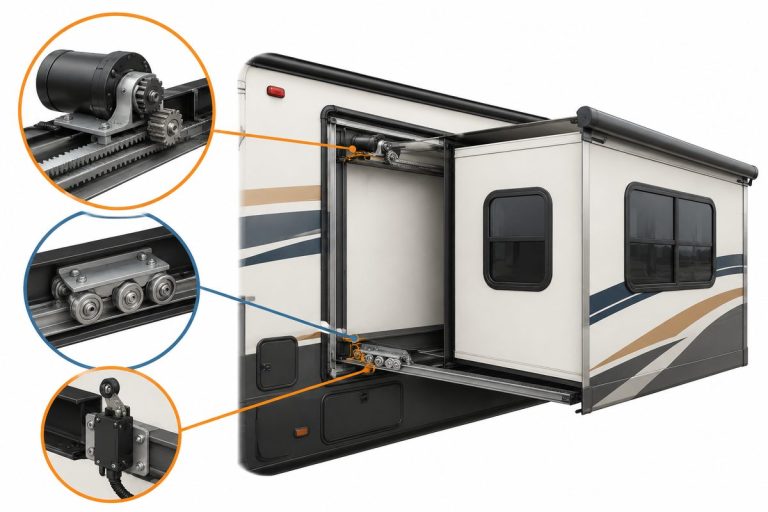
- If someone sleeps in a separate room or a slide-out bedroom, give that space its own detector.
Emergency procedure
If people have symptoms but the detector is silent, assume the detector has failed: get outside first, call 911 if anyone is confused or struggling to walk, and don’t use the furnace again until it has been inspected. Anyone who lost consciousness or had severe symptoms needs an emergency room, even if they seem to recover.
Where to put a CO detector in an RV
Follow the installation instructions for your specific detector: manufacturers specify mounting height and distances, and RV CO alarms are designed for that environment. These general rules apply to almost every RV:
| Location | Verdict | Why |
|---|---|---|
| Near the sleeping area | Best | Where people are most vulnerable and least alert |
| Within 3 feet of the furnace | Avoid | Heat and nuisance alarms; may miss CO elsewhere |
| Next to the stove | Avoid | Cooking fumes cause false alarms |
| Separate sleeping room or slide-out bedroom | Add a second detector | CO levels can differ between rooms |
- At least one detector close to every sleeping area.
- Test it monthly with the TEST button.
- Make sure it has battery backup or a fused 12V supply; shore power can drop overnight.
Annual prevention checklist
Do this in early fall, before the heating season.
| Task | How often | Typical cost |
|---|---|---|
| Test the CO detector (TEST button) | Monthly | Free |
| Check the detector’s manufacture date | Yearly | Free |
| Replace an expired detector | As needed | $20-35 |
| Inspect and clear the exterior exhaust vent | Before the season | Free |
| Inspect and clear the combustion air intake | Before the season | Free |
| Look for soot or cracks on the heat exchanger | Yearly | Free |
| Professional furnace service and pressure test | Every 2 years | $120-200 |
| Note wind direction vs the furnace vents | At each site | Free |
Call a certified RV technician when
Frequently asked questions
Can an RV furnace cause carbon monoxide poisoning?
Yes. A cracked heat exchanger, a blocked exhaust or intake vent, or backdraft from exhaust fans can let combustion gases into the living space. A working, in-date CO detector near the sleeping area is the essential safeguard.
What are the symptoms of carbon monoxide in an RV?
Headache, nausea, dizziness and fatigue, often mistaken for altitude or dehydration. Symptoms that ease when you step outside, or several people affected at once, should be treated as CO: get outside and call 911.
How long do RV CO detectors last?
Commonly 5-7 years, depending on the model. The sensor wears out silently and the TEST button only checks the alarm circuit, so replace the unit at the end of its stated service life. Models with an end-of-life warning tell you when.
Where should a CO detector go in an RV?
Close to the sleeping area and installed according to the detector manufacturer's instructions, away from the furnace and the stove. A separate bedroom or slide-out bedroom should have its own detector.
Is it safe to run the bathroom fan while the furnace is on?
It can pull exhaust backward through the furnace flue in some RVs. Avoid running exhaust fans while the furnace heats, or open a window on the windward side to provide make-up air.
Safety and disclaimer. This guide is general information, not professional advice. Work on propane, gas and electrical systems carries real risk; when in doubt, stop and call a qualified RV technician, and always follow your unit's service manual. If a carbon monoxide or propane alarm goes off, get everyone out of the RV first. How we research.