Field guide · Schwintek, Lippert, Kwikee, HWH
RV Slide-Out Won't Move? Manual Override and 6 Causes to Check
Whether the slide won't go out or, worse, won't come back in before checkout, here is how to retract it manually and then find the cause.
On this page
There are two versions of this problem. A slide that won’t extend is annoying. A slide that won’t retract is urgent, because you can’t safely drive with a room sticking out. If you need to leave, go straight to the manual override below and come back to the diagnosis once you’re parked.
Emergency: slide won’t retract and you need to drive
Every RV slide-out has a manual override for when the motor, controller or power fails. The method depends on the system. Check your owner’s manual for the exact procedure for your model.
In-wall systems (two motors per slide)
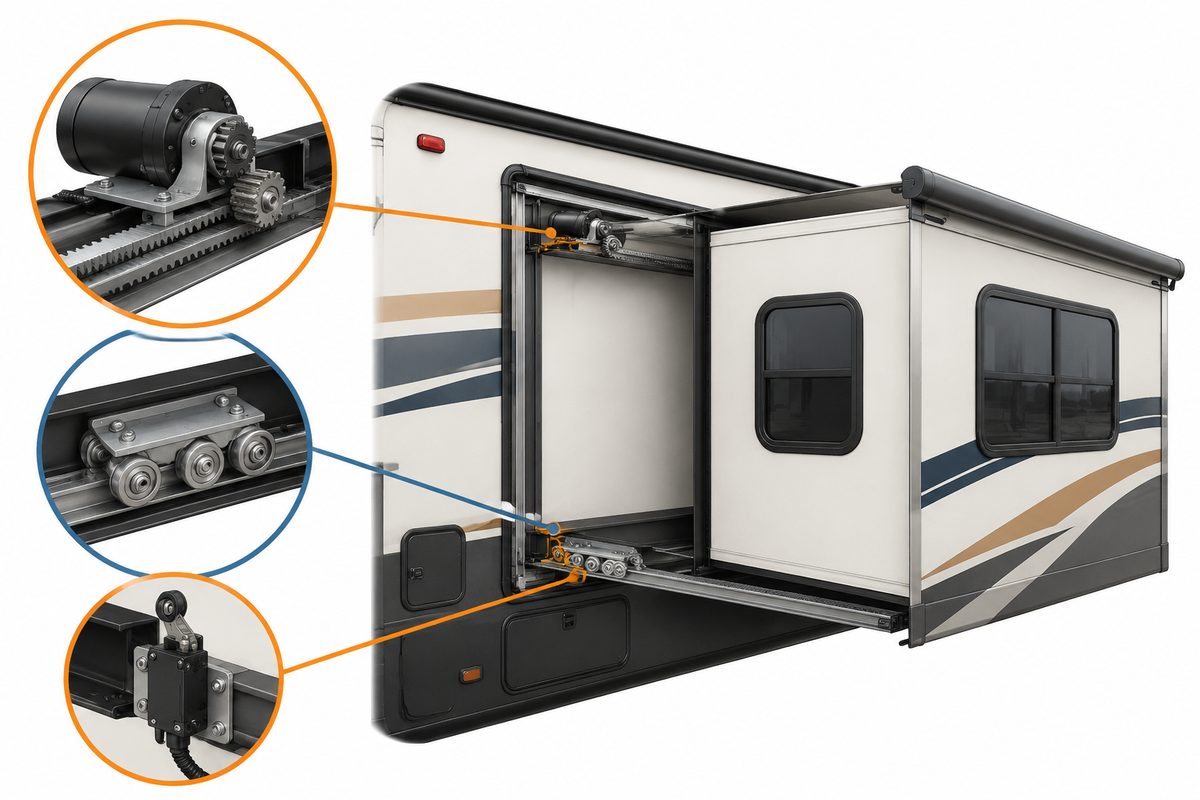
Each motor has a hex override socket, usually 3/8 inch, reachable from outside along the top and bottom edges of the slide opening. Use a wrench or a drill with a hex bit and turn in the retract direction given in your manual.
Electric rack-and-pinion
Usually a manual override shaft reachable from outside, often with a 1/2 inch hex socket, sometimes behind a small access cover. Lippert’s documentation for your model (lci1.com) shows the exact location.
HWH and Lippert hydraulic
Usually an emergency hand pump or a gravity retract valve on the hydraulic pump unit in a basement compartment. Procedures vary a lot between manufacturers, so follow your coach manual.
How a slide-out works, and which system you have
- You press the switchThe signal goes to the slide controller.
- The controller checks voltageBelow about 10.8V, most controllers won’t run the motor.
- The motor gets 12VPolarity decides extend or retract.
- The drive moves the roomA pinion gear runs along a toothed rack, or a cable or hydraulic cylinder pulls the room.
- A limit switch is reachedThe controller cuts motor power at full travel.
- The seals compressOn retract, the weather seal seats fully.
| System | How to identify it | Most common failure |
|---|---|---|
| Rack and pinion (Schwintek, Lippert) | Motors visible along the slide edges, usually two per slide | Motor failure, debris in the gear |
| Cable or chain (Kwikee, Equalizer) | Cable or chain under the slide, one central motor | Cable stretch, pulley wear |
| Hydraulic (HWH, Lippert) | Cylinders on the slide frame, pump unit in a basement bay | Low fluid, failed pump, air in the lines |
Five quick checks first
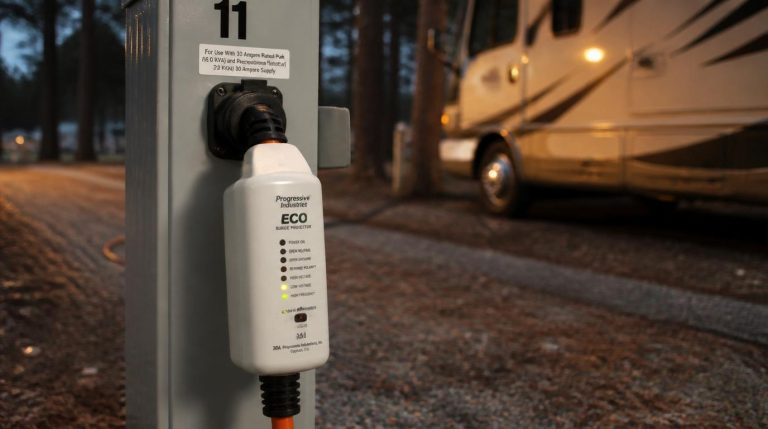
- 12V battery voltage. A slide motor draws 15-30 amps. A battery at 12.0V resting can sag below 10.5V under that load. Below 12.2V resting, charge or plug into shore power first.
- Lockout switch and fuse. Some coaches have a slide lockout switch near the door or dash. Also check the slide fuse (typically 30-50A) in the 12V panel.
- Obstructions inside and out. Rugs, cushions, bags or furniture in the slide path inside; gravel, debris or a neighbor’s awning outside.
- Controller reset. On many Lippert systems: hold IN and OUT together for about 5 seconds. On Schwintek: disconnect 12V to the controller for 30 seconds, then reconnect. Check your manual for your model.
- Position indicator. If the monitor says “slide not in travel position” while the slide is fully in, a limit switch or position sensor may be misreading and blocking the controller.
The 6 causes, in order of likelihood
Not enough 12V power
Symptom: the slide won’t move at all, or moves a few inches and stops.
The controller refuses to run the motor below roughly 10.8-11.0V. A battery that seems fine for lights and the fridge can still be far too weak for the slide, especially after sitting for two weeks, after a night without the converter, or near the end of its life.
- Plug into shore power and let the converter run 10-15 minutes, then try again.
- Watch the battery monitor while you press the switch. A drop below 11.5V means the bank is too weak.
- Running the generator does the same job as shore power.
Blown fuse or controller fault
Symptom: no response at all: no sound, no movement, no indicator light.
A blown slide fuse means the circuit saw a current spike, usually from a motor pushing against an obstruction. Controllers can also lock out after a power interruption, because they lose track of the slide’s position and refuse to move it.
- Fuse: find the slide fuse (12V panel or a separate block near the controller). Replace it with the same rating, never higher.
- Reset: use the reset procedure above, wait 10 seconds and try again.
- Recalibrate: if the slide moves erratically or stops short, the controller may need its end-stops relearned. On many Lippert systems: extend fully, then hold OUT for about 5 seconds past the stop.
Slide motor failure
Symptom: a hum or click at the controller, but the slide doesn’t move.
A failed motor either hums without turning (a seized armature, often from moisture or repeated stalls) or stays silent with 12V applied (open winding or worn brushes). On Schwintek slides, one dead motor out of two can still move the slide slowly and unevenly, which looks like racking.
- Voltage at the motor: measure at the motor connector while pressing the switch. 12V present but no movement means a failed motor. No voltage means a controller or wiring problem.
- Rotation: with power off, turn the motor shaft or override socket. It should turn with moderate resistance; seized solid means a damaged motor.
- Swap test: on Schwintek, swap in a motor from a working slide of the same model to isolate the bad one.
Debris or ice in the track
Symptom: the slide starts moving, then stops and trips the fuse or controller.
Gravel, wood chips, pine cones or ice in the gear rack or roller track stall the motor, and the controller cuts power to protect it. A slide that went out fine but won’t come back in is the classic sign: something got into the track while it was extended.
- With the slide out, inspect the toothed rack and roller channel with a flashlight and clear debris with a stiff brush.
- For ice, use a hair dryer on low or let the coach warm up. No hot water on the rack.
- Check inside too: a rug corner, a cord or a fallen item in the travel path.
- After cleaning, use a dry PTFE slide lubricant. Avoid WD-40 and petroleum lubricants, which collect grit and degrade seals.
Hydraulic system issue
Symptom: slow, partial or no movement (hydraulic systems only).
- Low fluid: check the reservoir with all slides retracted and top up with the fluid your manual specifies (often Dexron ATF).
- Air in the lines: after fluid work, cycle each slide in and out several times to bleed it.
- Failed pump: the pump runs but builds no pressure. This is a technician repair.
- Stuck solenoid valve: one slide won’t move while the others work normally.
Mechanical binding or misalignment
Symptom: uneven travel, grinding, or a hard stop partway.
A slide run against an obstruction, driven partly extended, or hit hard can rack. Worn rollers (rubber or nylon that flatten, crack or fall off) make the room drag instead of roll, and a torn or debris-packed seal can add enough drag to stall the motor on retract.
- Watch both sides from outside: they should move at the same speed and stay parallel.
- Replace missing, flat or cracked rollers before using the slide again.
- Inspect the whole seal for tears, buildup or loose sections.
Seasonal checklist
Slide failures rarely come without warning: slower travel, new noises, needing more voltage than before. A spring and fall check catches them early.
- Check battery voltage before any slide operation: 12.4V or more at rest
- Clean the gear rack and roller track and apply dry PTFE lubricant
- Inspect all slide seals for cracks, tears or lifting sections
- Treat seals with a rubber conditioner to keep them from hardening
- Run each slide through its full travel and listen for grinding or speed changes
- Check rollers for flat, cracked or missing pieces
- Check slide mounting bolts are tight; vibration loosens them over a season
- Look for any twist or asymmetry in the frame when extended
- Practice the controller reset so you know it when you need it
- Find and test your manual override before you ever need it
| Item | Typical cost | Notes |
|---|---|---|
| Dry PTFE slide lubricant | $8-14 | Twice a year |
| Rubber seal conditioner | $12-18 | Once a year |
| Replacement rollers (set) | $15-35 | Match your slide brand |
| Slide motor | $35-80 | Per motor |
| Slide controller | $80-150 | Brand and model specific |
| Hydraulic fluid top-off | $8-15 | Use the spec in your manual |
Prevention: under $40 a year. A typical slide-out repair: $200-900 or more.
When to stop and call a technician
Frequently asked questions
How do I manually retract an RV slide-out?
Use the manual override for your system. Schwintek in-wall slides have a hex socket on each motor that you turn equally on both motors; Lippert electric slides usually have an override shaft with a hex socket outside; hydraulic slides use a hand pump or gravity valve on the pump unit. Check your owner's manual for the exact location.
Why won't my RV slide-out move when the battery seems fine?
A slide motor draws 15-30 amps. A battery that runs lights and the fridge can still sag below the controller's cutoff of roughly 10.8-11V under that load. Plug into shore power or run the generator and try again.
How do I reset an RV slide-out controller?
On many Lippert systems you hold the IN and OUT buttons together for about 5 seconds. On Schwintek systems you disconnect 12V power to the controller for 30 seconds and reconnect. Procedures vary by model, so confirm in your manual.
What lubricant should I use on RV slide-outs?
A dry PTFE slide-out lubricant on the gear rack and rollers, and a rubber conditioner on the seals. Avoid WD-40 and petroleum-based products, which attract grit and degrade seals.
How much does it cost to fix an RV slide-out?
A slide motor is about $35-80, a controller $80-150 and a set of rollers $15-35. Shop repairs typically run $200-900 or more, especially if the frame is racked.
Safety and disclaimer. This guide is general information, not professional advice. Work on propane, gas and electrical systems carries real risk; when in doubt, stop and call a qualified RV technician, and always follow your unit's service manual. If a carbon monoxide or propane alarm goes off, get everyone out of the RV first. How we research.