Field guide · Campground life
How to Pick a Quiet RV Campsite (and Handle Noisy Neighbors)
Most bad nights at a campground are predictable from the map. How to choose a quiet site before you book, read your loop on arrival, and deal with noise without a confrontation.
On this page
A bad night at a campground is rarely bad luck. Generator loops, entrance roads and site layout are all visible on the map before you book. This guide shows what to look for when booking, what to ask when you call, how to read your loop on arrival, and how to handle a noisy neighbor without a confrontation.
Where campground noise comes from
| Source | Why it matters |
|---|---|
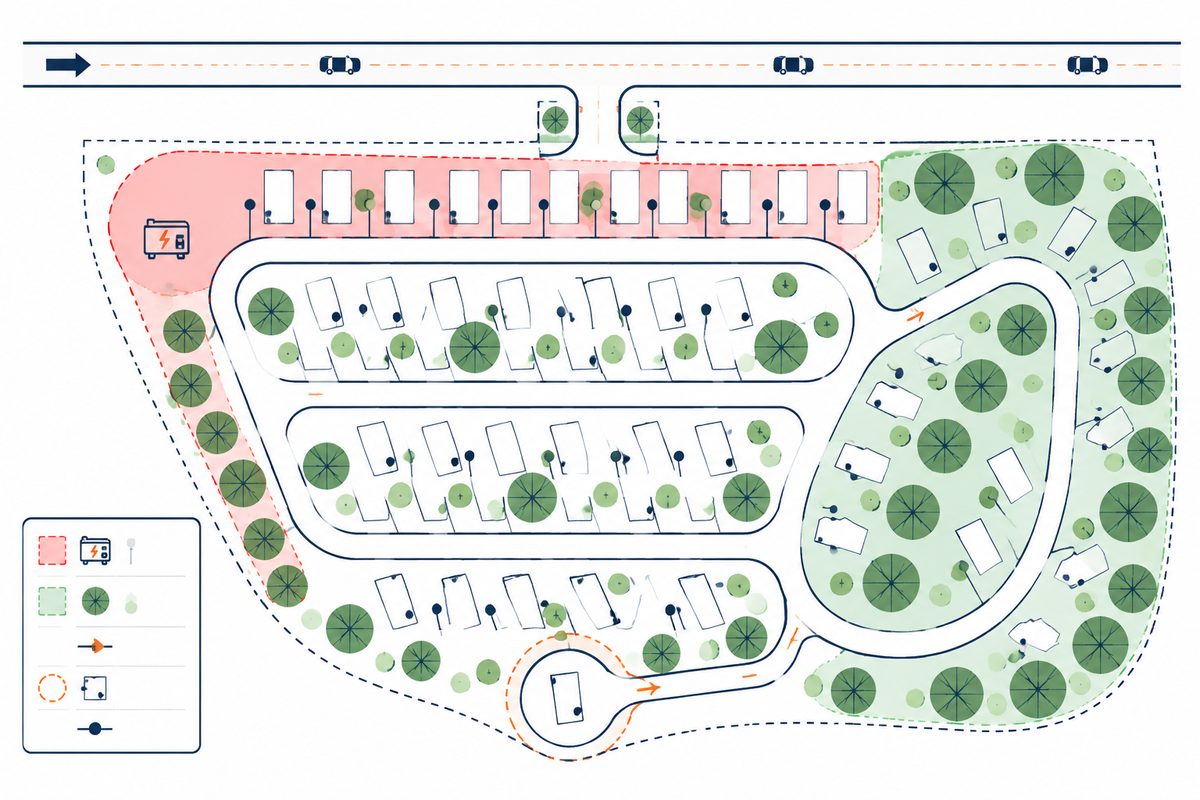
| Generator areas | One running generator is heard across several sites; a loop of them sets a constant hum until the last one shuts off. Most campgrounds that allow generators assign them a loop, and it’s on the map. |
| The entrance road | Every late arrival drives past with headlights and engine running, especially on gravel and on Friday nights. |
| Loop geometry | Back-in sites face each other across the loop, 20-30 feet apart. Pull-throughs sit side by side. End-of-loop sites have the fewest neighbors. |
| Natural barriers | Mature trees, a hillside or dense vegetation absorb sound. An open, mowed field doesn’t. |
Before you book: the 5-step check
- Open the full campground mapNot the booking thumbnail. Most parks publish a PDF map; if not, ask them to email one.
- Find the generator areaLabeled on the map or in the rules. No designated area usually means generators are allowed anywhere.
- Cross off sites near the entrance roadRoughly the first three sites along the traffic path get every late arrival.
- Mark end-of-loop and cul-de-sac sitesThey have one or two neighbors instead of three or four.
- Look at site photosGoogle Maps, Campendium and The Dyrt photos show real tree cover and spacing better than any map.
6 rules for a quiet campsite
The first three apply when you book, the last three when you arrive.
Never book in or next to the generator area
Even when generator users respect posted hours, they often run into the evening, and not everyone reads the rules. Find the generator section on the map, in the rules, or in recent reviews on Campendium or The Dyrt (search the campground name plus “generator”). If generators are allowed anywhere, book far from the busiest section and expect some noise before quiet hours.
Stay away from the traffic path
Trace the road from the gate through the campground. Avoid sites it passes directly in front of, sites next to the check-in office (idling cars) and the dump station (morning traffic), and the first sites of each loop where every car turns in.
Call ahead and ask three questions
- “Which area of the campground tends to be quietest?”
- “Are generators allowed, and where?”
- “Is there anything about this site I should know that isn’t on the map?” (maintenance roads, seasonal party groups, upcoming roadwork)
Call Tuesday to Thursday, before noon, when staff have time to talk. Avoid Friday afternoons.
Think about which way the site faces
In a horseshoe or oval loop, back-in sites put two outdoor living areas face to face across 20-30 feet, and fireside conversation carries easily. Pull-throughs usually put your window toward a neighbor’s wall. Corner sites on an L-shaped loop and end-of-loop sites face fewer neighbors, and a large tree between you and the loop road matters more than extra square footage.
Take a 20-minute walk before dark
Walk your loop once you’ve set up. Signals worth noticing: a large group of adults with a speaker already on, a fire and coolers going by late afternoon, a reactive dog on a lead near your site, a generator wired in with its exhaust pointing your way. None is a guarantee, but together they’re a forecast.
Arrive early, and go midweek if you can
Arriving before about 3pm, especially on Fridays and before holidays, means the office is open, sites are still free and you can switch. Note a backup site when you book. And if your dates are flexible, Tuesday to Thursday nights are quieter at almost every campground.
When a neighbor is the problem
You did everything right and the site next door turns the speaker up at 10:30pm. This sequence works most of the time, ordered from most effective to most disruptive:
- Ask directly and politelyWalk over and say something like: “I hate to bring this up, but the sound is carrying tonight and we have an early morning. Any chance you could keep it down a bit?” Specific, first person, and it gives them an easy way out. Most people didn’t realize.
- The camp hostAfter quiet hours, or if asking didn’t work: “I’m in site 14, site 9 is still loud past quiet hours. Can you help?”
- Management and a site moveUse the after-hours number if there is one, or ask at the office in the morning for a quieter site. A move is something they can actually deliver.
When to just move sites
- The noise is structural: a generator loop, road traffic or layout won’t change after a conversation.
- Quiet hours have passed and a polite request didn’t work.
- It’s a multi-night stay: ask in the morning, framed as a preference: “Is there anything a bit more sheltered? This spot is noisier than we expected.”
- Safety is involved: move first, explain later.
Frequently asked questions
How do I choose a quiet campsite?
Open the full campground map, avoid the generator area and sites along the entrance road, and prefer end-of-loop sites with trees or a hillside behind them. Site photos on Google Maps or Campendium show real spacing and tree cover.
Which campsites are the quietest?
End-of-loop and cul-de-sac sites, sites backed by mature trees or a hillside, and outer-edge pull-throughs, away from the generator loop, entrance road, check-in office and dump station.
What should I do about noisy campground neighbors?
Ask them politely first, giving a specific reason. If that fails or it's past quiet hours, go to the camp host, and if needed ask management for a site move. If someone becomes aggressive, contact management and move.
Are back-in or pull-through sites quieter?
Pull-throughs usually feel quieter because rigs sit side by side; back-in sites in a loop face each other across 20-30 feet, so conversation carries.
When is a campground quietest?
Midweek: Tuesday to Thursday nights are quieter at almost every campground, with fewer generators and late arrivals.
Safety and disclaimer. This guide is general information, not professional advice. Work on propane, gas and electrical systems carries real risk; when in doubt, stop and call a qualified RV technician, and always follow your unit's service manual. If a carbon monoxide or propane alarm goes off, get everyone out of the RV first. How we research.
2 Comments