RV Comfort & Interior Setup Guide
A practical framework for setting up your RV interior so it actually works for daily living – not just a weekend visit.
Introduction: Living vs. Visiting
The first few nights in a new RV feel fine. The space is novel. The novelty keeps things interesting. You are visiting your RV, and visiting is easy.
Then a week passes. Then two. The ceiling feels lower. The cabinet you need is always behind something else. The lighting gives you a headache by evening. The air smells stale before noon. You are not visiting anymore – you are living here, and the difference turns out to be significant.
Most RV discomfort is not about size. It is about setup. A poorly arranged small space wears you down faster than a well-arranged one ever would.
This is not a guide about buying things. It is a guide about thinking clearly before you arrange, equip, and commit to how your RV interior is going to function. The decisions you make in the first few weeks tend to calcify into habits and then into permanent arrangements. Getting them right early matters more than most people realize.
This guide covers the principles behind a functional RV interior setup, the zones worth thinking about deliberately, and the mistakes that make RV living harder than it needs to be. If you are looking for specific accessory recommendations, the RV Interior Accessories Guide covers what actually improves comfort and what most people get wrong when buying gear.
The Reality of Living in a Small Space
Small spaces are not just scaled-down versions of large ones. They behave differently, and understanding how they behave is the first step toward setting one up well.
You Are Always Close to Everything
In a home, you can walk away from a problem. A messy counter in the kitchen does not follow you into the living room. In an RV, it does. The counter, the bed, the seating area, and the entry door are all within a few steps of each other. This means that anything out of place stays in your field of view. Anything that smells, you will smell. Any noise, you will hear. The psychological boundary between zones is almost entirely created by habit and intention, not by physical separation.
Friction Compounds Quickly
In a house, a slightly awkward cabinet placement is an inconvenience you notice occasionally. In an RV you live in full-time, that same cabinet might frustrate you fifteen times a day. Small frictions – a drawer that catches, an item stored two steps away from where you use it, a light switch in the wrong place – compound over days into something that genuinely erodes comfort. This is why setup matters so much more than gear. A perfectly selected accessory in a poorly arranged space still generates friction.
There Is No Default Zone Separation
Homes have rooms. Rooms give different activities a physical location, which helps the brain shift between modes – work, rest, cooking, relaxing. An RV typically has one continuous space with soft boundaries at best. Without deliberate attention to zone separation, everything bleeds into everything else. You end up eating where you sleep, working where you relax, and never quite switching off because there is nowhere to switch off to.
How to Think About RV Interior Setup
Before moving anything or buying anything, it helps to have a set of principles that guide decisions. These are not rules – they are lenses that tend to produce better outcomes when applied consistently.
Function Over Appearance
An RV interior that looks beautiful but generates daily friction is not a good interior. An RV interior that looks modest but allows you to cook, sleep, work, and relax without constant small obstacles is a genuinely good interior. This is not an argument against caring how things look – it is an argument for letting function lead and allowing appearance to follow. When you optimize for appearance first, you tend to make choices that look right in photos but work poorly in practice.
Fewer Items, Better Layout
The instinct when setting up a new living space is to fill it. Resist this. Every item in an RV occupies either physical space or visual space or both. Items that are not actively useful subtract from the space rather than adding to it. Start with less than you think you need. Add things only when their absence creates a real problem. This approach consistently produces more comfortable setups than the alternative.
Reduce Daily Friction
Walk through an ordinary day in your head. You wake up, make coffee, get dressed, sit down to work or read, prepare a meal, clean up, relax in the evening, and go to sleep. Every one of those activities involves reaching for something, putting something away, moving through the space, or occupying a position for an extended period. Map where friction occurs in that sequence and solve for it directly. This is more useful than any general advice about storage or organization.
Design for Movement
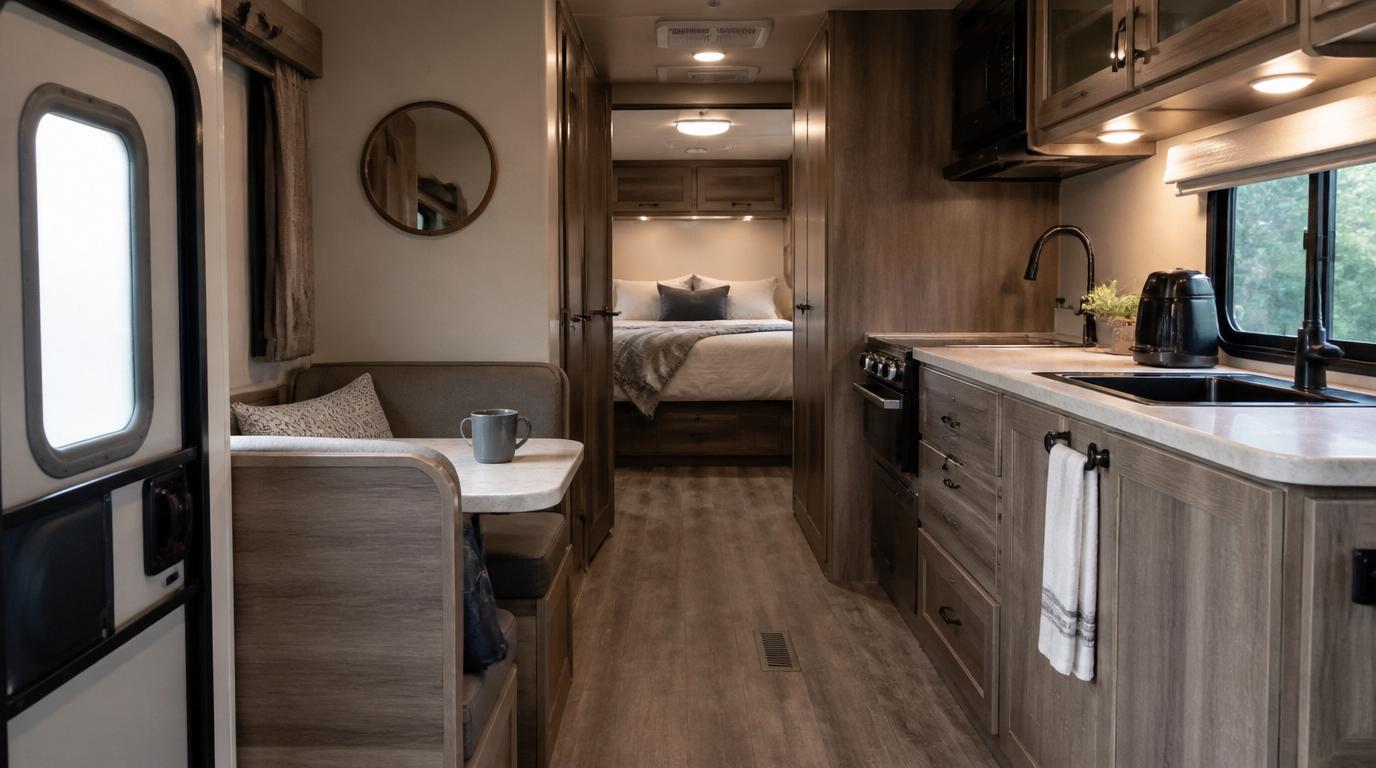
RV interiors are narrow. The difference between a space that feels manageable and one that feels claustrophobic is often how easily two people can pass each other, whether you can open a cabinet without stepping back into something, and whether the path between the entry and the sleeping area is clear. Clear movement paths feel like space even when space is objectively limited.
Creating Functional Zones
Zone creation in an RV is less about physical separation and more about intentional assignment. You are deciding what each area is for and then setting it up to support that function consistently.
The Sleeping Area
The sleeping area should be optimized for one thing: sleep. This means it should be as dark as possible when needed, as quiet as the RV allows, and physically comfortable for the duration of a full night. The mattress is the single most important physical element in this zone. RV factory mattresses are almost universally inadequate for long-term living. Addressing this early – before you have spent weeks sleeping badly and attributing the resulting fatigue to something else – is one of the highest-return setup decisions you can make.
Storage immediately adjacent to the sleeping area should contain only things related to sleep and personal preparation. Keeping work items, tools, or kitchen overflow in the sleeping zone erodes the psychological separation that helps the brain treat it as a rest space.
Seating and Relaxation
The seating area is where you will spend the majority of your waking hours inside the RV. Factory dinette seating is designed to look usable in photos, not to be comfortable for four hours of reading or working. If your RV has a dedicated seating area, evaluate it honestly: can you sit there for two hours without discomfort? If not, this is worth addressing.
The seating area also benefits from having its own lighting character – something warmer and lower than the overhead lights – and from being reasonably clear of items that belong to other zones. A seating area that doubles as a storage surface never fully functions as a place to relax.
Kitchen and Prep Area
RV kitchens are compact by design. The goal is not to replicate a home kitchen but to make the specific meals you actually cook as frictionless as possible. This means storing frequently used items within reach of where you use them, having a clear prep surface available without moving things first, and keeping the cleaning process simple enough that it happens immediately rather than accumulating.
The RV Kitchen and Cooking Gear Guide covers the specific tools and arrangements that work well in compact kitchen setups.
Storage Zones
Storage in an RV is not about maximizing capacity – it is about making the right things accessible at the right times. Divide storage mentally into three categories: daily-use items that should be immediately reachable, weekly-use items that can be slightly less accessible, and rarely-used items that can be stored in less convenient locations. Most setup problems come from treating all storage as equivalent and ending up with daily-use items buried behind things you only need once a month.
Airflow and Ventilation Setup
Air quality inside an RV is a comfort factor that operates below conscious awareness until it becomes a problem. By that point it has usually been affecting mood, sleep quality, and general wellbeing for some time already.
Creating Airflow Paths
Effective ventilation is not about having a vent open – it is about creating a path for air to move through the space. This requires at least two openings: one where air enters and one where it exits. A roof vent fan exhausting air from the highest point, combined with a window or lower vent drawing in outside air, creates a draft that moves air through the entire interior rather than just circulating the same stale air.
The direction of the roof vent fan matters by season. In warm weather, exhausting hot air upward while drawing cooler air in from below is more effective. In cooler conditions, reversing the fan to bring fresh air in while reducing heat loss through open windows can be the better approach.
Managing Humidity
Cooking, breathing, and showering all introduce moisture into the air. In a sealed small space, this moisture accumulates faster than most people expect. Condensation on windows and walls is the visible sign of a humidity problem, but the effects on air quality and material condition begin before condensation appears. Running ventilation during and for a short period after cooking or showering is a habit that prevents most humidity-related problems before they start.
Fan Placement for Sleeping
A fan positioned to create gentle airflow across the sleeping area serves two functions: it improves temperature comfort and it provides consistent white noise that masks campground sounds. The airflow should be indirect – moving air through the space rather than blowing directly onto the bed, which becomes uncomfortable over a full night.
Lighting Setup
Factory RV lighting is almost universally optimized for brightness and energy efficiency rather than livability. This is a practical manufacturing decision that happens to produce interiors that are tiring to spend time in.
Layered Lighting
The principle of layered lighting means having multiple light sources at different positions and intensities rather than relying on a single overhead source. In practice, this means overhead lights for general visibility, task lighting where you cook and work, and lower ambient lighting for evening use. Each layer serves a different purpose and together they allow the interior to shift character across the day.
Task vs. Ambient Lighting
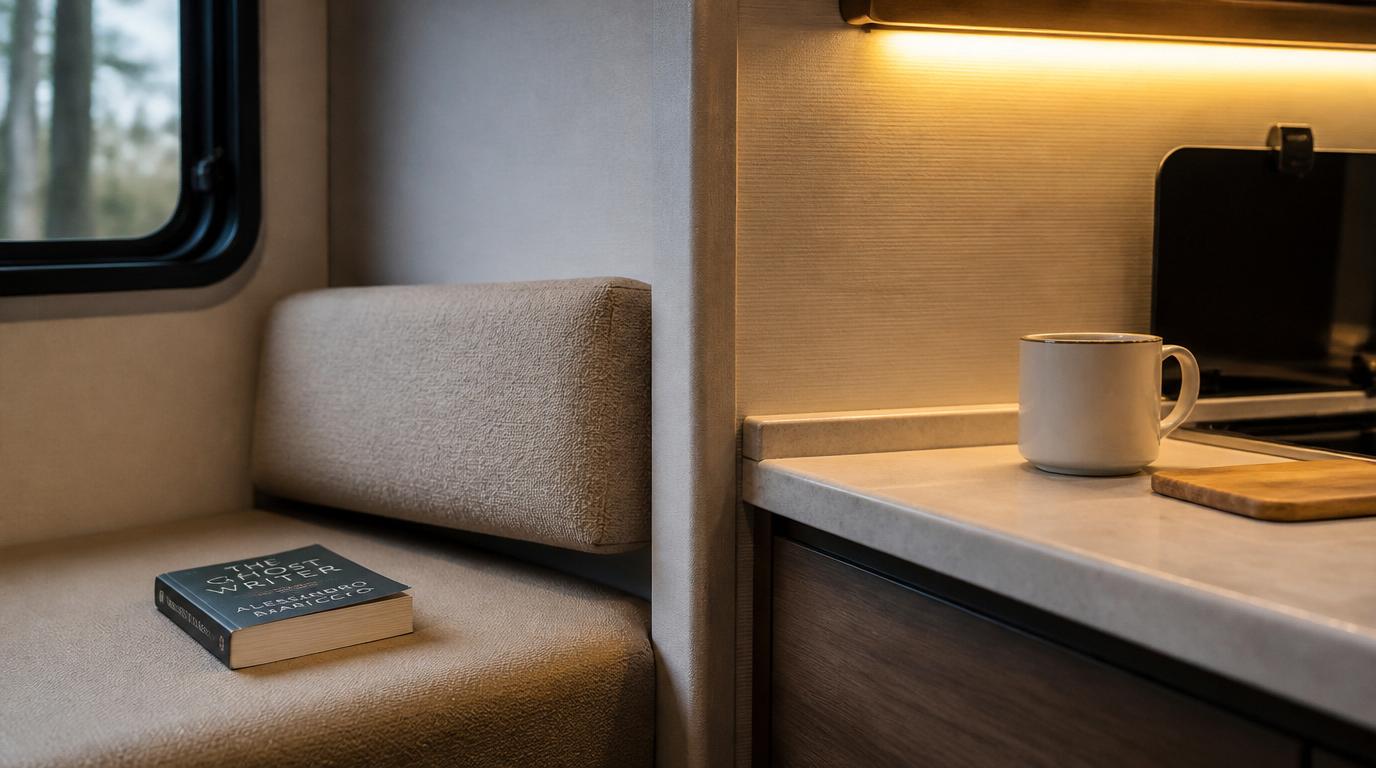
Task lighting is bright and directed – above the kitchen prep area, over a reading position, at the vanity. It should be available where you need focused light without illuminating the entire interior. Ambient lighting is soft and indirect – under cabinets, along floor level, or from small lamps – and it creates the background conditions that make a space feel comfortable rather than clinical.
Evening Lighting for Comfort and Sleep
The color temperature of light affects how awake your body feels. Cool white light in the 5,000 to 6,500 Kelvin range signals daytime to your nervous system. Warm light in the 2,700 to 3,000 Kelvin range signals evening and supports the natural shift toward rest. Having warm, dimmable lighting available for the hours before sleep is one of the simplest changes that improves sleep quality in an RV, and it costs very little to implement.
Daily Use Optimization
Once the major zones and systems are in place, the remaining work is optimizing for the specific patterns of your daily life. This is where generic advice becomes less useful and honest self-observation becomes more important.
Where Things Live
Every item in an RV should have a specific location, and that location should be chosen based on where you use the item, not on where it happens to fit. Coffee equipment belongs near the kettle. Chargers belong near where you sit when you use devices. Tools belong near the entry, not at the back of a storage bay. This sounds obvious but it requires deliberate attention, because the path of least resistance when loading an RV is to put things where they fit rather than where they belong.
Easy Access vs. Hidden Storage
Not all storage should be equally accessible. Items you reach for daily should be in open or easily opened locations – no latches, no items stacked in front of them, no requirement to move something else first. Items you use weekly can tolerate a small amount of friction. Items you use monthly or less can be stored in inconvenient locations without meaningfully affecting daily comfort. The mistake is mixing these categories, which results in frequently used items buried behind rarely used ones.
Reducing Repeated Effort
Pay attention to any task you find yourself doing repeatedly that feels more effortful than it should. Repeatedly moving the same item to reach something behind it. Repeatedly clearing a surface before you can use it. Repeatedly untangling cords or reorganizing a cabinet. Each of these is a signal that something is positioned incorrectly. Solving one repeated friction point is worth more in cumulative comfort than almost any accessory purchase.
Comfort Over Time
The relationship between setup quality and comfort is not immediate – it is cumulative. A poorly set up RV does not feel unbearable on day one. It feels slightly off. Then slightly more off. Then, after a few weeks, you are fatigued in a way that is hard to attribute to any single cause because the actual cause is the accumulation of many small things.
Fatigue from Bad Setup
Physical fatigue from sleeping on a poor mattress is obvious. The more insidious fatigue comes from cognitive and sensory friction – the constant low-level processing of a cluttered visual field, the repeated small frustrations of a poorly arranged space, the background discomfort of air that never quite refreshes. These do not feel dramatic. They feel like being slightly more tired than you expected, slightly more irritable than seems warranted, slightly less enthusiastic about the trip than you were at the start.
The Compound Effect of Small Issues
One uncomfortable seat is manageable. One uncomfortable seat plus poor evening lighting plus a mattress that is slightly too thin plus an air quality problem that makes you wake up with a headache is a setup that makes RV living feel like a burden. None of those things individually would end a trip. Together, they create an environment that erodes the experience slowly and consistently. This is why addressing setup issues early – before they compound – matters more than waiting until something becomes unbearable.
Fix Problems When They Are Small
The most common version of this mistake is deciding to live with something that bothers you on the first day. The mattress is thin but you tell yourself you will get used to it. The overhead light is harsh but you will sort it out later. The clutter is building but you will reorganize next week. These decisions feel reasonable in the moment and costly in aggregate. The effort required to fix a small problem early is almost always less than the effort required to recover from the fatigue of living with it for months.
Common Setup Mistakes
Most setup mistakes follow recognizable patterns. Knowing them in advance makes them easier to avoid.
Copying Home Layouts
The instinct to recreate the comfort of home inside an RV is understandable but usually counterproductive. Home layouts are designed for the scale and permanence of a house. Applying them to an RV produces spaces that feel like poor imitations rather than spaces that work on their own terms. An RV interior that is designed honestly for what it is – a compact, mobile living space – works better than one that is trying to be something it cannot be.
Overfilling the Space
More items do not produce more comfort in a small space. They produce less. The visual and physical density of a cluttered RV interior creates a constant low-grade stress that accumulates over days. Most experienced long-term RV travelers describe their setup evolution as a process of gradual removal – taking things out until only what is genuinely needed remains. Starting with less is easier than subtracting later, but both paths lead to the same place.
Ignoring Airflow and Lighting
These two factors account for a disproportionate share of how a space feels to spend time in. They are also the two factors most consistently overlooked during initial setup, because they do not show up in the showroom, they do not appear in accessory lists, and their impact is gradual rather than immediate. An RV with good ventilation and thoughtful lighting feels noticeably better to live in than one with premium furniture and poor air and light quality. For a detailed look at the accessories that address these areas practically, see the Best RV Interior Accessories guide.
Prioritizing Aesthetics Over Function
There is a large market for RV decor – items that make an interior look more like a stylish small home. Some of these items are harmless. Many of them add weight, take up surface or storage space, and contribute nothing to the actual experience of living in the space. The test worth applying to any potential addition is simple: does this make something I do every day easier or more comfortable? If the answer is no, it is decoration rather than improvement.
If You Only Remember This
- Comfort is about friction, not size. A small space that works well feels better to live in than a large space that generates constant small obstacles.
- Layout matters more than gear. Where things are positioned determines how the space feels day to day. No accessory compensates for a poorly arranged interior.
- Small changes compound. A slightly better mattress, slightly improved lighting, and slightly better airflow together produce a noticeably more comfortable environment than any one of them alone.
- Start with less. Every item in the space has a cost in visual and physical density. Add things only when their absence creates a real problem.
- Fix problems early. The effort to address a small friction point on day one is always less than the cost of living with it for a month.
- Design for how you actually live. Not for how the showroom looked, not for how a home is arranged, and not for what looks good in photos – for the specific sequence of things you do every day inside this space.