Best Solar Panels for RVs in 2026
Four verified RV solar panels compared side by side – including the Renogy RV solar panel kit, Victron BlueSolar, BougeRV bifacial, and Go Power! portable – plus flexible panel guidance for curved roofs. Based on manufacturer specs and published reviews. No hands-on testing conducted.
Choosing an RV solar setup means sorting through overlapping claims about watts, controllers, and cell types. This guide covers four verified products – the Renogy RV solar panel kit, Victron BlueSolar, BougeRV 300W Bifacial, and Go Power! 200W portable – plus one category-level recommendation for curved-roof RVs where no specific brand could be independently verified at time of writing.
If you’re trying to find the best solar panels for an RV, the choice depends on roof type, budget, and how much power you realistically need. What this guide is: a desk-research comparison drawing on manufacturer datasheets, current retail listings, and aggregated user feedback. What it is not: a hands-on test. No products were physically evaluated. Performance figures reflect manufacturer-published STC specifications unless labelled otherwise.
– In a hurry? Jump to the Quick Picks or skip to the comparison table.
How We Evaluated These Panels
Four products in this guide were selected as verified picks based on: (1) confirmed availability on major retail platforms as of April 2026, (2) volume and consistency of published user reviews, (3) manufacturer documentation quality, and (4) relevance to common RV use cases. A fifth section covers flexible panels as a category for curved-roof applications – no specific brand in that slot has been independently verified for current availability.
Ranking criteria and weighting used in this guide:
Renogy ranks first on value (complete matched kit at mid-range price), ease of install, and expandability. Victron ranks higher on efficiency and durability but lower on value for most users. BougeRV addresses bifacial output on reflective roofs. Go Power! solves shaded-parking situations without roof installation. The flexible panel section is category guidance only – no specific brand was verified for current availability.
Note: Scores reflect desk research only – no hands-on testing. Verify current specs with manufacturers before purchasing.
What You Need to Know Before Buying RV Solar Panels
Understanding a few fundamentals makes it much easier to decide which solar panels are best for your RV – and to avoid spending more than you need to.
Panel Type
- Monocrystalline – More power per square inch. Better in heat and low light. The right choice for most RV roofs where space is limited.
- Polycrystalline – Lower cost, but typically 14-17% efficiency vs. 20-22% for mono. On a space-constrained RV roof, that difference can matter – though for larger roofs with ample space, polycrystalline can be a cost-effective choice.
Watts Needed
Most people underestimate this. A single 100W panel won’t keep a fridge running through one cloudy night. Use the table below as a starting point.
Charge Controller
- MPPT – Recommended for most roof-mounted systems. Under standard test conditions, MPPT controllers are documented to recover 10-30% more power than PWM controllers (source: NREL technical guides), particularly when panel voltage significantly exceeds battery voltage. The gain is conditional on system voltage difference and operating conditions.
- PWM – A simpler, lower-cost option. Suitable for small portable setups where panel and battery voltages are closely matched. Less efficient when there is a significant voltage gap between panels and batteries.
| How You Camp | What You Run | Watts Needed |
|---|---|---|
| Weekend trips, lights only | LED lights, phone charging | 200W – 300W |
| Regular camping, fridge on | Fridge 24/7, laptop, fan | 400W – 600W Sweet Spot |
| Full-time RV living | Fridge, Starlink, possible AC boost | 800W+ |
⚡ Quick Picks
Four verified picks ranked by use case, plus one category recommendation for curved roofs.
4 Verified RV Solar Panels – Reviewed & Ranked
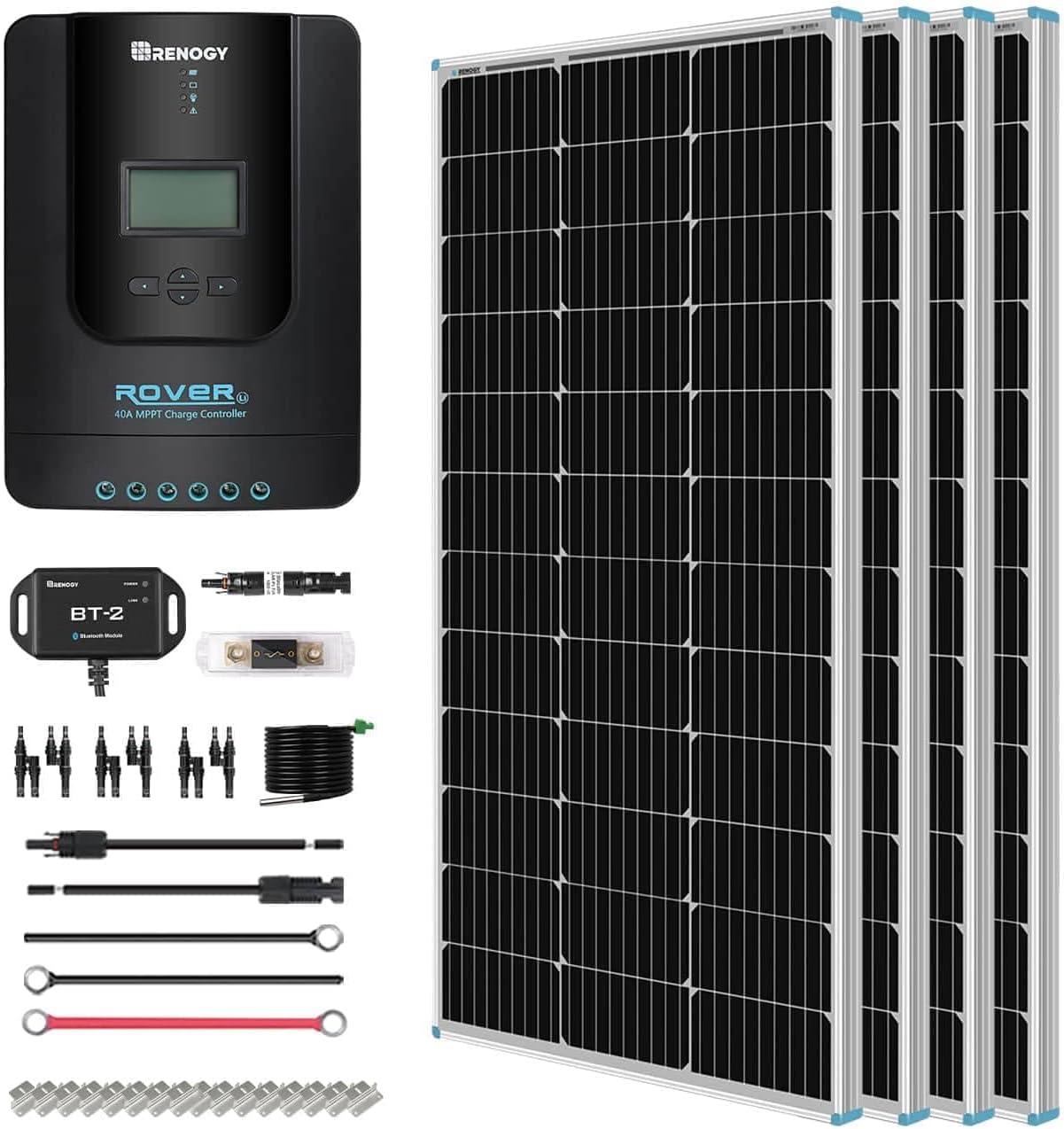
🏆 Renogy 400W Monocrystalline Solar Kit – Best Renogy RV Solar Panel Kit
The Renogy RV solar panel kit ships as four 100W monocrystalline panels, a 40-amp Wanderer MPPT charge controller, branch connectors, and solar cables. Per Renogy’s published datasheet: each panel measures 46.9 × 20.9 × 1.4 inches, weighs 14.3 lbs (6.5 kg), and is rated at 21.0% efficiency under STC (1000 W/m², 25°C). Real-world output will be lower – the degree depends on sun hours, angle, temperature, and shading at your specific site. A community planning estimate of 70-80% of rated wattage is sometimes used as a rough starting point; treat it as informal guidance, not a specification. Z-bracket mounting hardware is sold separately. The included 40A controller limits expansion to roughly 520W at 12V; upgrading the controller is needed beyond that.
✅ Pros
- Complete kit – no missing parts
- MPPT controller included
- Monocrystalline – space-efficient
- Well-documented installation guides
- Wide availability of compatible accessories
⚠️ Cons
- Rigid – incompatible with curved roofs
- Z-bracket mounting hardware not included
- Included 40A controller limits future expansion beyond ~520W (at 12V)
- 21% efficiency – Victron offers 22.2% if roof space is tight
- Renogy’s standard warranty is 5 years on materials – verify current terms
Victron Energy Rigid Solar Panels
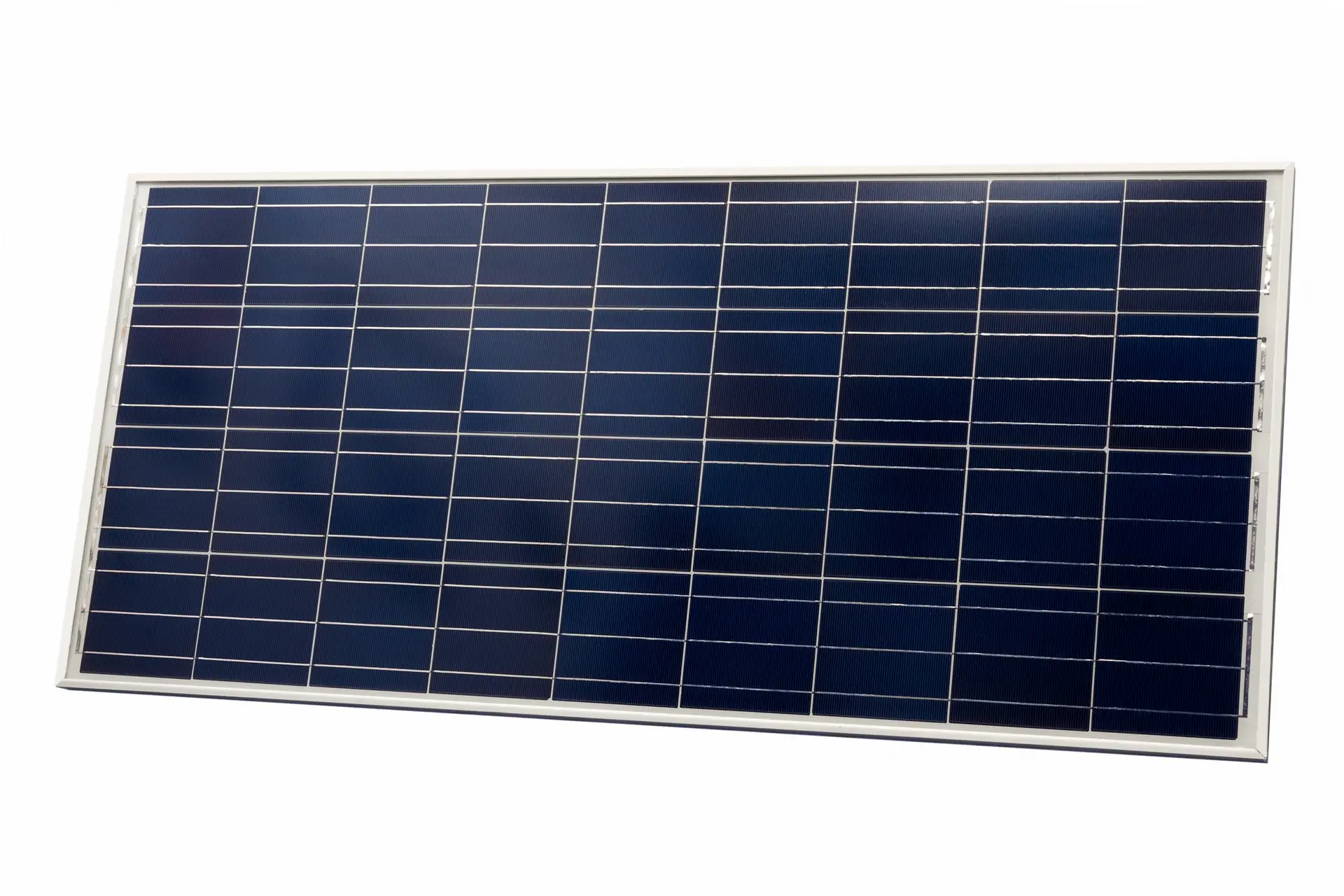
Victron’s BlueSolar range represents some of the most specified rigid solar panels available for RV installations. Victron publishes multiple panel models; this entry refers to their BlueSolar monocrystalline series. Per Victron’s published datasheet (available at victronenergy.com), their 175W panel achieves 22.2% efficiency under STC (1000 W/m², 25°C, AM1.5). The panel is certified to IEC 61215 and IEC 61730 – independent safety and performance standards tested by accredited labs, not Victron internally. Operating temperature range per datasheet: -40°C to +85°C. The Victron ecosystem advantage is real but requires separate purchases: a Victron SmartSolar MPPT controller and BMV-712 battery monitor connect via Bluetooth to the VictronConnect app. None of these are included in a panel purchase. User reports describing multi-year consistent output are anecdotal (forum and review-sourced) and should not be treated as warranty claims. Victron’s standard solar panel warranty is 12 years on materials and 25 years on power output – verify current terms at victronenergy.com.
✅ Pros
- Highest efficiency on this list
- Full ecosystem integration via app
- Built to commercial/marine standards
- Strong long-term user reports
⚠️ Cons
- Premium price – substantially higher cost per watt than Renogy
- No kit option – controller, monitor, and mounting all sourced separately
- Full ecosystem benefit only realized with additional Victron component purchases
- Overkill complexity and cost for part-time or weekend RV use
- Availability varies by region – confirm stock before budgeting
BougeRV 300W N-Type Bifacial Panel
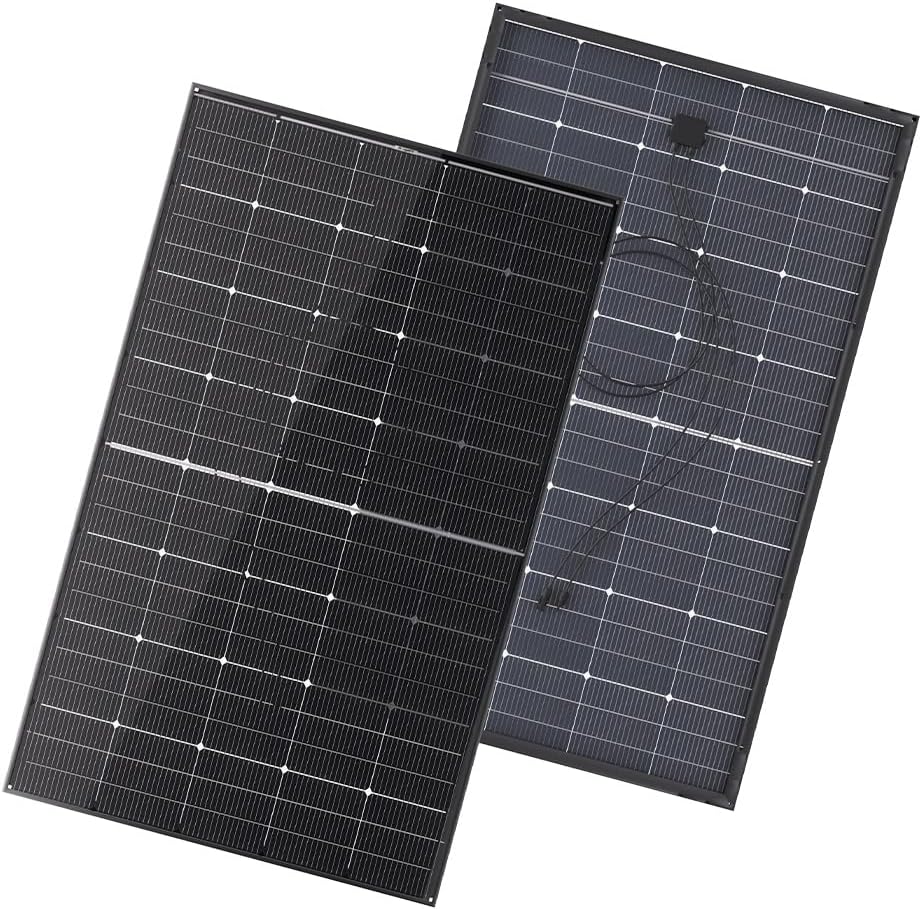
The BougeRV 300W N-Type Bifacial is rated at 300W front-face output under STC. The rear face captures reflected light from the roof surface below – BougeRV claims up to 25% additional output under optimal conditions. NREL bifacial field research suggests real-world gain typically falls in the 5-25% range depending on roof reflectivity and panel clearance; the higher end requires a highly reflective white surface. User reports of 15-20% gain on white RV roofs are anecdotal. N-Type cells are claimed by BougeRV to degrade more slowly than P-Type mono; independent long-term field validation for this brand is limited. The rear-face benefit requires at least 3-4 inches of clearance (per BougeRV installation guidance) – adhesive mounting is not compatible.
✅ Pros
- Potential for higher output on light-colored roofs with proper clearance – gain is conditional on roof reflectivity and mount height
- N-Type cells – lower reported degradation
- Good value for power output
⚠️ Cons
- Bifacial gain is conditional – minimal on dark or reflective-poor roofs
- Requires 3-4 inch clearance – Z-brackets required, not adhesive
- BougeRV is a newer entrant – less install history and community support than Renogy
- Verify current warranty terms before purchasing – details vary by model revision
- 300W output is front-face only; bifacial gain is additional and variable
Go Power! 200W Portable Solar Kit
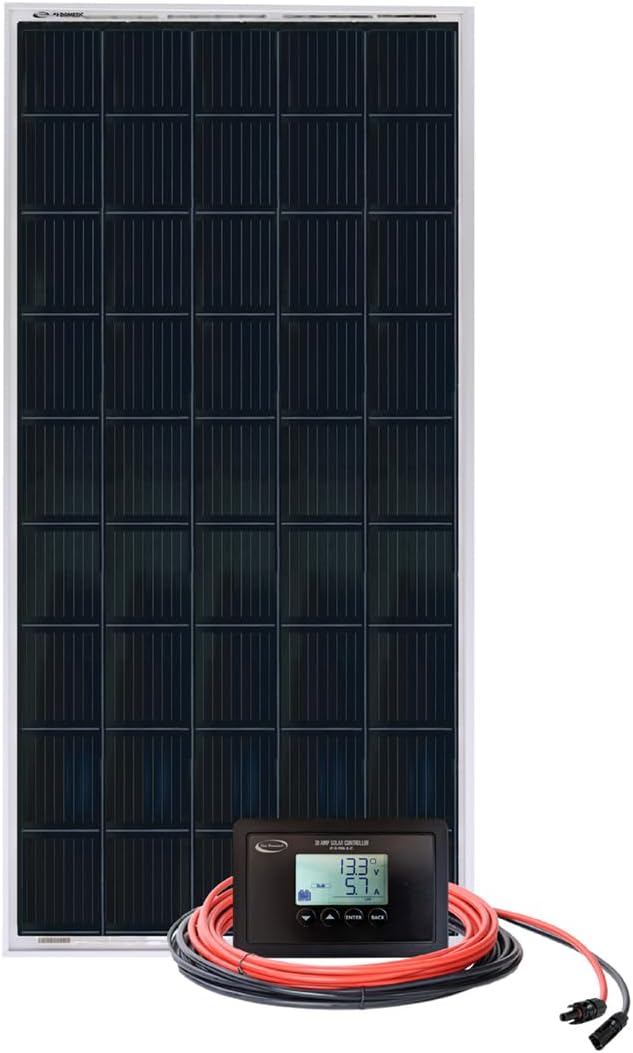
Per Go Power!’s published product specifications, the GP-PSK-200 kit folds to approximately 29 × 22 × 3 inches and weighs 28 lbs (12.7 kg) including the carry bag. The kit ships with a PWM charge controller (not MPPT) and a 20-foot cable for connection to a standard RV solar port. The PWM controller included is rated for this 200W configuration; it is not a limitation for casual use at this power level, but if you plan to combine this unit with additional roof panels, a separate MPPT controller would be required for the combined system. Go Power! markets the case as designed for repeated daily setup cycles; hinge and connector durability over multi-year use is user-reported (anecdotal) rather than published-specification. At 28 lbs, this requires two hands to carry comfortably and is not a lightweight portable in the backpacking sense – context matters when comparing “portable” products.
✅ Pros
- Deploy away from RV – full sun freedom
- No roof installation needed
- Good backup when roof panels are shaded
- Complete kit – nothing extra needed
⚠️ Cons
- 28 lbs is awkward to carry solo – not lightweight by any standard
- PWM controller limits efficiency gain vs. MPPT – not suitable as a combined-system controller
- 200W hard ceiling – not expandable without buying a separate roof system
- Daily setup and storage adds friction compared to a permanent installation
- Hinge and connector longevity over years of daily use is user-anecdotal only
Category guidance only – not ranked against the four verified products above. The following section describes flexible solar panels as a product category for curved-roof RVs. No specific brand has been verified for current availability and specifications in this slot.
Flexible Solar Panel Category ⚠️
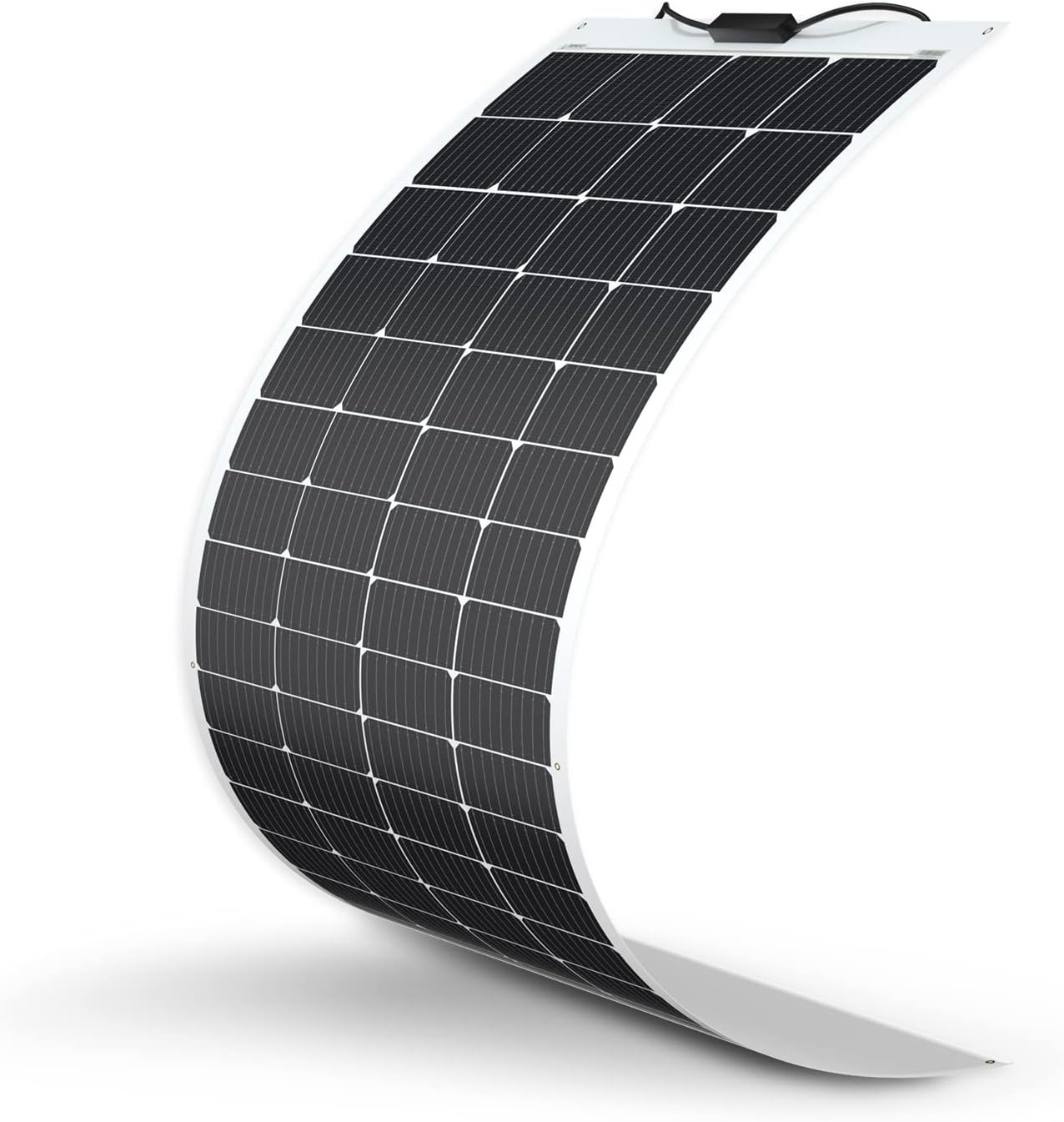
This section describes flexible solar panels as a category for curved-roof applications. No specific brand has been verified for current availability in this slot. Typical specifications for 150W flexible mono panels: 17-18% efficiency under STC (vs. 20-22% for rigid mono), weight of 4-5 lbs, and adhesive mounting that leaves no air gap between panel and roof. Flush-mounted panels run hotter than raised panels – solar panel datasheets document a temperature coefficient of approximately -0.35% to -0.45% per °C, meaning heat buildup measurably reduces output on hot days. The adhesive bond is permanent; removal risks damage to the roof surface. Search major retailers for a currently available flexible mono panel in this wattage class and confirm brand, warranty, and specifications before purchasing.
✅ Pros
- Fits curved roofs rigid panels can’t
- Very lightweight – 4-5 lbs
- No mounting hardware or height added
- Low profile – no aerodynamic drag
⚠️ Cons
- Brand availability unverified as of April 2026 – confirm before purchasing
- 17-18% efficiency vs. 20-22% for rigid mono panels
- Flush mount causes heat buildup – measurably reduces output on hot days
- Adhesive installation is permanent; removal risks roof surface damage
- Flexible panels typically have shorter rated lifespans than rigid equivalents
- Not expandable beyond what the roof adhesive area allows
Side-by-Side Comparison: 4 Verified Panels
The 🏆 highlighted row – the Renogy RV solar panel kit – is our overall top pick for most RVers. The final row is category guidance only and is not ranked against the four verified products.
| Panel | Output | Efficiency¹ | Install Type | Controller | Best For | Buy |
|---|---|---|---|---|---|---|
| Renogy 400W Kit 🏆 #1 Overall |
400W | 21% (STC) | Rigid, roof-mount | MPPT 40A incl. | First install, flat roof⚡ Best Kit Value | Buy ↗ |
| Victron BlueSolar | 175W (per panel) | 22.2% (STC) | Rigid, roof-mount | Not included (sep.) | Full-timers, tight roof🔋 Highest Efficiency | Buy ↗ |
| BougeRV 300W Bifacial | 300W front + up to 25% bifacial gain | ~21% front-face est. (N-Type mono typical; verify on BougeRV datasheet) | Rigid, raised Z-mount | Not included (sep.) | White/light roof, max output🔬 Bifacial | Buy ↗ |
| Go Power! GP-PSK-200 | 200W | Not stated by manufacturer (portable kit; verify on gpelectric.com) | Portable, foldable | PWM incl. (not MPPT) | Shade parking, no-drill🎒 Most Portable | Buy ↗ |
| Flexible Panel Category ⚠️ Category guidance only — not ranked |
~150W typical | 17-18% (STC, category) | Flexible, adhesive | Not included (sep.) | Curved roofs only⚠️ Unverified Brand | Verify brand first |
¹ All efficiency figures are manufacturer-published STC ratings (1000 W/m², 25°C, AM1.5) – real-world output is typically lower due to heat, shading, and wiring losses. | “(incl.)” = included in purchase. “(sep.)” = purchased separately. | ⚠️ Flexible Panel Category row describes a product category, not a single verified brand – confirm availability before purchasing.
Making Your System Last
Installing panels is only half the work. These three practices are what keep a solar setup performing well over years rather than months.
Battery Chemistry: LiFePO4 vs. Lead-Acid
LiFePO4 (Lithium Iron Phosphate) batteries are widely preferred for solar RV setups where weight and depth-of-discharge matter. They are generally lighter and can be discharged to a higher percentage of capacity than lead-acid without accelerated degradation – most manufacturers specify 80-100% usable capacity vs. 50% for AGM. However, LiFePO4 costs significantly more upfront. Lead-acid (AGM) remains a practical choice for budget builds, cold climates where lithium requires heating, or occasional-use setups. Battery choice depends on budget, climate, weight constraints, and your charging profile – there is no single correct answer.
Keep Panels Clean
Dust, pollen, and bird droppings reduce panel output. The degree of loss varies with location, environment, and panel tilt – a commonly cited range in solar maintenance literature is 5-20% for significant soiling (figures vary widely by source and condition; treat this as a general-guidance range, not a fixed specification). Wiping panels with a soft damp cloth periodically is low-effort and widely recommended. Avoid abrasive materials that can scratch the glass surface.
Mount with Airflow
Z-brackets or tilt mounts that raise panels 1-2 inches above the roof surface allow airflow underneath. Solar panel output does decrease as cell temperature rises – this is a well-documented effect described in panel datasheets as the temperature coefficient (typically around -0.35% to -0.45% per °C above 25°C for monocrystalline panels). The practical difference between a well-ventilated and a flush-mounted panel on a hot roof can be meaningful, though the exact magnitude depends on ambient temperature, roof material, and wind conditions.
Use Quality Cabling
UV-resistant solar cable (also called PV wire or USE-2 cable) is specified for outdoor use and resists brittleness from sun exposure. Standard household wire is not rated for direct UV exposure and degrades faster. Quality kits typically include appropriate cabling; if sourcing components separately, verify that cables are rated for outdoor solar use and sized correctly for the current and cable run length.
Before You Buy – Quick Checklist
Run through this before purchasing to avoid the most common solar setup mistakes.
⚡ RV Solar Buying Checklist
- Measured available roof space (flat vs. curved)
- Estimated total wattage needed for your load
- MPPT controller recommended for most roof-mounted systems (see methodology for context)
- Battery chemistry considered (LiFePO4 or AGM) based on budget, weight, and climate
- Verified panel weight vs. roof load rating
- Mounting hardware included or separately sourced
- UV-rated solar cable confirmed
- Roof penetrations sealed with compatible sealant
FAQ – Common Questions
Straightforward answers to the questions that come up most when comparing RV solar options. Jump to the comparison table or Quick Picks to find your match. Note: this article is not installation advice. Electrical work and roof penetrations involve safety and structural risks – consult a qualified technician for your specific setup.
-
It depends on your use case, roof type, and budget. For a first install on a flat roof at mid-range budget: the Renogy 400W kit is the most complete entry point. For full-time living where budget is secondary to reliability: Victron rigid panels. For curved roofs: a flexible panel category. For shaded parking without roof work: a portable kit. There is no single correct answer – use the comparison table to match your specific constraints.
-
Full-time living typically requires 600W+ of panels and 200Ah+ of battery capacity – actual requirements depend on your specific load. Victron is frequently cited by full-timers for its monitoring ecosystem and component reliability. Renogy is also used by full-timers on tighter budgets, with the option to expand incrementally. Either approach works; the choice comes down to monitoring needs and budget tolerance.
-
Renogy solar panels for RV setups are consistently described as good value in aggregated retail reviews and community discussion. The kit format – matched panels, controller, and cables from one manufacturer – reduces compatibility guesswork, which is the main practical advantage over buying components separately. Renogy publishes installation documentation and has a large user community. These are stated advantages based on public information; we have not tested the product directly. Verify current pricing and warranty terms before purchasing.
-
More than most people estimate. A 12V compressor fridge typically draws 40-60Ah per day (this is a commonly cited range in RV communities; your specific fridge model will have a published amp-draw spec). Add laptop, lights, and fans and 200W-300W is often borderline for regular use with a fridge on. The wattage table above provides a starting framework. Use your actual appliance specs to calculate your real load – don’t rely on generalized estimates for a purchasing decision.
-
Many RV owners do. Kits like the Renogy 400W include installation documentation. Key considerations: roof penetrations must be sealed properly; wire gauge must match cable run length and current (use a wire gauge calculator for your specific run); and the controller must be configured for your battery chemistry. If you’re not comfortable with basic DC wiring or roof work, a certified RVIA technician is the appropriate resource. This guide cannot serve as installation advice.