Field guide · Compressor, absorption, thermoelectric
Keep Your RV Fridge Cold on the Road: Prep, Packing, Power and Food Safety
Most fridge failures on a trip are really routine failures: prep, packing, power and placement. Here's how to reach day five with cold food and a charged battery.
On this page
When food spoils on day two of a trip, the fridge itself is rarely the problem. What fails is the routine around it: how it was prepped, how it was packed, how much battery it really had, and where it sat in the sun. This guide covers all four, for 12V compressor fridges, 3-way absorption fridges and thermoelectric coolers.
Know your fridge type
| Type | Power | In the heat | Best for |
|---|---|---|---|
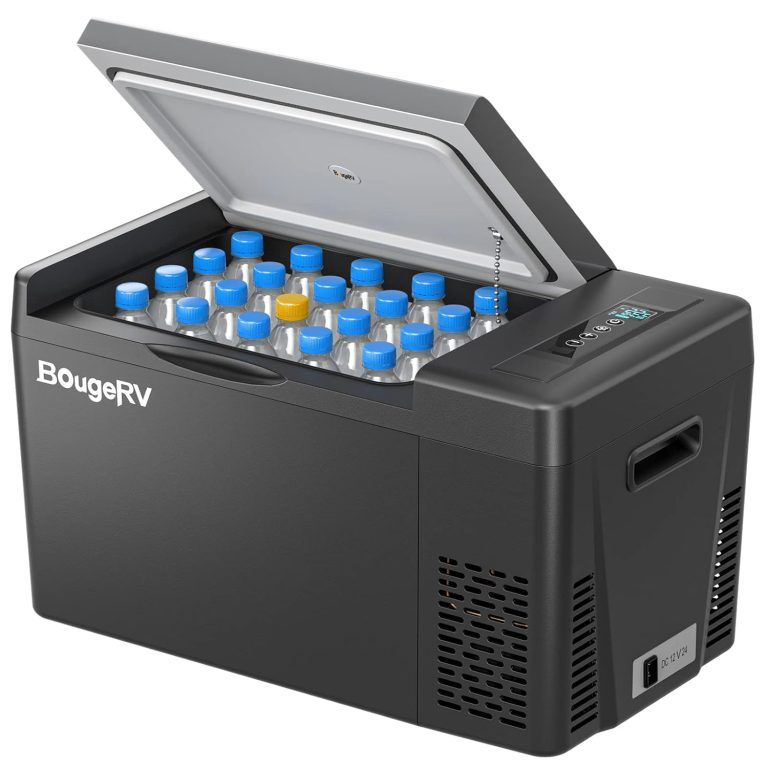
| 12V compressor | 12V DC battery | Strong; many models hold temperature above 100°F when properly ventilated. Doesn’t need to be level. | Off-grid trips, hot climates |
| 3-way absorption | Propane, 120V or 12V | Struggles above about 90°F; must be close to level. On 12V it draws far more current than a compressor fridge. | Campgrounds with shore power or propane |
| Thermoelectric cooler | 12V DC | Only cools about 30-40°F below the outside air: on a 95°F day, 55-60°F inside at best. | Drinks and snacks on short trips |
Before you leave: the 24-hour routine
Do this the evening before departure, not the morning of. A fridge that starts cold stays cold far more easily than one catching up while running on battery for the first time.
- Pre-chill for 24 hours on shore power, empty or nearly empty, before loading.
- Load only food and drinks that are already cold. Every warm item pulls the temperature up for everything else and makes the compressor work harder.
- Freeze 2-3 water bottles as “cold batteries”: they hold temperature through door openings and short power gaps, and become cold drinking water.
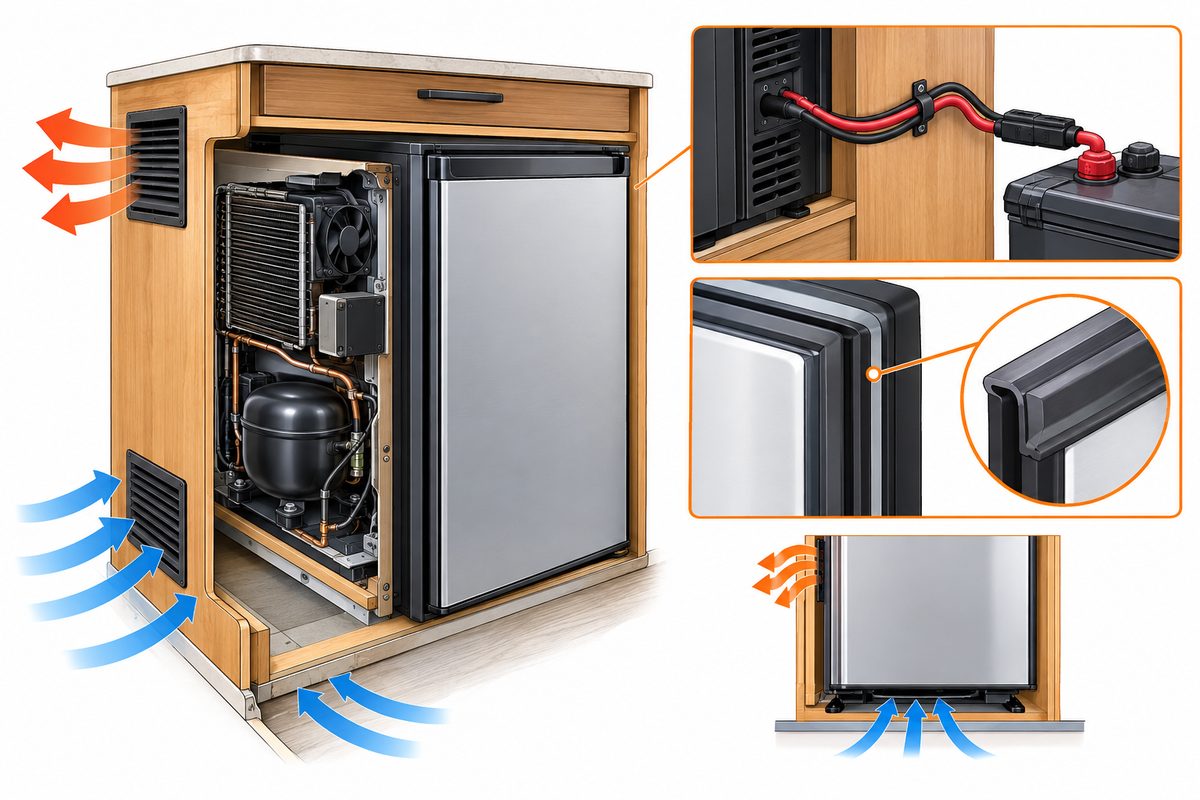
- Do the dollar-bill test on the seal. Close the door or lid on a bill and pull it out; if it slides out with no resistance, warm air is leaking in all the time.
- Clean the condenser coils and vents, and add a fridge thermometer so you know the real temperature.
Packing rules
- Fill empty space with water bottles. Packed food and bottles hold cold better and recover faster after the door opens than a fridge full of empty air.
- Raw meat sealed, on the bottom shelf or in a tray, to prevent drips and cross-contamination.
- Keep the internal vent clear in upright fridges. Most circulate air with a small fan; food packed against it creates warm pockets.
- Use bins. Know where things are before you open the door, so it stays open for seconds, not minutes.
- Portion hot food into shallow containers and refrigerate it promptly. USDA guidance is that hot food can go straight into the fridge; shallow containers cool it fast without warming everything around it.
Power: the simple math
This decides whether the fridge runs for a weekend or a week.
- Find your fridge’s daily drawRunning current (amps, from the data plate) × 24 hours × duty cycle. Example: 3.5A running 40% of the time on a hot day = about 33.6Ah a day; at 25% on a cool day, about 21Ah. A typical 40-50L compressor fridge averages around 25Ah a day, more in heat.
- Use usable battery capacity, not ratedLithium (LiFePO4): roughly 80-100% of rated capacity usable. Lead-acid and AGM: about 50% before you risk damage.
- Add every other load on the same batteryLights, water pump, inverter idle draw and anything else.
- Divide, then keep a reserveRuntime = usable Ah ÷ total daily Ah. Plan on about 80% of that, keeping 20% in reserve.
Run your own numbers: the RV fridge battery calculator does this math for your fridge, battery, solar and driving.
Recharging: solar panels sized to your daily draw and the sun hours on your route (a fridge alone using about 30Ah a day usually needs more than one small panel on cloudy days), and a DC-DC charger that refills the house battery from the alternator while you drive.
Placement and ventilation
- Leave the vent clearance your manual specifies, commonly 2-4 inches.
- Keep the fridge out of direct sun; a closed vehicle in summer gets extremely hot inside.
- Use an insulated cover or reflective shade where sun can’t be avoided.
- Absorption fridges: level the rig, add a rear vent fan, and turn propane off at fuel stations, on ferries and wherever rules require it.
Temperatures and food safety
Set the fridge to 34-40°F (37-38°F is the sweet spot) and the freezer to 0°F. Colder doesn’t make food safer; it just uses more power. The danger zone is 40-140°F: perishables shouldn’t sit in it for more than 2 hours, or 1 hour when it’s above 90°F.
| Situation | Timeframe | What to do |
|---|---|---|
| Power out, fridge door kept closed | About 4 hours | Generally safe; check with a thermometer |
| Power out, door opened | Shorter | Discard perishables above 40°F for 2+ hours (1+ hour above 90°F) |
| Freezer, door kept closed | About 48 hours full, 24 hours half full | Usually safe if food still has ice crystals or is fully cold |
Daily routine on the road
- Check the fridge thermometer and battery state of charge morning and evening
- Decide what you want before opening the door
- Rotate frozen bottles daily: thawed one to the freezer, frozen one to the fridge
Troubleshooting
| Problem | Likely cause | Fix |
|---|---|---|
| Not cooling at all | No power, blown fuse or compressor failure | Check the fuse or breaker, then voltage at the fridge terminals |
| Battery dead by morning | Draw underestimated, or another load left on | Redo the Ah math; look for other parasitic loads |
| Fridge keeps cutting out | Voltage drop from thin or long wiring, or cutoff set too high | Correct wire gauge for the run length; check the cutoff setting |
| Frost buildup | Door left open, or a worn seal | Dollar-bill test; defrost and reset |
| Condensation outside | Humid air on a cold surface | Normal in humid climates; wipe and monitor |
Frequently asked questions
How long will my battery run my RV fridge?
Divide the battery's usable amp-hours by your total daily amp-hours (fridge plus everything else on that battery), then plan on about 80% of the result. A 100Ah lithium battery with a 35Ah/day load lasts roughly two days without recharging.
Can I run an RV fridge overnight without solar?
Usually yes on a properly sized battery: one overnight cycle uses well under half of a full day's draw. Problems show up after several nights with no recharging.
What temperature should an RV fridge be?
34-40°F, with 37-38°F as the sweet spot, and 0°F for the freezer. Colder doesn't make food safer, it just uses more power.
Why does my RV fridge keep shutting off when the battery is charged?
Usually voltage drop from wire that is too thin or too long: the fridge's low-voltage cutoff reads the sag at its terminals. Use the correct gauge for the run and a dedicated fused circuit.
Is a thermoelectric cooler enough for an RV trip?
Only for drinks and short trips. It cools only about 30-40°F below outside air, which is not a safe margin for raw meat or dairy in hot weather.
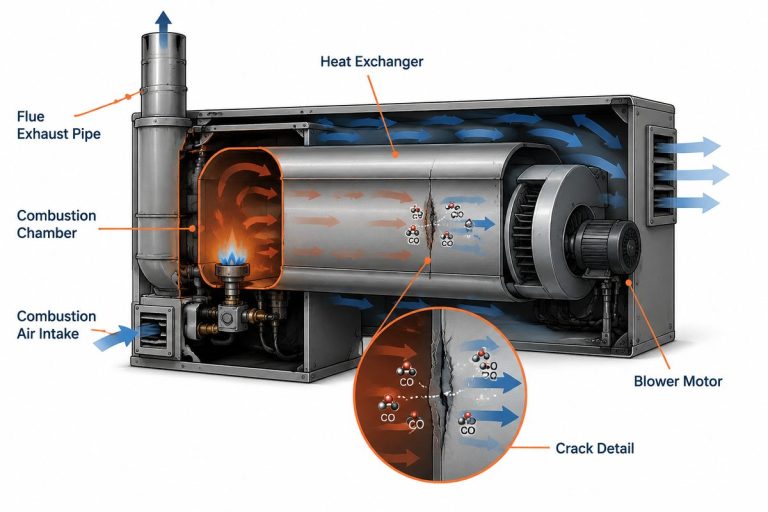
Safety and disclaimer. This guide is general information, not professional advice. Work on propane, gas and electrical systems carries real risk; when in doubt, stop and call a qualified RV technician, and always follow your unit's service manual. If a carbon monoxide or propane alarm goes off, get everyone out of the RV first. How we research.