Exterior RV Accessories Guide (2026)
A practical guide to the accessories that protect, cover, and equip the outside of your RV – from roof vents to entry steps, awnings to slide-out toppers.
The exterior of your RV faces more daily abuse than almost any other part of it. Sun, rain, wind, road debris, insects, and temperature swings all work against the materials on the outside of your rig – and those materials are not cheap to repair or replace.
Exterior RV accessories are the products that attach to, cover, or protect the physical surfaces of your RV’s exterior. This guide covers those categories specifically: what they are, what problems they solve, and how to think about prioritizing them. It does not cover utility setup gear like leveling equipment, electrical management, water pressure regulators, or sewer systems – those topics have their own dedicated guides.
- What Counts as an Exterior Accessory?
- Exterior Protection Accessories
- Awning and Shade Accessories
- Entry, Door, and Screen Accessories
- Roof, Vent, and Slide-Out Accessories
- Exterior Lighting and Visibility
- Exterior Storage and Ladder Accessories
- How to Prioritize Exterior Accessories
- Common Mistakes
- Frequently Asked Questions
What Counts as an Exterior RV Accessory?
The term “exterior RV accessories” gets used loosely online, and many product lists bundle together things that do not actually belong in the same category. Surge protectors, leveling blocks, water hoses, and sewer kits are all things you use outside – but they are utility and setup equipment, not exterior accessories in the true sense.
For the purposes of this guide, an exterior RV accessory is something that:
- Attaches to, covers, or protects a physical surface on the outside of the RV
- Deals with the rig’s exterior shell, openings, roof, entry points, or structural surfaces
- Addresses weathering, UV damage, insects, debris, or physical wear on the exterior itself
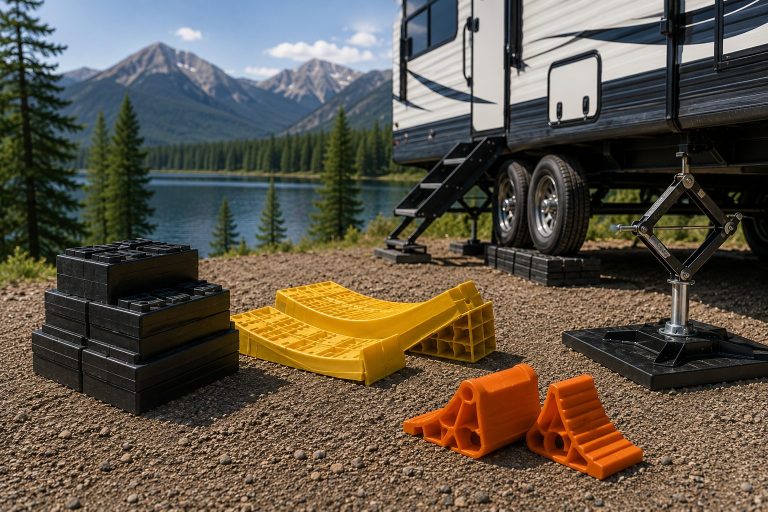
- Leveling blocks, stabilizer jacks, wheel chocks, and jack pads
- Surge protectors, EMS systems, electrical adapters, and power cords
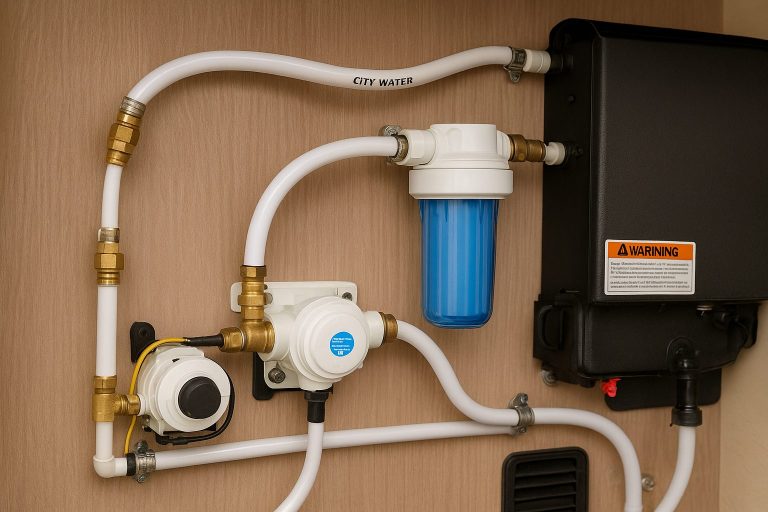
- Water pressure regulators, hoses, and inline filters
- Sewer hoses, holding tank treatments, and waste management equipment
- Interior accessories of any kind
What this guide does cover are the products that directly interact with the RV’s surfaces, openings, roof, and entry points – the accessories that protect and equip the rig itself.
Why Exterior RV Accessories Matter
An RV’s exterior faces more sustained stress than almost any other part of the rig. It lives outside – parked in direct sun for months at a time, exposed to rain, temperature swings, road debris, and the slow cumulative grind of UV radiation on every surface it has. The exterior shell is what protects everything behind it, and when it starts to fail, the repairs are rarely minor.
UV exposure is the most underestimated factor. It fades paint and decals, degrades rubber seals around windows and slide-outs, breaks down the bonding agents in fiberglass gel coat, and dries out tire sidewall compounds until cracking begins. None of this happens overnight – which is exactly why it goes unaddressed until the damage is already significant. The seals around roof vents, antennas, and slide-out frames that keep water out of the walls do not fail in a single storm. They fail gradually, over seasons of UV exposure and thermal cycling, until one rainy trip reveals a stain on the ceiling.
Rain itself causes less damage than the gaps that UV damage creates for it. Once a seal cracks, a seam separates, or a slide-out topper is missing and debris has worked into the entry gasket, water finds its way in. Interior water damage – delaminated walls, soft floors, mold in insulation – is the most expensive category of RV repair, and most of it traces back to exterior surfaces that were not maintained or protected.
Exterior storage bays are vulnerable in their own way. Compartment door seals degrade, vent screens fail, and the result is moisture-damaged gear, insect activity, or in cold climates, freeze damage to stored water lines and components.
It is rarely one hailstorm or one hard winter that degrades an RV’s exterior. It is years of UV exposure on unsealed surfaces, uncovered tires, and unprotected seams – damage that builds invisibly until it crosses a threshold. Exterior accessories interrupt that accumulation before it reaches the threshold where repairs become unavoidable.
Exterior Protection Accessories
UV radiation, moisture, road grime, and temperature fluctuation are the primary enemies of your RV’s exterior. Protection accessories form the first line of defense against long-term surface deterioration. They are not glamorous, but they represent some of the highest-return purchases an RV owner can make.
RV Covers
A full RV cover is a fitted fabric shell designed to protect the entire rig during storage. It shields paint, decals, rubber seals, and roofing materials from UV fading, moisture penetration, bird droppings, tree sap, and airborne debris. For any RV that spends significant time outdoors between trips, a quality cover dramatically slows exterior aging.
Cover quality varies considerably. The most important factors are breathability, fit, and material durability. A cover that traps moisture underneath can accelerate the very damage it is meant to prevent. Cheap, loose-fitting covers that flap in the wind will abrade the surfaces they contact. Fit is specific to RV type and length – always verify dimensions before purchasing.
Tire Covers
RV tires are expensive, and UV exposure is one of the leading causes of premature tire failure. The sidewall compounds in tires degrade under continuous sunlight exposure, leading to surface cracking – a condition called dry rot – that can compromise the tire’s structural integrity even when tread depth appears adequate. Tire covers block sunlight from the sidewalls and are among the most cost-effective exterior protection purchases available.
Fit matters here too. Covers that are too loose flap against the tire and can trap moisture around the sidewall. Most are sold by tire size or by RV type; verify the fit against your actual tire dimensions.
Windshield Covers
Motorhome windshields are large, expensive pieces of glass that absorb significant UV exposure and thermal stress when parked. Windshield covers – typically reflective insulated fabric panels that attach to the exterior of the glass – serve a dual purpose: they block UV from degrading interior upholstery and dashboard materials, and they dramatically reduce interior temperatures when the rig is parked in direct sun. For motorhome owners, they also protect the windshield itself from debris, bird droppings, and sap during storage.
Exterior Surface Protectants
Beyond physical covers, a range of products designed to condition and protect exterior surfaces fall into this category. Fiberglass wax and UV protectants preserve gel coat and paint. Rubber roof coatings and sealants maintain the watertight integrity of membrane roofing. Slide-out seal conditioners keep the rubber gaskets around slide rooms supple and functional. These products overlap with maintenance, but they are worth knowing as part of the broader exterior protection picture.
No protection accessory works well if it does not fit properly. An ill-fitting cover that flaps in wind or pools water in low points can cause more harm than protection. Always match cover sizing to your specific RV’s dimensions, not just its type or class.
Decal and Trim Protection
Most modern RVs use vinyl graphics and decals as part of their exterior finish. These are not painted on – they are adhesive films applied over the fiberglass, and they are significantly more vulnerable to UV and moisture damage than the underlying surface. Decal protectant films and UV-blocking coatings help extend their lifespan. Some owners choose to pre-emptively apply clear paint protection film over decals and lower trim areas that are prone to road debris impact.
Awning and Shade Accessories
The awning is one of the most heavily used exterior features on any RV. It defines the outdoor living space, provides shade and weather protection, and takes more wear than almost any other exterior component. Awning accessories extend its functionality and help protect it from the conditions that damage it most.
Awning Tie-Downs and De-Flappers
An extended awning in wind is vulnerable. Even modest gusts can stress the arms, distort the fabric, or cause the awning to collapse unexpectedly. Awning tie-down kits anchor the outer rail of the awning to the ground, significantly improving stability in breezy conditions. De-flappers clip the awning fabric to the roller tube to eliminate the repetitive stress of fabric flapping in light wind – a primary cause of premature fabric wear and seam failure.
Awning Privacy Screens and Side Walls
Vertical fabric panels that attach to the outer edge and sides of a main awning enclose the covered area, providing privacy from adjacent campsites, additional wind protection, and shade on low-sun angles. Some screens are solid fabric; others are mesh that allows airflow while still blocking insects and reducing glare. For campers who spend significant time at the campsite, these panels can transform an open awning into something closer to a covered outdoor room.
Awning Lights
LED strip lights and string light systems designed to attach to the awning rail extend the usable hours of the outdoor space after dark. Most modern awning lighting systems run on 12V DC power from the RV, with some using wireless remotes or smart home integration. Lighting attached to the awning rail requires weatherproofing appropriate for outdoor exposure – products designed for other applications may not hold up in rain or dew.
Slide-Out Awnings
Many RVs include small awnings over their slide-out rooms – low-profile fabric panels that extend when the slide opens to divert rain and debris away from the slide-out’s top seal. On rigs where these are not factory-installed, aftermarket slide-out awnings can be added and are worth considering in regions with significant rainfall. They are separate from the main patio awning and serve a specific protective function rather than a comfort function.
Awning Replacement Fabric
Awning fabric degrades over time – UV exposure, mildew, and physical stress eventually require replacement. When a fabric needs replacing before the mechanical components do, replacement fabric panels for most common awning brands are available. This extends the life of the hardware without replacing the entire unit.
The most common cause of awning damage is leaving it extended unattended. Wind conditions can change overnight in ways that are difficult to predict. Retracting the awning before sleeping or leaving the campsite is the simplest form of awning protection.
Entry, Door, and Screen Accessories
Every time you enter or exit your RV, you pass through the same entry point. The door, its screen, its step, and the frame around it all face significant wear – and they are also the primary vector through which insects, drafts, and dirt enter the living space. Accessories in this category address both protection and usability at the entry.
Screen Doors and Screen Door Replacements
The factory screen door on most RVs is functional but not always robust. Hinged and sliding screen door replacements with stronger frames and tighter-sealing mesh are a common upgrade. Magnetic screen door panels – frameless mesh panels held closed by embedded magnets – are popular as secondary screens because they are easy to install, seal well, and allow hands-free entry. They are particularly effective at keeping insects out during peak evening hours when the main door is open for ventilation.
Bug Screens for Windows and Vents
Factory window screens vary in quality and coverage. Aftermarket window bug screens – typically custom-cut mesh panels that attach to the exterior of window frames – provide tighter insect exclusion than many factory screens, and they can cover openings that do not have built-in screens. These are particularly useful on older rigs where original screens have degraded or do not seal well around the edges.
Entry Step Covers and Step Lights
The entry step on most RVs is a hard surface that can become slippery in rain or when wet with dew. Non-slip step covers – rubberized or textured mats designed to fit the step profile – reduce the risk of slipping on entry and exit. Step lights, either battery-powered or wired into the RV’s 12V system, illuminate the step area after dark and are a meaningful safety improvement for trips with late-night movement around the campsite.
Door Handle Covers and Protectors
Entry door handles and keypad lock surfaces are high-contact points exposed to UV, rain, and physical wear. Protective covers keep moisture out of keypad mechanisms and reduce UV degradation on plastic handle components. These are minor accessories, but keypad entry systems on RVs are not cheap to replace when moisture-damaged.
Entry Door Awnings
Small fixed or retractable awnings positioned directly above the entry door provide a rain-protected zone for the step and doorway. They are distinct from the main patio awning and focus specifically on keeping rain off the entry step and door threshold – useful on rigs where the main awning does not extend to cover the door area.
Good insect screening on doors and windows matters most in warm weather when ventilation is the primary cooling strategy. If you camp in areas with heavy mosquitoes or biting insects, upgrading screen quality is one of the most comfort-impactful exterior changes you can make.
Roof, Vent, and Slide-Out Accessories
The roof is the most weather-exposed surface on any RV and the one that causes the most expensive damage when it fails. Roof accessories address the components that penetrate, cover, or seal the roofline – and the slide-out rooms that extend through the RV’s sides are subject to their own set of exterior wear issues.
Roof Vent Covers
Roof vent covers are low-profile domed or angled covers that fit over the openings of roof vents. Their primary function is to allow the vent to remain open during rain, dramatically improving ventilation options in wet weather. Without a vent cover, opening a roof vent in rain quickly leads to water intrusion. Most RV roof vents can accommodate aftermarket covers, though dimensions vary and fit should be verified.
Vent covers also provide some protection from debris, UV degradation of the vent lid, and in some cases nesting insects during storage. They are a straightforward and inexpensive addition to any rig.
Roof Vent Fan Replacements and Upgrades
While not strictly a cover or protection accessory, upgraded roof vent fans with integrated covers and better airflow performance are among the most-installed aftermarket roof components. Many RVers replace the factory vent fans in the bathroom and main living area with higher-performance units that include integrated rain sensors, reversible airflow, and better sealing. The cover component – which must seal well and handle outdoor exposure – is part of what distinguishes these upgrades from simple interior fan replacements.
Slide-Out Toppers
Slide-out toppers are fabric covers that deploy over the top surface of slide-out rooms when extended. They solve a specific and common problem: debris, water, and leaves accumulating on the slide-out’s roof surface and being dragged back into the RV’s interior seals when the slide is retracted. This debris accumulation is a leading cause of slide seal wear and water intrusion around the slide-out frame.
Toppers must be matched to the specific dimensions of the slide-out room and to the retraction mechanism of the slide itself. They are a meaningful protective investment for RVs with slide-out rooms, particularly on rigs parked under trees or in areas with significant leaf fall or bird activity.
Why Slide-Out Toppers Matter
- Prevent debris from being dragged into slide seals
- Reduce water pooling on the slide-out roof
- Protect the slide seal from abrasion over time
- Reduce cleaning required before retracting slides
What to Verify Before Buying
- Slide-out width and depth dimensions
- Slide retraction direction (in vs. down)
- Clearance above the slide when extended
- Compatibility with factory or aftermarket awnings
Roof Ladder Covers and Caps
The ladder rungs and mounting points on RV roof ladders collect moisture and are a common point of rust or oxidation on metal-framed rigs. Rubber rung caps and mounting point covers protect these surfaces and improve grip on wet rungs. These are minor accessories but relevant to anyone who accesses the roof regularly for inspection or maintenance.
Antenna and Satellite Covers
Roof-mounted antennas, satellite dishes, and solar panels all require protective accessories during storage or travel to prevent damage from low-clearance obstacles, road debris, and UV exposure. Travel covers for satellite dishes protect the dish surface and motor mechanism. Antenna cradles and travel locks prevent vibration-induced wear on antenna mounting hardware during transit.
Exterior roof accessories only work if the roof they protect is in good condition. Cracked sealant around vent bases, antenna mounts, and seams is the primary source of water intrusion in RVs. Roof vent covers and slide-out toppers reduce wear but do not substitute for annual inspection and resealing of all roof penetrations.
Exterior Lighting and Visibility
Exterior lighting on an RV serves two distinct purposes: it provides functional illumination around the campsite and entry points, and it contributes to safety visibility when the RV is on the road or parked in a public area. Both are worth understanding separately.
Porch and Entry Lighting
The porch light above the entry door is a standard feature on most RVs, but the factory bulb and fixture are often a starting point rather than a finished solution. LED replacement bulbs and upgraded fixture housings are among the most common exterior lighting improvements. Better porch lighting improves safety on the entry step, makes finding keys and locks easier after dark, and improves campsite usability in the hours around dusk.
Motion-sensing porch light replacements are increasingly popular – they conserve battery power by only activating when someone approaches the door, and they provide a security benefit for rigs left unattended overnight.
Campsite Perimeter Lighting
String lights, solar-powered stake lights, and clip-on LED systems designed for outdoor use around the campsite create a defined and usable outdoor living area after dark. These accessories are not attached to the RV itself – they define the space around it. Solar stake lights require no connection to the RV’s electrical system; string lights typically run from a 120V outlet or a USB source.
Underbody and Compartment Lighting
LED strip lighting installed in exterior storage compartments and under the RV chassis serves a practical purpose: it makes finding and retrieving items in dark storage bays significantly easier. Compartment lights activated by the compartment door opening – similar to a refrigerator light – are available as add-ons for rigs that lack them from the factory.
Tow and Running Light Accessories
For towed trailers and fifth wheels, LED upgrade kits for marker lights, running lights, and brake lights improve both visibility and longevity – LED light assemblies are significantly more durable than incandescent bulb fixtures in the vibration-prone environment of a towed vehicle. Clear lens covers for light assemblies protect against stone chip damage to lenses during highway travel.
If your RV still uses incandescent exterior bulbs, switching to LED equivalents is worth the effort. LED exterior lighting draws a fraction of the power, runs cooler, and lasts significantly longer – the last point matters most on a vehicle that encounters road vibration and thermal cycling regularly.
Exterior Storage and Ladder Accessories
RV exterior storage bays and roof access ladders are heavily used features that benefit from purpose-built accessories. The categories here address how to better organize and protect what your rig already has – not how to add cargo capacity through hitch-mounted racks, which is a separate topic.
Exterior Storage Bay Organizers
The large pass-through storage bays on travel trailers and fifth wheels, and the side storage compartments on motorhomes, are often deep and difficult to organize effectively. Slide-out shelf systems, hanging organizers, and magnetic tool strips designed for these spaces make it easier to access gear without unpacking the entire bay. Many are designed to fit within common bay dimensions, though measuring your specific compartments before purchasing is always the right approach.
Storage Bay Vent Covers
Most RV storage bays include small vents to prevent moisture and odor buildup. These vents can become entry points for insects during storage. Fine-mesh vent screens or covered vent replacements block insect entry while maintaining airflow. These are small accessories but worth noting for anyone who has found wasp nests or rodent activity in exterior compartments.
Compartment Door Seals and Latches
The rubber seals around exterior storage bay doors are a point of ongoing maintenance. When seals fail, water intrusion into the storage bay follows. Replacement door seal kits and aftermarket latch hardware extend the functional life of compartment doors and improve their weather seal. These accessories overlap with maintenance but are worth calling out as preventive additions before seal failure causes water damage to stored contents.
Ladder Step Covers
Exterior roof access ladders on travel trailers and fifth wheels are often the single most physically demanding part of routine RV use – climbing a vertical ladder to the roof for inspection or cleaning is genuinely challenging on some rigs. Rubber non-slip step covers improve grip significantly in wet conditions. Ladder standoff mounts increase the gap between the ladder and the RV sidewall, making rung grip more comfortable and reducing the body position that makes standard RV ladder climbing awkward.
Ladder Locks and Travel Covers
During travel, exterior ladders can vibrate and rattle against the RV’s sidewall, potentially causing surface wear over time. Foam-padded ladder bumpers and travel lock clips secure the ladder to the rig’s surface and dampen vibration during transit.
Hitch-mounted cargo carriers, bike racks, and roof racks are often grouped with exterior accessories but are treated separately in our cargo and towing guides, where weight distribution and hitch compatibility are covered in detail.
How to Prioritize Exterior RV Accessories
Not every exterior accessory is equally urgent. The table below organizes the categories covered in this guide by how soon most RV owners typically need them. These are general starting points – your specific situation will vary based on climate, how frequently you use your rig, and where you store it.
| Accessory | What It Protects Against | Best For | Priority |
|---|---|---|---|
| Tire Covers | UV degradation of tire sidewalls | All RV types; especially those stored outdoors | High |
| Roof Vent Covers | Rain intrusion through open vents | All RV types in any climate | High |
| Awning Tie-Downs | Wind damage to extended awning | Any RV with a main patio awning | High |
| RV Cover | UV, weather, and debris during storage | RVs stored outdoors for extended periods | High |
| Entry Step Cover / Non-Slip | Slip hazard on wet entry step | All RV types; especially in wet climates | High |
| Windshield Cover | UV and thermal stress on windshield | Motorhomes; Class A, B, C | Medium |
| Slide-Out Toppers | Debris damage to slide-out seals | Any RV with slide-out rooms | Medium |
| Screen Door / Magnetic Screen | Insect entry through open door | Warm-weather camping; wooded or lakeside sites | Medium |
| Awning Privacy Screens | Sun angle and campsite privacy | Campground-focused RVers | Medium |
| Exterior Porch / Step Lighting | Trip hazard after dark | Any RV used at night | Medium |
| Bug Screens for Vents | Insect entry during storage | RVs stored outdoors in warm climates | Medium |
| Storage Bay Organizers | Wasted space and inaccessible gear | RVs with large pass-through storage | Optional |
| Awning Lights | Limited campsite usability after dark | Campers who spend evenings outside | Optional |
| Ladder Accessories | Grip and vibration wear on roof ladder | RVs with exterior roof access | Optional |
| Decal / Trim Protectants | UV fading of exterior graphics | RVs with vinyl decals; desert or high-UV climates | Optional |
Once you have a clear sense of which categories apply to your rig and how you camp, the Best Exterior RV Accessories guide covers specific product options within these categories.
Common Exterior RV Accessory Mistakes
Most mistakes with exterior RV accessories come down to fit, timing, and misplaced priorities. These are the ones that come up most consistently.
-
✕
Buying a cover without measuring RV covers are sized by type and length, but two rigs of the same stated length can have meaningfully different profiles – slide configurations, ladder placement, and roof equipment all affect fit. A cover that does not fit properly is either constantly fighting the wind or pooling water in sagging sections. Measure your rig and verify fit specifications before ordering.
-
✕
Skipping tire covers because the tires look fine UV-induced tire sidewall degradation is not always visible until it is significant. The cracking that indicates compromised sidewall compound often appears suddenly after years of cumulative UV stress. Tire covers are inexpensive relative to RV tire replacement, and the right time to start using them is before damage is visible – not after.
-
✕
Leaving the awning extended in wind or overnight Awning damage is one of the most common and most preventable RV repair expenses. The accessory answer – tie-downs and de-flappers – helps, but no accessory substitutes for the habit of retracting the awning before sleeping or leaving the site. Treat tie-downs as backup protection, not primary protection.
-
✕
Installing slide-out toppers without checking retraction clearance Slide-out toppers need to work with the specific retraction mechanism and movement arc of each slide-out room. Installing a topper that binds against the RV body when the slide retracts can damage the topper, the slide mechanism, or both. Verify retraction clearance and mechanism type before purchasing.
-
✕
Treating exterior accessories as a substitute for roof inspection Roof vent covers, slide-out toppers, and antenna covers reduce wear on roof components, but they do not seal cracks in caulk or replace degraded seam tape. The number one source of water damage in RVs is a failed roof seal – no accessory prevents this. Annual roof inspection and resealing is separate from, and not replaced by, protective accessories.
-
✕
Buying magnetic screen panels that do not fit the door opening Magnetic screen door panels are popular but vary significantly in width and how well they seal around specific door frame profiles. A panel that is too narrow leaves gaps; one that is too wide bunches at the sides and does not hang straight. Measure your door opening and check the panel’s attachment method before purchasing.
Frequently Asked Questions
What are exterior RV accessories?
Exterior RV accessories are products that attach to, cover, or protect the physical surfaces of your RV’s outside – things like covers, awning accessories, screen doors, roof vent covers, slide-out toppers, entry step covers, and exterior lighting.
They are distinct from utility setup gear like leveling equipment, surge protectors, water pressure regulators, and sewer systems – all of which are used outside the RV but interact with utility connections rather than the RV’s exterior surfaces.
Do I need an RV cover if I store my rig indoors?
If your RV is stored in a fully enclosed building with no UV exposure and controlled humidity, a full cover adds less value. However, breathable cover fabric can still protect against dust and minor moisture in partially enclosed storage.
For outdoor storage of any duration, a quality cover is worth the investment. The UV exposure that causes the most long-term surface damage accumulates even on overcast days.
Are roof vent covers worth installing?
Yes, for almost every RV owner. The ability to leave roof vents cracked open during rain without water intrusion is a practical benefit that changes how you can use ventilation on the road. The covers also protect the vent lids themselves from UV degradation and provide some protection against debris during storage.
They are inexpensive relative to their usefulness and compatible with most standard roof vent sizes.
What is a slide-out topper and does my RV need one?
A slide-out topper is a fabric cover that extends over the roof of a slide-out room when it is open. When the slide retracts, the topper rolls back and wipes debris – leaves, dirt, pine needles, bird droppings – off the slide-out roof before it can contact the slide’s entry seals.
RVs with slide-out rooms benefit from toppers, particularly if parked under trees or in areas with significant debris. Accumulated debris on slide-out roofs is a leading cause of seal wear and water intrusion around slide openings. Not all rigs can accommodate aftermarket toppers, so compatibility should be verified before purchasing.
How do magnetic screen door panels work?
Magnetic screen door panels are frameless mesh panels with a magnetic closure strip running down the center. The panel is secured around the door frame with adhesive velcro tape. When you walk through, the two halves of the mesh part and then close behind you automatically as the magnets realign.
They work well in most conditions and are significantly easier to install than replacing the factory screen door. Their main limitations are that they do not seal as tightly as a framed screen door in wind, and they require careful sizing to match the door frame opening.
Can I leave tire covers on while driving?
No. Tire covers are for stationary protection only and must be removed before moving the RV. A cover left on a rolling tire will be destroyed within seconds and can create a road hazard. Remove and store all tire covers as part of your pre-departure checklist.
Do awning tie-downs work well enough to leave the awning out overnight?
Awning tie-downs significantly improve resistance to wind damage when properly installed, but they are not designed to make leaving the awning extended overnight risk-free. Wind conditions can change dramatically and quickly, and tie-downs that hold at 15 mph will not hold at 40 mph. The consistent recommendation from experienced RVers is to retract the awning before sleeping regardless of weather forecast, and to treat tie-downs as backup protection for the hours when you are actively using the space.
How do I know which accessories fit my specific RV?
Most exterior accessories are sized to specific RV dimensions or component sizes rather than to RV type alone. For covers, you need the RV’s overall length, height, and width, plus any features like a rear ladder or roof A/C unit that affect the cover profile. For vent covers, you need the vent opening size. For slide-out toppers, you need the slide’s width and the retraction mechanism type.
Taking your own measurements rather than relying on the RV’s stated length is the safest approach. Many manufacturers offer fit guides once you have the actual dimensions.