Field guide · Costs and budget
Free Overnight RV Parking: 8 Legal Options Beyond Walmart
From two weeks on public land to one night near the interstate: eight legal free (or nearly free) places to park an RV overnight, with the rules that keep them open.
On this page
Everyone knows about Walmart. This guide covers eight other legal, free (or nearly free) places to spend a night in an RV, from two weeks on public land to a single night between destinations, with the rules and etiquette that keep them open. For a deeper comparison of public land, state parks and Harvest Hosts as camping styles, see our boondocking locations guide.
Rules that apply almost everywhere
Stay limits are real
BLM and National Forest dispersed camping typically allow 14 days at one location, after which you must move (on BLM land, commonly 25 miles or more). Overstays at popular spots draw citations and put the option at risk for everyone.
Leave no trace
Pack out everything, including gray water: dumping it on the ground is illegal on BLM and National Forest land. Sites that look camped-in get closed; the ones that look untouched stay open.
Be self-contained
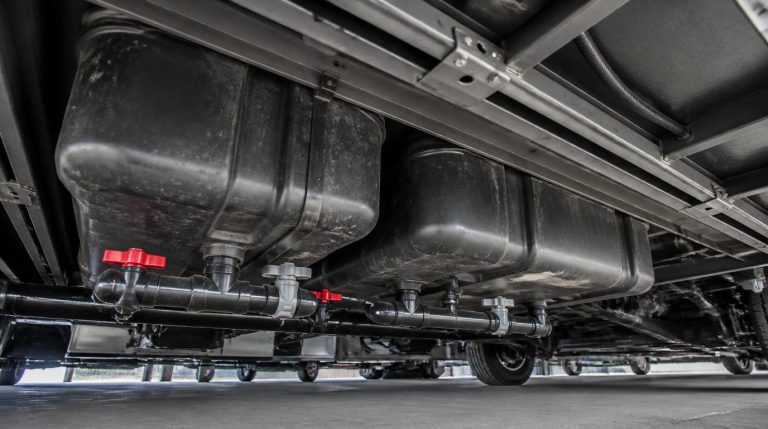
Most free options have no dump station, water or services. If your tanks can’t handle 3-5 days, stick to options with services, such as casinos and truck stops.
Before you park: the 5-point checklist
- Confirm the land type and its rules. National Parks don’t allow dispersed camping; National Monuments and state land vary. BLM and National Forest land generally allow it unless posted. When in doubt, call the field office or ranger district.
- Check cell signal before dark, and download maps while you still have coverage.
- Check tank capacity for multi-night stays. A 40-gallon fresh tank lasts two people roughly 2-3 days with careful use.
- Read the posted signs on site. They reflect closures, permits and fire damage that websites may not.
- Tell someone where you are and when you plan to leave, before you lose signal.
The 8 options
Roughly from the biggest savings for longer stays to the most convenient for a single night on the road.
BLM dispersed camping
Best for: long, free stays in the western US.
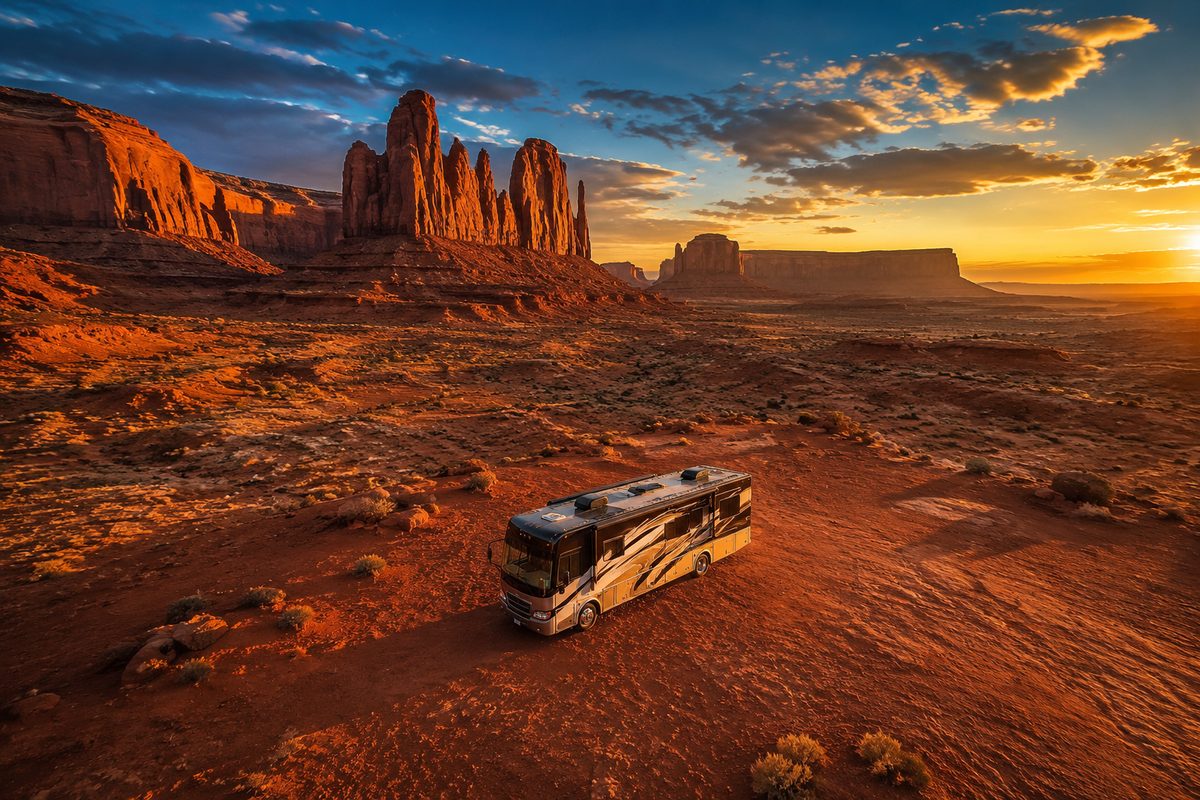
The Bureau of Land Management oversees roughly 245 million acres, mostly in western states such as Arizona, Utah, Nevada, New Mexico, Colorado, Wyoming, Montana, Idaho and California. Dispersed camping is allowed on most of it unless posted closed. Spots range from a gravel pull-off to a remote mesa; user-reported locations on Freecampsites.net, Campendium and iOverlander show road conditions and signal.
- Cost: free. Stay: usually 14 days, then move. Hookups and facilities: none.
National Forest dispersed camping
Best for: forests and mountains, including the eastern US where there’s little BLM land.
US Forest Service land has similar dispersed camping rules across forests, mountains and river corridors nationwide. Many forests require camping a set distance from water, roads and trails (often 100-200 feet), and some have permit or vehicle restrictions, so check the rules for the specific forest.
- Cost: free (day-use fees may apply at developed areas). Stay: commonly 14-16 days. Hookups: none. Find it: fs.usda.gov, by individual forest.
Casino RV parking
Best for: a lit, secure, convenient night near major routes.
Many casinos, tribal casinos in particular, allow free overnight RV parking in a dedicated lot as an advertised amenity, with 24-hour restrooms and security. Some also run a paid RV park with hookups next to the free lot. Stay limits are usually 1-3 nights. Check the casino’s website or call.
Harvest Hosts
Best for: memorable one-night stays at wineries, farms, breweries and museums.
A paid annual membership (check harvesthosts.com for current plans) gives access to thousands of host locations across the US and Canada. The stay itself is free, and you’re expected to support the host by buying something they produce. Book or message the host in advance; stays are usually one night.
Cracker Barrel
Best for: a single night near an interstate.
Cracker Barrel has no formal written policy, but many locations have long welcomed overnight RVers, especially rural ones with big lots near interstate exits. Call the specific location the same day and ask; urban locations with tight lots often say no. Park at the back or side, clear of traffic, and have breakfast there in the morning.
Truck stops with RV pull-throughs
Best for: safety on an overnight between destinations.
Pilot Flying J, Love’s, TA/Petro and many independents have large pull-through spaces. They’re lit all night, staffed and on camera, which makes them a good choice for solo travelers. There’s usually no formal limit, but 12-24 hours is the understood maximum. Showers, food and fuel are on site.
State rest areas
Best for: a few hours of sleep on a long drive.
Many states allow RVs to stop at rest areas for a limited time, often somewhere between a few hours and 24 hours; some restrict overnight stays. There are no hookups or reservations. Rules vary by state and even by facility, and DOT websites aren’t always current.
City parks and host networks
Best for: towns and suburbs where there’s no public land.
Some small towns, fairgrounds and municipal parks allow free overnight RV parking to attract travelers. Rules are hyper-local, so check Freecampsites.net (it has a city-park category), search “[town] RV parking”, or call the parks department or city hall. Host networks such as Boondockers Welcome (now part of Harvest Hosts) connect you with RVers who offer a driveway or land for a night or two, sometimes with power or water.
All 8 at a glance
| Option | Cost | Typical stay | Best for |
|---|---|---|---|
| BLM dispersed | Free | Up to 14 days | Long stays, western US |
| National Forest dispersed | Free | 14-16 days | Forests, eastern US |
| Casino lots | Free (paid hookups at some) | 1-3 nights | Convenience, security |
| Harvest Hosts | Annual membership + a purchase | 1 night | Unique stays |
| Cracker Barrel | Free (call first) | 1 night | Interstate travel |
| Truck stops | Free | 12-24 hours | Safety en route |
| State rest areas | Free | Per posted limit | Mid-drive sleep |
| City parks / host networks | Free or membership | 1-2 nights | Towns and suburbs |
Apps and resources
- Freecampsites.net: the broadest free-camping database for the US and Canada, with user GPS points, photos and reviews.
- Campendium: strong on dispersed camping, with cell signal reports by carrier.
- iOverlander: useful for remote BLM and Forest Service spots.
- Truck stop apps (Pilot Flying J, Love’s): filter for RV amenities, pull-throughs and showers.
- Harvest Hosts (including Boondockers Welcome): browse hosts along your route.
- BLM.gov and fs.usda.gov: the authoritative source for fire restrictions, permits and closures by field office or ranger district.
Frequently asked questions
Where can I park my RV overnight for free?
Common legal options are BLM and National Forest land (dispersed camping), many casino lots, truck stops with RV pull-throughs, some Cracker Barrel locations (call first), state rest areas where allowed, some city parks, and host networks such as Harvest Hosts.
How long can you stay on BLM land for free?
Typically 14 days at one location, after which you must move, commonly 25 miles or more. Check the local field office rules.
Does Cracker Barrel allow overnight RV parking?
Many locations do, but there's no company-wide written policy. Call the specific location the same day, park away from the entrance, and buy a meal.
Can I sleep in my RV at a rest area?
In many states for a limited time, but rules vary by state and by facility. The posted sign at the rest area is the rule to follow.
Is Harvest Hosts free?
The stays are free, but it requires a paid annual membership and you're expected to buy something from the host. Check harvesthosts.com for current plans.
Safety and disclaimer. This guide is general information, not professional advice. Work on propane, gas and electrical systems carries real risk; when in doubt, stop and call a qualified RV technician, and always follow your unit's service manual. If a carbon monoxide or propane alarm goes off, get everyone out of the RV first. How we research.
One Comment