Field guide · Shurflo, Flojet, Aquajet
RV Water Pump Won't Prime or Keeps Cycling? 6 Causes to Check
No water at the faucet, a weak trickle, or a pump that kicks on every minute with every tap closed: find the cause before you buy a new pump.
On this page
No water at the faucet, a pump that runs but only gives a trickle, or a pump that kicks on for a second every minute with every tap closed: all three come back to the same 12V diaphragm pump. It’s one of the simplest systems in an RV, but it often fails in ways that don’t look like pump failure, so pumps get replaced that didn’t need it. This guide covers Shurflo, Flojet, Aquajet and most standard 12V RV pumps.
Which failure do you have?
| Symptom | Most likely cause | Start with |
|---|---|---|
| Pump runs, no water or very weak flow | Empty tank, air lock or clogged strainer | Causes 1-3 |
| Pump won’t run at all | Blown fuse, failed pressure switch or dead motor | Fuse, then 5 and 6 |
| Pump cycles every 30-90 seconds with all taps closed | Failed check valve or a slow leak | Cause 4 |
| Pump runs constantly and never shuts off | Pressure switch failed or set too high | Cause 5 |
| Normal pressure that drops off fast | Outlet check valve or a small leak | Cause 4 |
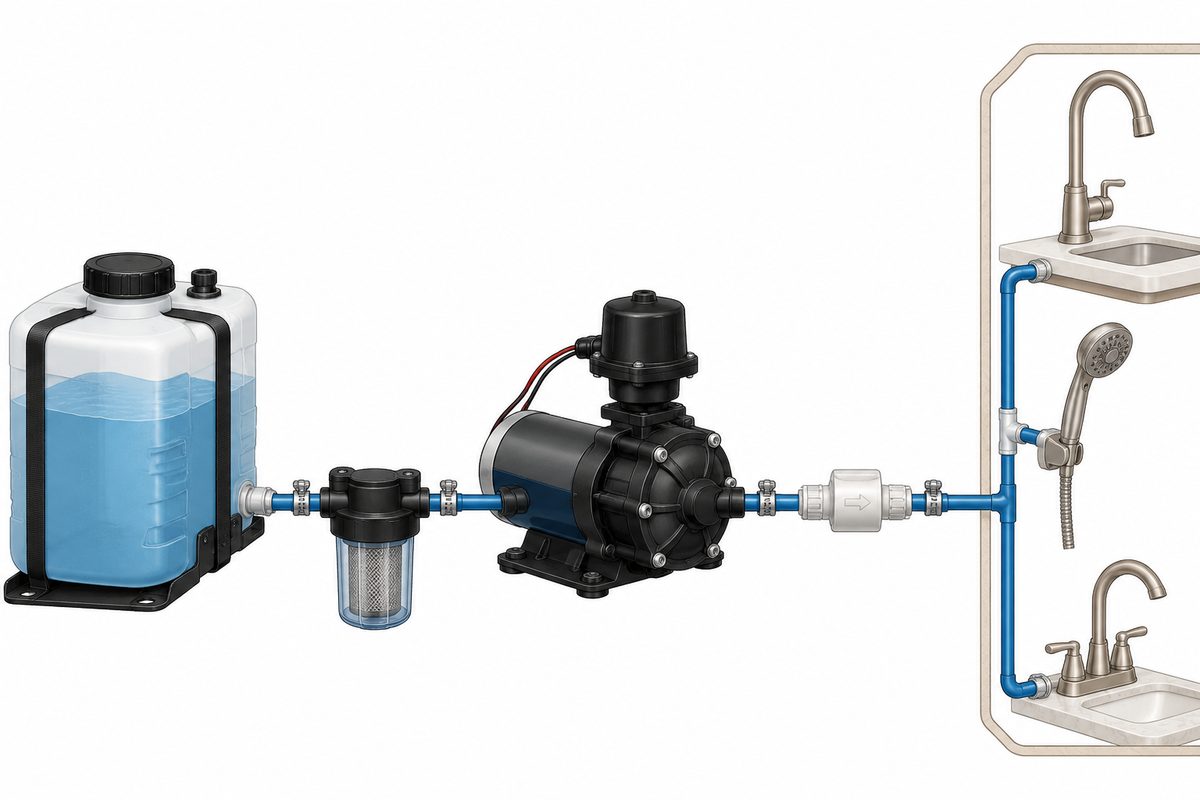
How an RV water pump works
- Pressure dropsYou open a faucet.
- The pressure switch starts the pump12V goes to the motor.
- The diaphragm draws water from the tankThe inlet check valve opens.
- The system pressurizesTypically 35-55 PSI, depending on the model.
- The pressure switch cuts powerThe outlet check valve holds pressure.
Five quick checks first
- Fresh tank level. If in doubt, add 5 gallons straight to the tank and try again.
- Pump switch and fuse. Most pumps use a 10-15A fuse in the 12V panel. If it blew, find out why before replacing it.
- Listen. Humming without running: seized motor. Running with no pressure: air lock or clogged strainer. Short bursts with everything closed: check valve or leak.
- Try city water. If the system works on city water with the pump off, the problem is the pump or the tank side. If city water is also weak, look downstream: a closed valve, a clog or a failed regulator.
- Look for moisture. Drips or white mineral deposits on fittings near the pump point to the slow leak behind short cycling.
The 6 causes, in order of likelihood
Empty tank or closed supply valve
Symptom: the pump runs and sounds normal, but no water comes out.
It sounds too obvious, but it’s the most common cause. The pump can’t tell you it has nothing to move: it just runs, pulls air and builds no pressure. Run it dry for more than a minute or two and a free fix becomes a $40-90 diaphragm repair.
- Tank gauge: gauges drift. If unsure, add 5-10 gallons and test.
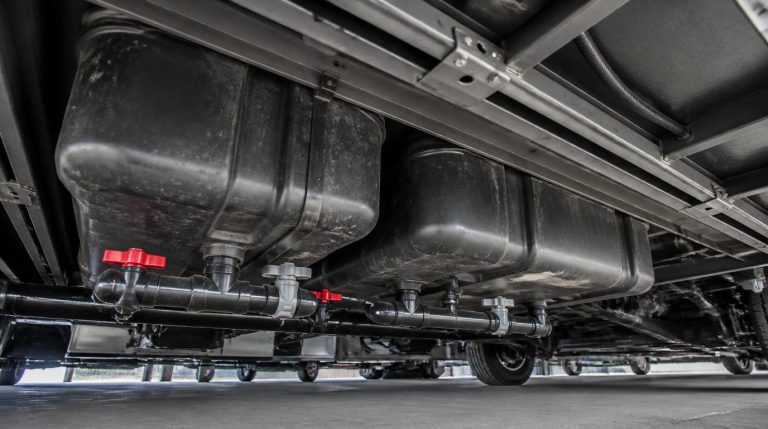
- Supply valve: the shut-off between the tank and the pump (often a quarter-turn valve near the pump) must be fully open, with the handle parallel to the pipe. It’s often left closed after winterizing.
- Tank drain valve: if it was opened for winterizing and not fully closed, the tank drains as fast as you fill it.
Air lock (lost prime)
Symptom: the pump runs, maybe faster or more labored than usual, but no water comes.
After winterizing, running the tank dry or disconnecting the inlet line, air gets into the pump. A diaphragm pump moves liquid, not air, so it spins without building pressure.
- Light air lock: open the faucet nearest the pump, run the pump 60-90 seconds until water follows the sputtering air.
- Stubborn air lock: with a towel ready, loosen the pump’s outlet fitting, run the pump for 2-3 seconds until water appears, reconnect, then purge at the faucet.
- After winterizing: open every faucet, hot and cold, slightly. Run the pump and close each one once water flows steadily, starting nearest the pump.
Clogged inlet strainer
Symptom: some water flows, but pressure is low and inconsistent and the pump runs longer and louder.
A small inline strainer between the tank and the pump catches sediment, and most owners don’t know it’s there until it clogs.
- Find it: follow the line from the tank toward the pump. It’s usually a clear plastic housing 2-3 inches long within a foot of the pump, or a screen built into the pump inlet.
- Clean it: pump off, supply valve closed, unscrew the housing (hand-tight on most), rinse the mesh, reassemble.
- Replace it if the screen is torn or won’t come clean: $4-8, five minutes. Worth doing yearly anyway.
Failed check valve
Symptom: the pump runs briefly every 30-90 seconds with all faucets closed.
When a check valve is worn, stuck or fouled, water slowly bleeds back and pressure falls. The pressure switch restarts the pump, it builds pressure in 2-3 seconds, stops, and the cycle repeats all night. A consistent interval with a short run is almost always a check valve or a leak.
- Bleed test: let the pump build full pressure, switch it off, and listen. Water moving back toward the pump within a minute points to the check valve.
- Isolation test: close the supply valve from the tank. If the cycling stops, the inlet check valve is leaking back to the tank. If it continues, pressure is escaping in the pressurized side: a fitting, a valve or a faucet leaking internally.
Pressure switch fault
Symptom: the pump runs constantly and won’t shut off, or won’t turn on at all.
- Won’t turn on: with the pump switch on and a faucet open, measure for 12V at the motor terminals. Voltage present but no running means a dead motor. No voltage means the pressure switch isn’t closing; briefly bridging its two terminals to see if the pump runs confirms it.
- Won’t shut off: disconnect one wire from the pressure switch. If the pump stops, the switch was stuck closed. If it keeps running, the fault is in the wiring.
- Adjustable switches (some Shurflo models) have a set screw. If cutoff is set higher than the system can reach, the pump runs until it overheats. Use the setting in your pump’s manual.
Diaphragm or motor failure
Symptom: the pump hums but doesn’t run, or runs with very low pressure and a different, slapping sound.
Diaphragms crack, stiffen with age or are damaged by running dry. Motors usually fail after repeated dry running, long hot running, or old age: a seized motor hums, a dead one is silent.
- Pressure check: with a gauge on a faucet outlet, a healthy pump with water available reaches 35-55 PSI within 15-20 seconds. Stalling at 15-20 PSI, or never passing 10, means a failing diaphragm.
- Look: many pump heads come off with 4-6 screws. Any crack, tear, stiffness or deformation in the round rubber diaphragm means replacement.
Seasonal checklist
A well-kept RV pump commonly lasts 5-10 years. About 20 minutes, twice a year: at the start of the season and before winterizing.
- Check the fresh tank before every trip; never run the pump dry
- Clean the inlet strainer at the start of the season
- Sanitize the fresh tank with a diluted bleach solution once a year
- Test pump pressure: 35-55 PSI within about 20 seconds
- Inspect pump fittings for moisture or mineral deposits
- Purge the whole system after winterizing, before first use
- Listen for short cycling after the pump shuts off
- Check the pump fuse is the correct rating (usually 10-15A)
- Check the pump mounting; vibration loosens fittings
- Drain the pump completely before winter; trapped water freezes and cracks the housing
| Item | Typical cost | Notes |
|---|---|---|
| Inline strainer | $4-8 | Replace yearly |
| Check valve kit | $8-18 | Model-specific |
| Pressure switch | $12-22 | Match the original rating |
| Diaphragm repair kit | $15-30 | Extends pump life |
| Inline pressure gauge | $8-14 | Reusable |
| Replacement pump | $45-120 | Depends on flow rate and brand |
Prevention: under $30 a year. A typical pump service call: $120-280.
When to stop and call a technician
Frequently asked questions
How do I prime an RV water pump?
Open the faucet nearest the pump and run the pump 60-90 seconds until air stops sputtering. For a stubborn air lock, loosen the pump outlet fitting and run it briefly until water appears. After winterizing, open every faucet slightly and close each once water flows steadily.
Why does my RV water pump turn on by itself?
Pressure is leaking away, usually through a failed check valve or a slow leak at a fitting or faucet. Close the tank supply valve: if the cycling stops, the inlet check valve is leaking back; if not, look for a leak on the pressurized side.
What pressure should an RV water pump reach?
Most 12V RV pumps shut off between about 35 and 55 PSI, depending on the model, and should reach it within roughly 15-20 seconds with water available.
Can running an RV water pump dry damage it?
Yes. Even 30-60 seconds without water can damage the diaphragm. Check the tank before trips and switch the pump off if the tank runs empty.
Should I repair or replace my RV water pump?
If only the diaphragm, check valves or pressure switch are worn, kits from $8-30 restore the pump. If the motor is seized or the housing cracked, a new pump ($45-120) is the better value.
Safety and disclaimer. This guide is general information, not professional advice. Work on propane, gas and electrical systems carries real risk; when in doubt, stop and call a qualified RV technician, and always follow your unit's service manual. If a carbon monoxide or propane alarm goes off, get everyone out of the RV first. How we research.


2 Comments